Pakistan’s Mobile Phone Industry Misses Localisation Target: Value Addition Stuck at 10-15%
Pakistan’s mobile phone industry has failed to meet its localisation goals despite attracting more than 35 international manufacturers to set up local plants. Domestic value addition remains stuck between 10 and 15 per cent against a target of 49 per cent that was supposed to be achieved by June 2023, according to a new policy brief by the Policy Research Institute of Market Economy (PRIME). The finding puts Pakistan mobile phone localisation back under scrutiny — and questions the Mobile Device Manufacturing Policy 2020, which was meant to move the country from simple assembly to genuine component manufacturing.
The brief, titled “Protecting Assembly, Distorting Markets”, argues that the policy’s incentives encouraged assembly-line work without building a competitive domestic component industry. Most Pakistani factories still rely heavily on imported completely knocked-down (CKD) kits — importing every part of a phone and putting it together locally. That dependence is the clearest symptom of how little Pakistan mobile phone localisation has achieved.
49% Target vs 10-15% Reality: How Assembly Became the Ceiling
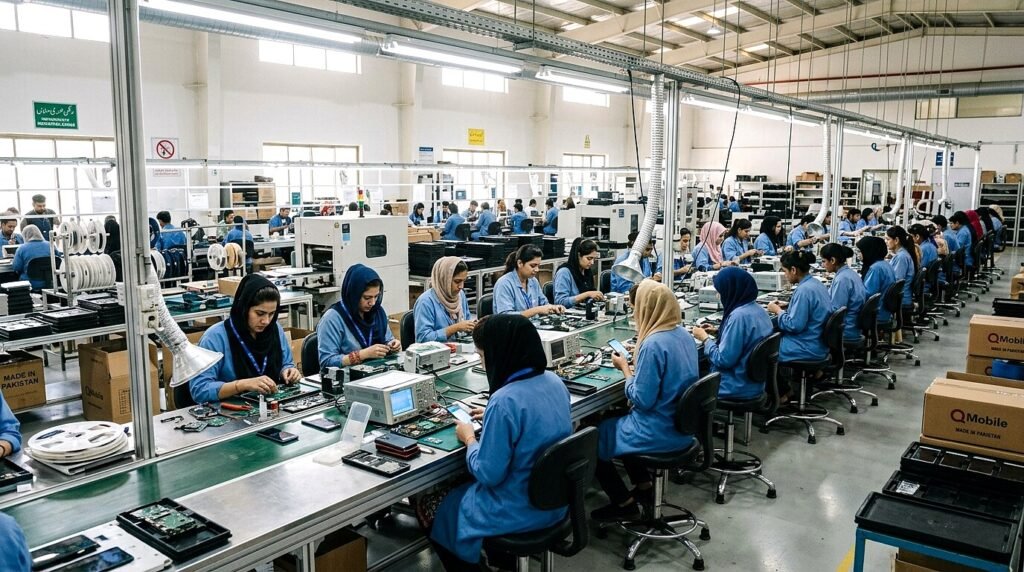
The Mobile Device Manufacturing Policy 2020 had a clear two-stage logic: first establish local assembly, then shift towards domestic production of components including motherboards, displays, batteries and chargers, building an export-oriented industry. The first stage worked — according to the PTA, more than 35 manufacturers, including Samsung, Xiaomi, OPPO, Vivo, Transsion and Nokia, set up facilities creating approximately 40,000 jobs.
By February 2023, 31 companies held manufacturing authorisations, drawing roughly $300 million in investment; domestic production hit 21.94 million handsets in 2022 against 1.53 million imported devices. But the second stage never arrived. Tecno Pack Electronics CEO Aamir Allawala told the researchers the policy envisaged a gradual transition from assembly to component manufacturing, yet the government never implemented the subsequent stages of its roadmap.
Assembly became the ceiling rather than the floor — and Pakistan mobile phone localisation stalled at a fraction of the 49 per cent goal.
The Inverted Tariff Structure That Punishes Local Parts Makers
At the heart of the failure is what the brief calls an inverted tariff structure. Imported components such as chargers, batteries, cables and motherboards attract zero customs duty when they arrive as part of CKD kits. Yet the raw materials and intermediate inputs a Pakistani company needs to manufacture those same components locally face customs duties of 20 to 30 per cent.
It is cheaper to import a finished battery than to buy the materials to make one in Pakistan. Industry representatives maintain that this upside-down tariff schedule discourages investment in local supply chains despite manufacturers’ willingness to expand. Until the duties are flipped, Pakistan mobile phone localisation will keep losing to the simple arithmetic of importing over making.
35 Manufacturers, 40,000 Jobs — But Rs520 Billion Still Flows Out
Customs data cited in the brief shows Pakistan spent approximately Rs520 billion on mobile phone imports during FY26 — including Rs420 billion on the CKD kits used for local assembly. More than 80 per cent of the “local” industry’s input bill is still an import bill — the damning statistic at the heart of Pakistan mobile phone localisation.
High taxes add to buyers’ pain: 23.6 per cent of a $30 handset’s cost, rising to 50.26 per cent for a $700 device — roughly Rs98,500 extra on a Rs196,000 phone. The legal-smuggled price gap has forced heavy enforcement: the PTA blocked around 100 million illegal devices in FY25, including nearly 72 million counterfeit phones and 27 million with cloned IMEI numbers. The PTA has also run separate drives to fix telecom coverage gaps nationwide — but affordability sits with tax and trade policy.
What India Did Differently: 20% Value Addition and $30 Billion Exports
The brief holds up India as the counter-example: higher duties on imported finished components and low tariffs on raw materials — exactly the reverse of Pakistan’s approach. The result is around 20 per cent local value addition, with more than 400 companies manufacturing components, production-linked incentives of 10 to 12 per cent, and mobile exports exceeding $30 billion last year.
Both countries started with assembly; one moved up the value chain through deliberate policy, the other let its roadmap gather dust. As Pakistan prepares for 5G services, demand for affordable locally made devices will only grow — and Pakistan mobile phone localisation is the difference between capturing those jobs or watching them go abroad.
PRIME’s Fix: Uniform Taxes and the 2026-33 Manufacturing Policy
PRIME recommends replacing the 25 per cent sales tax on phones above $500 with a uniform 18 per cent rate, tying incentives to verifiable localisation, production and export targets, and monitoring formal imports, tax collection and registration violations — so Pakistan mobile phone localisation targets carry penalties, not promises.
The proposed Mobile and Electronic Devices Manufacturing Policy 2026-33 offers a new window: more domestic component production, technology transfer and exports, with penalties for missed localisation commitments. Researchers agree it must align customs duties with manufacturing priorities and reward measurable domestic value addition over assembly volumes. If it repeats old mistakes, the next review of Pakistan mobile phone localisation will still read 10-15 per cent.
Sources: Profit by Pakistan Today; PRIME Institute policy brief “Protecting Assembly, Distorting Markets”; Pakistan Telecommunication Authority (PTA).
Related Posts
 TechnologyNCCIA Warns Against Fake Social Media Profiles, Online Blackmail of Women in Pakistan
 TechnologyPakistan Sets October 23 as New Date for Mandatory E-Passport Issuance
 TechnologyBYD Pakistan Plant to Start Operations by Mid-December, Hubco Confirms
 TechnologySindh Signs MoU with Huawei to Build Pakistan’s First AI-Powered Digital Province
 TechnologyNCCIA Arrests Faheem Akram in Lahore Over Alleged $126M US Postage Fraud
 TechnologyPakistan Expands Digital Infrastructure for AI Push: 5G, Fibre and Satellite Plans Unveiled in Seoul
Most Popular
 How-ToPTA Tax Calculator 2026: Check Mobile Tax on Any Phone142 views
 Canada JobsTech Jobs in Canada: Roles, Salaries, and Skills Needed116 views
 TechnologyTecno Mobile Prices in Pakistan 2026: Spark, Camon and Pova Series Compared109 views
 TechnologyRedmi K100 Launching on 28 October: 10,000mAh Battery, 185Hz Display and Full Specs109 views
 ShowbizWomen’s Fashion in Pakistan 2026: Trends, Brands and Style Guide97 views
 BISPPunjab Driving License Scam Alert: Fake Websites & “Without Test” Fraud | UrduPro94 views