World Bank Digital Strategy Launches at Seoul Summit: AI, Affordable Internet and Jobs for 1.2 Billion Youth
The World Bank digital strategy is now official. The World Bank Group on Tuesday launched its first-ever digital strategy at the Global AI and Digital Summit in Seoul, bringing together the lender’s public and private sector arms to help developing countries expand affordable digital access, improve services and create jobs. The announcement, made before nearly 900 delegates from around 160 countries, puts artificial intelligence, cheap internet and digital skills at the centre of the Bank’s development agenda.
Pakistan has a direct stake in the plan. The World Bank digital strategy was unveiled at the same summit where Pakistan’s IT minister presented the country’s digital roadmap this week — and several of the strategy’s four priorities mirror Islamabad’s own Digital Nation Pakistan push, from the record 2026 spectrum auction to 5G rollout, fibre expansion and a sovereign AI agenda.
World Bank Digital Strategy: The Four Priorities Explained
The World Bank digital strategy rests on four priorities: expanding reliable connectivity; making digital devices and data more affordable; strengthening digital services and skills; and preparing developing countries to benefit from artificial intelligence — in particular task-specific “small AI” applications rather than giant general-purpose models.
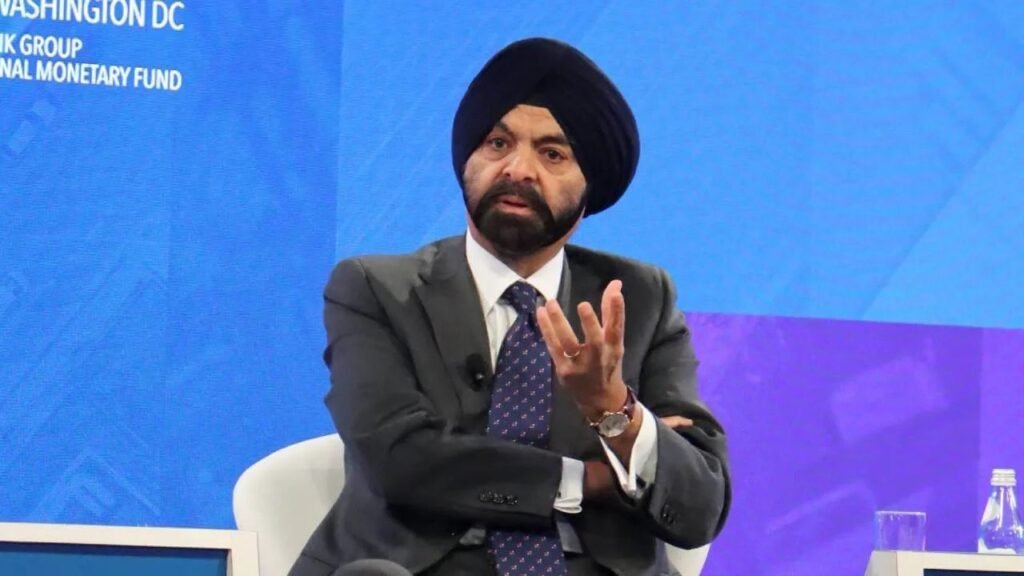
World Bank Group President Ajay Banga said digital technology could help countries create jobs and make scarce resources go further, but only through a comprehensive approach — “from reliable connectivity and affordable devices to digital skills and useful services”. He described the ambition as building the foundations for “the promise of small AI — AI for the people”. On stage, Banga pointed to an educational AI programme and challenged the Bank to scale it: “Take that and put it to work in 100 countries,” he said.
Small AI for Big Jobs: The 1.2 Billion Youth Challenge
The timing of the World Bank digital strategy is driven by a looming employment crisis: roughly 1.2 billion young people will reach working age in developing countries over the next 10 to 15 years, while those economies are projected to create only about 420 million jobs. The strategy bets that digital technology — especially affordable, practical AI — can bridge much of that gap.
Anna Bjerde, the Bank Group’s managing director of operations, cautioned against overestimating what AI can do where the basics are missing. “It’s easy to overestimate what AI can do when you only see it working in places where the basics are already in place,” she said, noting that around 2.2 billion people remain offline globally. “Countries should not have to build everything from scratch. Small AI offers a practical starting point,” she added, citing an AI tutoring initiative in Peru as proof that the point is not sophistication but whether a tool solves a real problem.
Shared GPUs Instead of National Data Centres
Alongside the World Bank digital strategy, the Bank announced an AI Infrastructure and Readiness Initiative to give emerging markets affordable computing power through shared, pay-as-you-go GPU infrastructure — a practical alternative to every country building its own national data centre. The initiative will initially focus on Africa and Latin America.
Compute is the hidden gatekeeper of the AI era: training and running capable models needs specialised chips most developing countries cannot afford alone. Shared GPU pools let governments rent capacity for local-language models, crop-disease diagnosis tools and health-worker assistants without billion-dollar data centre investments. On trust, Bjerde was blunt: “People will only use digital systems if they know their information and money are protected.”
What the World Bank Digital Strategy Means for Pakistan
Pakistan showed up in Seoul as both audience and example. IT Minister Shaza Fatima Khawaja used her keynote at the same summit to lay out Pakistan’s four AI governance lessons and a USD 1 billion AI commitment through 2030 (read our full report on her address).
The overlaps with the World Bank digital strategy are direct. The strategy’s connectivity pillar matches Pakistan’s March 2026 spectrum auction — 480 MHz for USD 509 million — and 5G at more than 1,700 sites across 24 cities with average speeds of 130 Mbps (details on Pakistan’s infrastructure push). The skills pillar lines up with Islamabad’s plan to train a million people in AI. While Pakistan is not among the first 40 pilot countries named so far, the framework opens doors: funding for connectivity, the shared GPU initiative as a shortcut to sovereign AI capacity, and the Digital Trust programme for the data-protection frameworks Pakistan is still formalising.
40 Countries, 2030 Targets: What Happens Next
The Bank will focus ten scalable digital solutions and its Digital Trust programme on 40 priority countries, including the Philippines — showcased because its PhilSys national ID already authenticates 18 million social protection beneficiaries. The headline targets: bring 600 million people onto the internet and another 400 million onto digital services by 2030, across five priority sectors — infrastructure and energy, agribusiness, health care, tourism and value-added manufacturing.
For Pakistan’s readers, the takeaway is simple: the global money behind digital development just got organised under one framework, and Islamabad — already speaking the same language on AI governance, connectivity and skills — is positioned to claim a share of it.
Sources: Aju Press, Nation Press
Related Posts
 TechnologyOppo Reno X Tipped With 8,000mAh Battery and Dual 200MP Cameras
 TechnologyShaza Fatima Announces $1 Billion AI Commitment at Seoul Summit, Shares Pakistan’s Four AI Governance Lessons
 TechnologyAuto Policy 2026-31: PM Shehbaz Approves Pakistan’s New Five-Year Auto Framework
 TechnologyBISP Introduces Interoperability in Digital Wallet Payments: Withdraw Funds from Any of 6 Partner Banks
 TechnologyPakistan’s Mobile Phone Industry Misses Localisation Target: Value Addition Stuck at 10-15%
 TechnologyNCCIA Warns Against Fake Social Media Profiles, Online Blackmail of Women in Pakistan
Most Popular
 How-ToPTA Tax Calculator 2026: Check Mobile Tax on Any Phone142 views
 Canada JobsTech Jobs in Canada: Roles, Salaries, and Skills Needed116 views
 TechnologyTecno Mobile Prices in Pakistan 2026: Spark, Camon and Pova Series Compared109 views
 TechnologyRedmi K100 Launching on 28 October: 10,000mAh Battery, 185Hz Display and Full Specs109 views
 ShowbizWomen’s Fashion in Pakistan 2026: Trends, Brands and Style Guide97 views
 BISPPunjab Driving License Scam Alert: Fake Websites & “Without Test” Fraud | UrduPro94 views