Pakistan could add between $60 billion and $80 billion to its GDP over the next five years through effective digital transformation, the Pakistan Digital Authority (PDA) told a parliamentary committee on Monday, as it laid out the country’s first National Digital Master Plan built on three pillars: Digital Society, Digital Economy and Digital Governance.
The Authority briefed the National Assembly Standing Committee on Information Technology and Telecommunication on its mandate, strategic objectives and the master plan. The meeting was held under the chairmanship of Syed Amin ul Haq, according to a TechJuice report on the briefing.
According to the Authority, the plan was developed in consultation with provincial and sectoral stakeholders and has been approved by the National Digital Commission, which has also issued directives for its implementation. The briefing marks one of the most detailed public disclosures yet of how Pakistan intends to turn its much-discussed digital ambitions into a governed, measurable national programme.
Pillar 1: Digital Society

A citizen using a smartphone and laptop. Photo: Wikimedia Commons (file photo).
The first pillar aims to improve citizens’ access to digital services and build an inclusive digital environment. In practice, this means public services moving online in a way ordinary Pakistanis can actually use — simpler interfaces, wider availability in local languages, and a focus on reaching people who are currently outside the digital fold.
Pakistan has already laid much of the physical groundwork for this pillar: broadband subscribers crossed 166 million this year and mobile internet penetration keeps climbing, according to the regulator. The master plan’s Digital Society component is meant to convert that connectivity into actual usage — digital identity, online service delivery and citizen-facing platforms that work for everyone, not just the urban tech-savvy.
Pillar 2: Digital Economy

Data centre infrastructure. Photo: Wikimedia Commons (file photo).
The second pillar seeks to promote economic growth through digital innovation, technology adoption and sectoral transformation. This is where the headline $60–80 billion GDP figure sits: the Authority’s pitch to the committee was that digitalisation is not just an administrative convenience but a growth engine — lifting productivity across agriculture, manufacturing, services and exports.
The argument aligns with the broader direction of Pakistan’s tech policy. The country’s IT and IT-enabled services exports have been climbing toward record territory, and policymakers have repeatedly framed digital exports, freelancing and startup growth as the fastest credible route to foreign-exchange earnings. The master plan’s Digital Economy pillar is meant to give that ambition a coordinated push rather than leaving it to scattered initiatives.
Pillar 3: Digital Governance

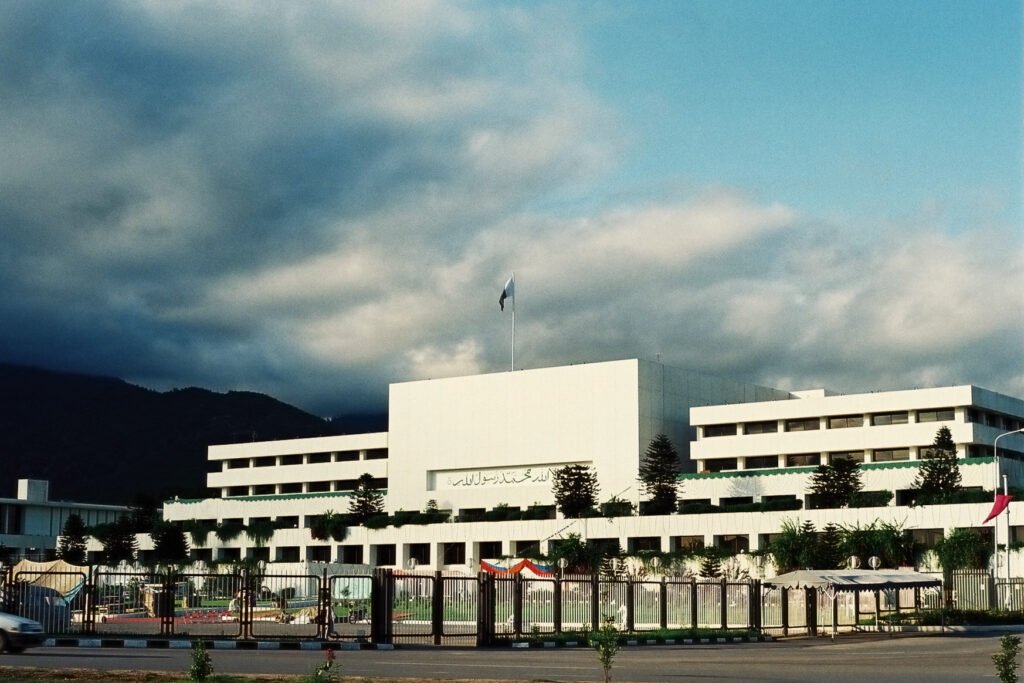
Parliament House, Islamabad. Photo: Wikimedia Commons (file photo).
The third pillar focuses on improving institutional efficiency, transparency and public service delivery through digital solutions. This covers the unglamorous but consequential work of government: digitising records, automating approvals, cutting the discretionary layers where delays and corruption breed.
The Authority told the committee it would develop a comprehensive digital roadmap with key performance indicators and implementation parameters to guide federal and provincial institutions and sectoral stakeholders. All relevant departments and institutions will be required to align their digitalisation initiatives with the master plan, the PDA said, to ensure coordinated and consistent implementation nationwide.
A roadmap with KPIs — and what departments must do

Pakistan Monument, Islamabad. Photo: Wikimedia Commons (file photo).
The commitment to a KPI-driven roadmap is the part of the briefing that will matter most in the months ahead. Pakistan has no shortage of digital strategies; the recurring criticism has been weak follow-through and overlapping mandates. By promising measurable indicators — and requiring every department to align its projects with the master plan — the Authority is setting a standard it can be judged against.
The institutional scaffolding already exists. The Digital Nation Pakistan Act, 2025 created the three bodies now running the show: the Pakistan Digital Authority, which develops and implements the master plan; the National Digital Commission, chaired by the Prime Minister, which approves the plan and issues implementation directives; and a Strategic Oversight Committee that monitors the Authority’s performance. The PDA’s leadership — chairperson Dr Sohail Munir and member Dr Muhammad J. Sear — was appointed in August 2025, and its mandate covers digital maturity assessments, data governance, AI oversight and national strategies for data and the digital economy, per the OECD’s policy tracker.
The Authority reiterated its commitment to providing strategic direction and a coordinated implementation framework to strengthen the digital economy, improve governance and move the country towards a digitally empowered society. The real test, as ever, will be execution: whether the roadmap’s KPIs bite, whether provinces genuinely align, and whether the $60–80 billion projection proves to be a plan or just a promise.
Sources: TechJuice report on the PDA briefing; OECD.AI policy profile of the Pakistan Digital Authority. Related reading: Pakistan’s digital infrastructure push for AI and Sindh’s AI-powered digital province plan.
Related Posts
 TechnologyEasypaisa Reportedly Fires Around 30 Employees Over Aggregator Account Irregularities
 TechnologyPakistan Mobile Phone Production Falls 20% in September Despite Strong Monthly Recovery, PTA Data Shows
 TechnologyLUMS Is Building an Industrial AI Lab to Train Engineers for the Factories of the Future
 TechnologyPTCL Appoints Amad Khan as Chief Marketing Officer — Who He Is and What He Will Lead
 TechnologyHackers Turn Supermarket Freezers Into 50°C Ovens Across Europe in Second Cyberattack Wave
 TechnologyVivo V80 Coming to Pakistan This Month: IP69 Rating, 144Hz AMOLED, 7200mAh Battery
Most Popular
 How-ToPTA Tax Calculator 2026: Check Mobile Tax on Any Phone396 views
 Pakistan NewsPIA Boeing 787 Lease Deal: What It Means for the Airline380 views
 SportsUEFA Champions League 2026-27: Format, Teams and Schedule373 views
 Canada JobsTech Jobs in Canada: Roles, Salaries, and Skills Needed354 views
 SportsBallon d’Or 2026: London Ceremony, Nominees and All-Time Records Ahead of 70th Anniversary336 views
 ShowbizWomen’s Fashion in Pakistan 2026: Trends, Brands and Style Guide332 views