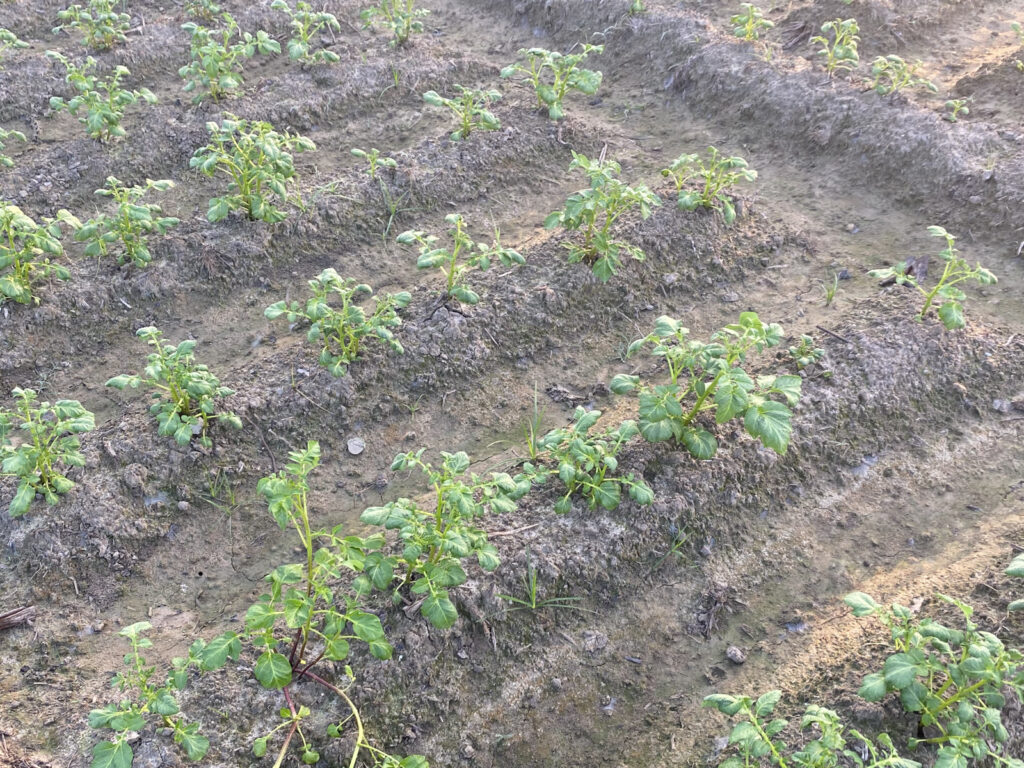
One day, the first people to live on the Moon may sit down to a meal that includes potatoes grown in Moon dust. That future moved a step closer this week, after scientists in the United States showed that potatoes can grow in soil made to copy the lunar surface — and that the harvest can match what the same crop produces on Earth.
The work, carried out at Oregon State University and backed by NASA, was published on 19 November 2026 in the journal npj Microgravity. The team grew a potato variety called Modoc in five different simulated lunar soils, and found that with the right help from ordinary earthworm compost, the plants completed their full life cycle and produced potatoes that were safe to eat.
What the researchers did
Moon soil is not really soil at all. Scientists call it lunar regolith: crushed rock and dust, often sharp and glass-like, formed over billions of years by meteorite impacts. It contains no organic material, and it carries high levels of heavy metals such as copper. Nothing about it is friendly to a plant.
To test whether food could still be grown in it, the Oregon State team, led by plant biologist Aymeric Goyer, obtained simulated regolith designed to match samples brought back by the Apollo missions. They tested five versions, representing both the dark plains known as lunar maria and the lighter highland regions of the Moon. For comparison, they also grew potatoes in soil from Hermiston, Oregon, a region known for some of the highest potato yields in the world.
The potatoes were grown in a greenhouse under sunlight and artificial light, with daytime temperatures held at 22 degrees Celsius and nights at 18 degrees. The chosen variety, Modoc, is an early-maturing potato with red skin and white flesh.
Worm compost made the difference
On its own, the simulated Moon dust was nearly useless for growing food. The breakthrough came when the researchers mixed it with vermicompost — a rich, nutrient-packed material produced when earthworms break down organic waste.
The team tried different mixtures, and the results were striking. When the simulated regolith contained 30 per cent vermicompost, the potato plants grew and developed just as well as plants raised in ordinary Earth soil. Less compost meant weaker growth; with enough of it, the Moon-soil potatoes kept pace with the Earth-grown control plants.
“We found that potatoes can complete their entire life cycle in simulated lunar soil when supplemented with organic matter,” Goyer said in a statement from the university.
The finding matters because compost is something a lunar base could produce on site, from food scraps and other organic waste, rather than hauling tonnes of soil from Earth at enormous cost.
Are the potatoes safe to eat?
A harvest is only useful if it is safe to eat, and this was one of the questions the study set out to answer. Lunar regolith is known to contain heavy metals, so the team analysed the potatoes they grew for contamination.
The result was reassuring: the potatoes grown in the compost-enriched lunar soil simulant were safe to eat, with growth and yields comparable to those produced on Earth. That clears one of the biggest worries about farming on the Moon.
There is one honest caveat. The potatoes themselves were small — generally less than a third of an ounce, or under 10 grams, each. But that was true of the Earth-grown potatoes in the same experiment too: the plants were grown in small pots, which limited how large any tuber could get. The point of the study was not the size of the harvest, but proof that the crop can grow and be eaten at all.
As for the taste, that question remains unanswered. “Unfortunately, we have not tasted them yet. We used what we harvested for lab analyses,” Goyer said.
Why potatoes — and why now
Potatoes were chosen for a practical reason. They produce more calories per unit of land than many other crops, they are rich in starch, vitamins, minerals and fibre, and they are a familiar staple food that keeps well. For astronauts living far from Earth for months at a time, that combination is hard to beat.
The timing is no accident either. Both the United States and China intend to send astronauts back to the lunar surface in the coming years and to build long-term bases there, most likely near the lunar south pole. NASA aims to return astronauts to the Moon by 2028 under its Artemis programme, and a permanent base would need food grown on site rather than shipped from Earth at vast expense. A Pakistani astronaut is also set to visit China’s Tiangong space station aboard the Shenzhou-24 mission, showing how spaceflight is widening beyond the old powers.
Growing food on the Moon is one of the last big practical problems standing between short visits and a lasting human presence there. This study shows that one of the world’s most important crops can do the job.
What comes next
The Oregon State team is not stopping here. A follow-up study is already planned, testing ten different potato varieties in simulated lunar regolith to find which ones are the most nutritious and resilient in Moon-like conditions.
If that work goes as well as this first study, the potato could become the first crop of the Moon age — a humble vegetable, grown in dust and worm compost, feeding the astronauts who will one day call the lunar surface home.
For now, the message from the greenhouse in Oregon is simple: the Moon may be a harsh place to farm, but with a little help from earthworms, it can be done.
Related Posts
 TechnologyIntuit Sells Mailchimp to Bending Spoons for $3.68 Billion — Less Than a Third of Its 2021 Price
 TechnologyMicrosoft To Do Is Shutting Down on 30 June 2027 — and Your Lists Won’t Move Themselves
 TechnologyYango Pakistan Launches Bank Card Payments — First Ride-Hailing App to Offer Cashless Rides
 TechnologyGlobal Memory Shortage Hits Smartphones: Qualcomm Says Brands Are Cutting Production as Prices Surge
 TechnologyElon Musk Says He Feels “Pretty Foolish” After Spending Nearly $500 Million on Republicans
 TechnologyPakistan Plans 15,206 MW of Renewable Energy by 2035 as NEPRA Approves Power Expansion Plan
Most Popular
 How-ToPTA Tax Calculator 2026: Check Mobile Tax on Any Phone420 views
 Pakistan NewsPIA Boeing 787 Lease Deal: What It Means for the Airline396 views
 Canada JobsTech Jobs in Canada: Roles, Salaries, and Skills Needed392 views
 SportsUEFA Champions League 2026-27: Format, Teams and Schedule389 views
 TechnologyPM Shehbaz Sets November Deadline for Alibaba AI and Digitalisation Projects in Pakistan370 views
 ShowbizWomen’s Fashion in Pakistan 2026: Trends, Brands and Style Guide366 views