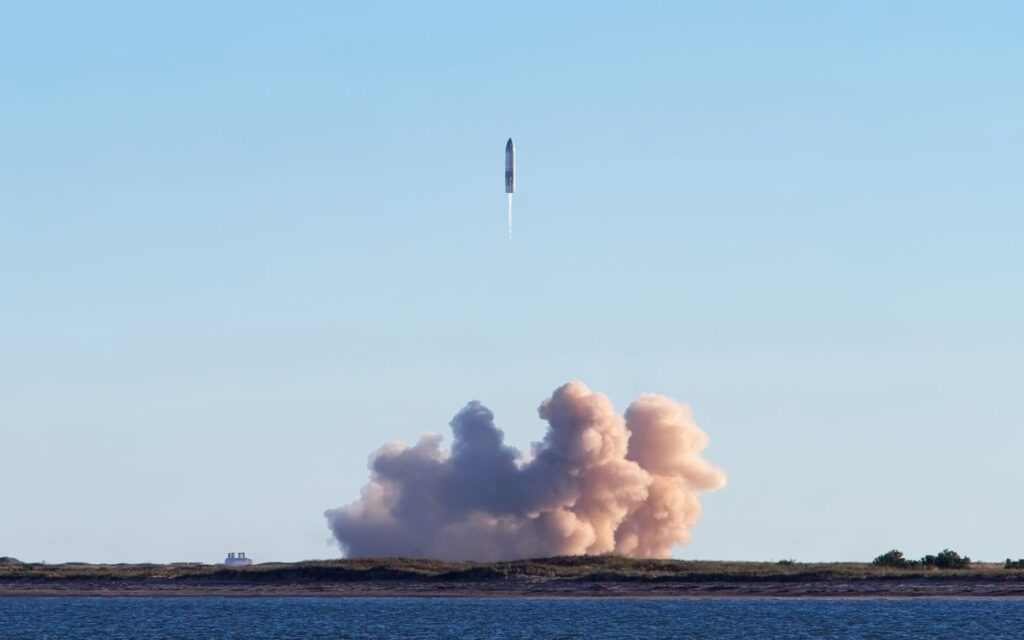
SpaceX has caught its Starship spacecraft as it returned from orbit, pulling off a feat no rocket has ever achieved before. The giant ship dropped out of the sky above Starbase in Texas on Saturday afternoon and settled gently between the mechanical arms of its own launch tower, 22 hours after it had blasted off.
The catch, on SpaceX Starship Flight 15, is the biggest step yet towards a fully reusable rocket — the goal Elon Musk has chased for more than a decade. It was not a perfect flight, however. The mission’s other headline attempt, catching the Super Heavy booster as well, failed within minutes of launch, and the booster was destroyed over the Gulf of Mexico.
A 22-hour flight that ended in the tower’s arms
The 124-metre rocket — the largest and most powerful ever built — lifted off from SpaceX’s Starbase facility in southern Texas on Friday afternoon, 13 November, at 5:47 p.m. Eastern Time. Its upper stage, known as Ship 42, separated from the Super Heavy booster and reached low Earth orbit about 27 minutes later.
Once in orbit, Ship 42 deployed its full payload of 26 Starlink V3 satellites, the next generation of SpaceX’s internet satellites. It then circled the Earth 14 times at an altitude of about 265 kilometres, in a coast phase lasting roughly 20 hours, while engineers checked the spacecraft and its heat shield.
The return began on Saturday afternoon. Ship 42 fired an engine to drop out of orbit, survived the blazing heat of re-entry, relit three of its Raptor engines to flip itself upright, and then throttled down to a single engine for the final descent. At about 4:20 p.m. Eastern Time, the 52-metre ship slid between the two giant mechanical arms — nicknamed Mechazilla — mounted on Launch Pad 2 at Starbase, and hung still above the ground.
SpaceX confirmed the moment on X within minutes: “Mechazilla catches Starship! Congratulations to the entire SpaceX team on this incredible achievement!” The ship was charred black from the heat of its return, but intact.
Why the catch matters so much
SpaceX has caught the Super Heavy booster with the tower arms before — the first time was on Flight 5 in October 2024 — but the upper stage had never been recovered this way. Until now, every Starship that reached orbit was deliberately ditched into the ocean at the end of its flight.
Catching the ship at the pad changes the economics of the whole system. It removes the need for landing legs and for recovery ships at sea, and it means the same vehicle can in principle be inspected, refuelled and flown again quickly from the same launch mount. That rapid reusability is the core of SpaceX’s plan to fly Starship often and cheaply enough to make large-scale missions affordable.
The flight also matters far beyond SpaceX. Starship is contracted by NASA as the crewed lander for the Artemis programme, which aims to return astronauts to the Moon. A reusable Starship is central to that plan, and to Musk’s longer-term ambition of sending cargo — and eventually people — to Mars. The company has spent more than 15 billion US dollars developing the system.
Flight 15 was only the second Starship flight to reach orbit at all. The previous flight, Flight 14 on 28 September, was the first to complete a full orbital mission and deployed the same number of Starlink satellites.
The booster catch that got away
The mission was designed to attempt something even more ambitious: the first-ever simultaneous catch of both stages of the rocket in a single flight. That half of the plan failed early.
Minutes after liftoff, the Super Heavy booster — known as Booster 22 — ran into trouble during its return. Its engines shut down earlier than planned during the boostback burn, and the guidance system detected that the booster was not on the correct trajectory for the tower. The flight software diverted it over open water, and it made a controlled splashdown in the Gulf of Mexico, where it was destroyed. Engineers are investigating what went wrong.
SpaceX had hoped to recover both parts of the rocket for the first time. The booster loss means the dream of a fully recovered flight will have to wait for a later test. Even so, the ship’s catch alone makes Flight 15 a landmark in the programme.
What happens next for Starship
SpaceX will now study Ship 42 and the data from its 22-hour flight, including how the heat shield and engines performed during re-entry. The company is also preparing to begin launching Starship from Florida in the coming months, in addition to its Texas base.
Each flight test has pushed the programme a step further: first the booster catch, then orbit, and now the ship catch. The next milestone will be recovering both stages on the same flight — and then doing it again, quickly, with the same hardware.
For now, the image of a 52-metre spacecraft hanging in the arms of its own launch tower, after a full day in space, is the clearest sign yet that the fully reusable rocket SpaceX has promised for years is finally within reach.
Sources: Associated Press; BBC News. For more on new technology launches, read our report on the BYD Denza N8 launch in China.
Related Posts
 TechnologyNCCIA Lahore Arrests 130 in Cyber Fraud Crackdown — Rs30 Million Returned to Victims
 TechnologySouth Korea’s Top Exam Scorer Confesses: He Cheated with AI and a Hidden Camera
 TechnologyPunjab’s First AI Climate Observatory Takes Shape in Lahore
 TechnologyGoogle’s Digital Sahafat Trains 4,000 Pakistani Journalists in AI Tools — Four Times Its Original Target
 TechnologyChatGPT Wallet Lets AI Agents Shop for You — Without Ever Seeing Your Card Number
 TechnologyGTA VI Pre-Load Goes Live: 212 GB Download, 30 FPS Confirmed as Launch Nears
Most Popular
 How-ToPTA Tax Calculator 2026: Check Mobile Tax on Any Phone420 views
 Pakistan NewsPIA Boeing 787 Lease Deal: What It Means for the Airline395 views
 Canada JobsTech Jobs in Canada: Roles, Salaries, and Skills Needed391 views
 SportsUEFA Champions League 2026-27: Format, Teams and Schedule388 views
 TechnologyPM Shehbaz Sets November Deadline for Alibaba AI and Digitalisation Projects in Pakistan368 views
 ShowbizWomen’s Fashion in Pakistan 2026: Trends, Brands and Style Guide365 views