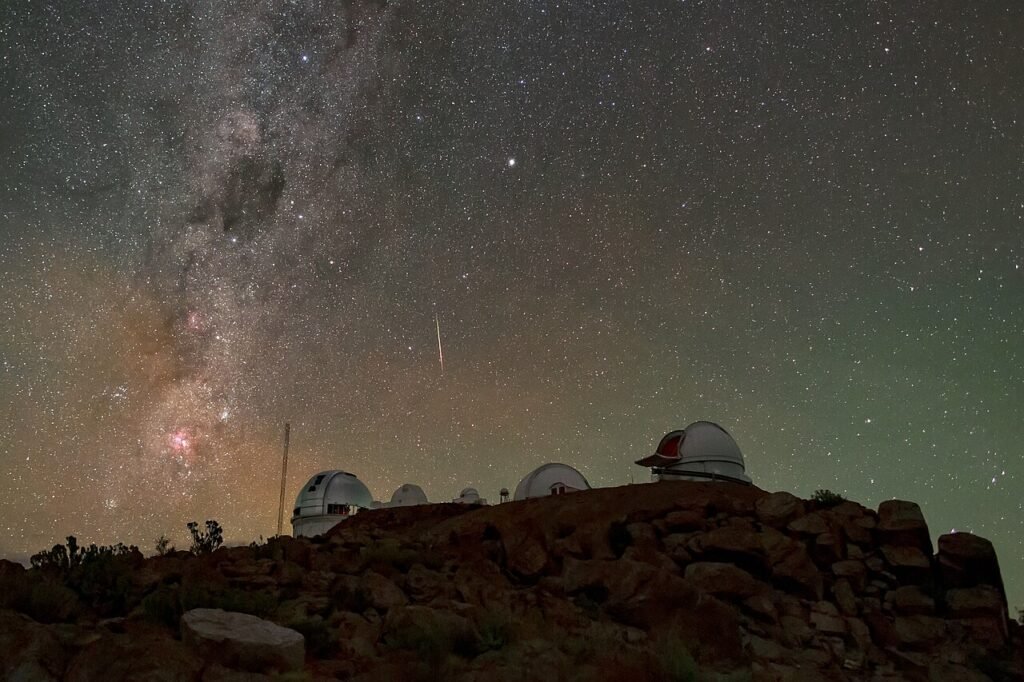
Step outside tonight and look up: the Southern Taurid meteor shower reaches its peak on the night of 4–5 November 2026, giving skywatchers across Pakistan their best chance of the year to catch one of the Taurids’ famous slow, bright fireballs streaking across the dark. The Southern Taurids are not the most prolific shower of the year, but they are among the most rewarding — their meteors move slowly, linger longer in the sky, and every so often produce a spectacular fireball that outshines the stars.
The peak is happening right now, with conditions described as favourable across much of the Northern Hemisphere. A slim crescent moon means the night sky stays dark enough for the meteors to show, and Pakistan’s position is ideal: all you need is a clear sky, a spot away from city lights, and patience.
Why the Taurid meteor shower 2026 is worth watching tonight
Under ideal dark-sky conditions the Southern Taurids produce only around five meteors per hour — a modest rate compared with showpiece showers. Their reputation comes from quality, not quantity: Taurid meteors enter Earth’s atmosphere at roughly 104,607 kilometres per hour, slower than meteors from most other showers, which means they remain visible for longer and leave particularly lengthy glowing trails. Occasionally, one grows into a fireball — an exceptionally bright meteor that can light up the sky for a few seconds.
This year the ingredients for a good show have come together. The peak period centres on the night of Wednesday 4 November into Thursday 5 November, with the highest activity expected in the late-night and pre-dawn hours. The moon is a waning crescent with only about 24–25 per cent illumination, so its light will not wash out the fainter meteors — a detail that observing guides have singled out as making this year’s Southern Taurid peak one of the better ones.
The shower is active every year from late September to late November, but the window around 4–5 November is when fireball activity is strongest. A second component of the same stream — the Northern Taurids — peaks a week later, around 11–12 November, offering another chance if tonight’s sky is cloudy.
How to watch the Taurid fireballs over Pakistan
No telescope or binoculars are needed — in fact, the best instrument for a meteor shower is simply the unaided eye, since meteors can appear anywhere in the sky. Give your eyes at least 20 to 30 minutes to adjust to the dark before expecting to see much.
Find the darkest spot you can reach: a rooftop, an open field, or anywhere away from streetlights and city glow will dramatically improve your chances. Lie back so you can take in as much of the sky as possible, and be patient — five meteors an hour means long quiet stretches punctuated by a sudden streak of light.
The meteors will appear to radiate from the constellation Taurus, which sits next to the familiar shape of Orion in the eastern sky after midnight. You do not need to stare directly at Taurus; looking at the darkest part of the sky you can see is the better strategy, since the longest, most dramatic trails appear some distance from the radiant. Meteor activity builds through the night and is typically strongest in the hours after midnight and before dawn.
Dress warmly, bring something to lie on, and check the cloud forecast before committing — a clear sky is the one thing technology cannot substitute. If clouds spoil tonight’s peak, remember the Southern Taurids remain active until around 20 November, and the Northern Taurids peak on 11–12 November.
The science behind the Southern Taurids: comet 2P/Encke
Every Taurid meteor is a grain of cosmic dust left behind by comet 2P/Encke — a short-period comet with the fastest orbit of any known comet in the solar system, circling the Sun roughly every 3.3 years. As Encke loops around the Sun, it sheds material that spreads into a wide stream of debris. Each autumn, Earth ploughs through that stream, and the debris grains burn up in our atmosphere as meteors.
The Taurids are unusual because the stream is broad and old, split into southern and northern branches that Earth encounters weeks apart. The Southern Taurids’ long activity period — about two months — and the occasional fireball are both explained by the stream containing some larger fragments, not just fine dust. Larger particles survive deeper into the atmosphere before burning up, producing the slow, bright fireballs the shower is known for.
NASA’s skywatching guides regularly list the Taurids among November’s highlights, and Bill Cooke, head of NASA’s Meteoroid Environment Office, has noted how the slim moon favours this year’s peak. The shower’s behaviour is monitored by networks such as the International Meteor Organization and the American Meteor Society, whose calendars place the Southern Taurid peak around 5 November and the Northern Taurid peak around 12 November.
November’s night sky: Leonids, Mars meets Jupiter and a supermoon
November 2026 is one of the busiest skywatching months of the year, so the Taurids are only the opening act. On 15–16 November, Mars and Jupiter will appear just 1.2 degrees apart in the pre-dawn south-eastern sky — close enough to fit within a binocular’s field of view, roughly the width of two full moons placed side by side.
A night or two later, the Leonid meteor shower peaks before dawn on 17–18 November. The Leonids are a stronger shower than the Taurids, with up to 10–15 meteors per hour possible under ideal conditions after the moon has set — making them November’s best-known meteor event. They are produced by debris from Comet 55P/Tempel-Tuttle.
The same week brings a remarkable deep-space milestone: NASA’s Voyager 1 spacecraft, launched in 1977, is expected to reach a distance of one light-day from Earth — about 16.1 billion miles — around 18 November. NASA is marking the occasion with a “Shine Bright for Voyager’s Light-Day” activation on 17 November.
Finally, the month closes with a full supermoon on 24 November — the first of three consecutive supermoons running through the new year. So if tonight’s fireballs hook you on the night sky, November 2026 has plenty more reasons to keep looking up.
Related Posts
 TechnologyPakistan Super App: Shaza Fatima Announces One App for All Government Services and Digital IDs
 TechnologyiOS 27.3 Beta Released: New Health App, Siri AI Upgrades and Release Date
 TechnologyKPITB AI Innovation Challenge 2026: Rs1 Million Prizes — Apply by 10 November
 TechnologySenate Panel Orders One Integrated E-Attestation System for PakistanTechnologyDigital Bill Deferred Again: NA Committee Sends E-Transactions Amendment Back Over PPP Objections
 TechnologySpotify Launches Audiobooks in Pakistan: Audiobooks+ Add-On Arrives
Most Popular
 How-ToPTA Tax Calculator 2026: Check Mobile Tax on Any Phone409 views
 Pakistan NewsPIA Boeing 787 Lease Deal: What It Means for the Airline385 views
 SportsUEFA Champions League 2026-27: Format, Teams and Schedule378 views
 Canada JobsTech Jobs in Canada: Roles, Salaries, and Skills Needed368 views
 TechnologyPM Shehbaz Sets November Deadline for Alibaba AI and Digitalisation Projects in Pakistan348 views
 ShowbizWomen’s Fashion in Pakistan 2026: Trends, Brands and Style Guide340 views