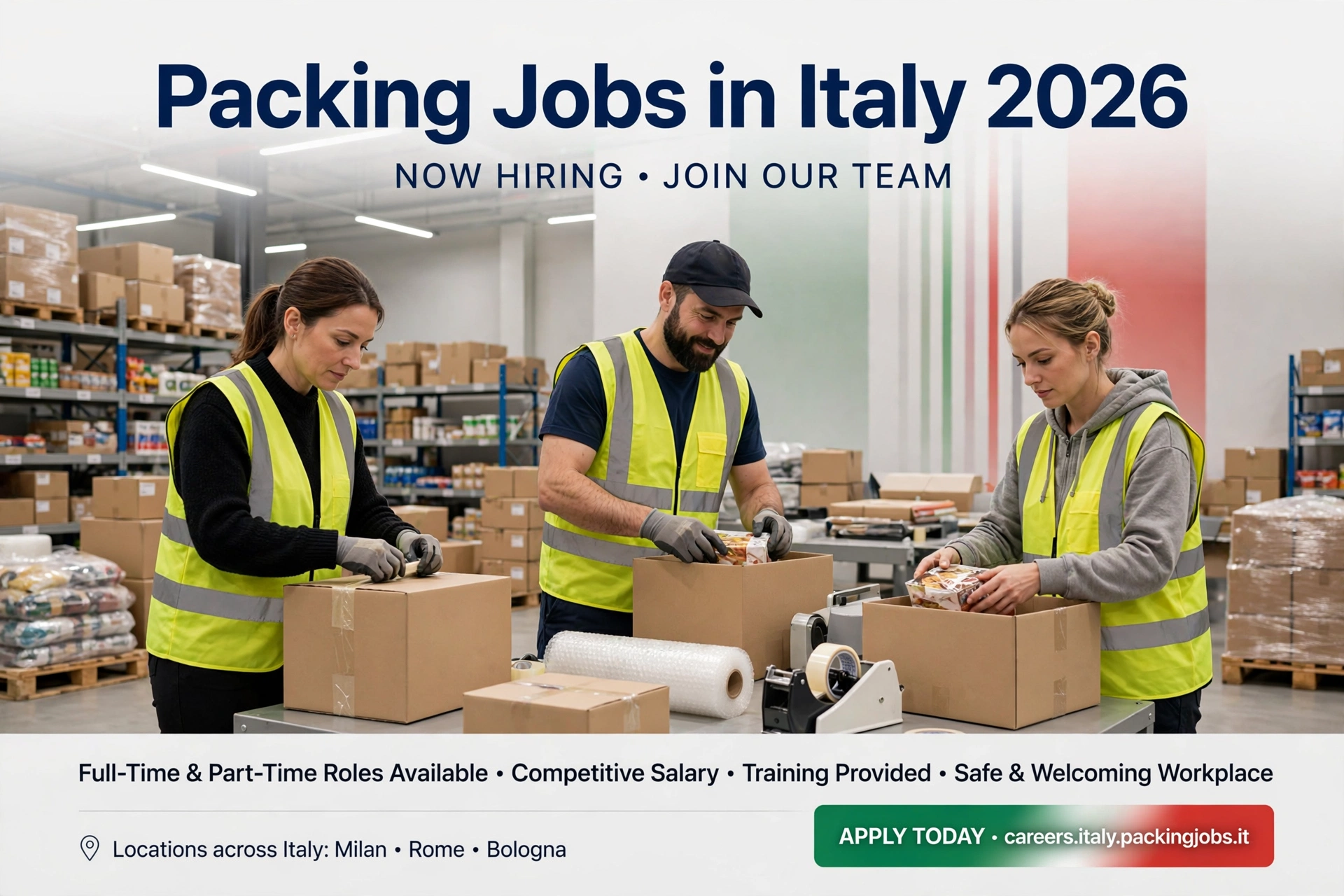
Italy is famous for its food, fashion, and furniture, but behind every pasta box, bottle of olive oil, and designer package is a huge workforce of packers, loaders, and warehouse staff. That is why packing jobs in Italy keep attracting job seekers from around the world.
The idea is appealing: a stable income in euros, a regulated labour system, and a chance to live in a developed European country. But the topic is also full of misinformation. Fake agents, “guaranteed visa” promises, and fraudulent job offers have cost thousands of hopeful workers their savings.
This guide separates fact from fiction. You will learn what packing jobs involve, what they pay, how the legal work-visa process works, where to look for employers, and how to protect yourself from scams. Immigration rules change often, so treat this article as a roadmap and always confirm current details with official Italian government sources.
What Are Packing Jobs in Italy?
A packing job involves preparing products for storage, shipping, or sale. Italy’s strong manufacturing and export economy means demand for this work is steady in many sectors.
Read Also: Hotel Staff Jobs in Italy
Common Types of Packing Work
- Food and beverage packing: Pasta, dairy, bakery products, canned goods, olive oil, wine, and confectionery.
- Fruit and vegetable packing: Sorting, grading, and boxing produce, especially in agricultural regions.
- Warehouse and logistics packing: Picking orders, wrapping pallets, labelling parcels, and loading trucks.
- E-commerce fulfilment: Packing online orders in distribution centres near major transport hubs.
- Industrial and manufacturing packing: Packaging furniture, ceramics, machinery parts, cosmetics, and pharmaceuticals.
- Fashion and textile packing: Folding, tagging, and boxing garments in clothing and leather-goods factories.
Typical Daily Duties
- Sorting and inspecting products for quality
- Assembling boxes and cartons
- Placing items into packaging safely
- Sealing, labelling, and scanning packages
- Stacking finished goods on pallets
- Keeping the work area clean and following hygiene rules
- Reporting damaged or defective items to supervisors
Most of this work is physical and repetitive. You will usually be on your feet for long shifts, so stamina and attention to detail matter.
Why Italy Needs Packing Workers
Understanding the demand helps you judge how realistic your plans are.
An Ageing Workforce
Italy has one of the oldest populations in Europe, and many employers struggle to fill manual and entry-level positions. This labour gap is one reason the government has opened legal channels for foreign workers.
A Strong Export Economy
Italian food, machinery, and luxury goods are shipped worldwide. Every export needs to be packed correctly, which creates year-round demand in northern industrial regions such as Lombardy, Veneto, Emilia-Romagna, and Piedmont.
Seasonal Agricultural Demand
During harvest periods, packing houses for fruit, vegetables, and wine-related products need extra hands. These seasonal peaks are one of the most common entry points for foreign workers.
Do You Need a Visa for Packing Jobs in Italy?
It depends on your nationality.
EU/EEA and Swiss Citizens
If you hold a passport from an EU or EEA country, or Switzerland, you can live and work in Italy without a work visa. You only need to register your residence after a few months.
Non-EU Citizens
If you are from outside the EU, which includes citizens of Pakistan, India, Bangladesh, Egypt, Nigeria, and many other countries, you generally cannot simply arrive and start working. You need legal authorisation, and this is where most of the confusion starts.
Important: A tourist visa does not allow you to work. Working without authorisation can lead to deportation and a ban on future entry to the Schengen area.
How the Italian Work Visa Process Works
For non-EU nationals, the main legal route into employment such as packing is through the Decreto Flussi, Italy’s annual quota system for foreign workers.
Step 1: A Genuine Italian Employer Applies for You
The process begins with the employer, not with you. An employer in Italy must apply for a nulla osta (work authorisation) on your behalf through the official online platform of the Italian authorities. Applications are usually submitted during specific “click day” windows announced under the Flussi decree.
Step 2: The Authorisation Is Reviewed
Italian authorities check the application against the available quotas and verify the employer’s details, including whether the job offer is genuine and whether the employer can afford to hire. This stage can take several months.
Step 3: You Apply for the Visa
Once the nulla osta is approved, it is sent to the Italian embassy or consulate in your country. You then apply for the entry visa for work, attending an appointment with your documents.
Step 4: Travel and Sign the Contract
After arriving in Italy, you typically sign a contratto di soggiorno (residence contract) with your employer at the local immigration office.
Step 5: Apply for the Residence Permit
Within eight days of arrival you must apply for your permesso di soggiorno (residence permit) at the post office or the designated office. This permit is what legally allows you to stay and work.
Seasonal Work Permits
Italy also issues seasonal work visas for agriculture and tourism. These are shorter-term permits, often a few months, and are a common route for harvest-related packing. In some cases, seasonal workers who return in later years may get simplified procedures.
Note: Quotas, dates, eligible nationalities, and procedures change from year to year. Always check the official Italian Ministry of Interior, Ministry of Labour, and embassy websites for the latest Decreto Flussi announcement.
Documents You Will Typically Need
Requirements vary, but you should be prepared with:
- A valid passport with sufficient remaining validity
- The approved nulla osta from the Italian employer
- Passport-size photographs
- Proof of accommodation arranged in Italy
- Medical insurance or health coverage as required
- A clean police clearance certificate, in some cases
- Educational or work-experience certificates, where relevant
- Visa application forms and fee payment
Keep both original documents and clear copies. Translations may be required in certain situations.
How Much Do Packing Jobs in Italy Pay?
Salaries in Italy are shaped by national collective labour agreements (CCNL) that set minimum pay for each sector, so wages are more regulated than in many countries.
Estimated Earnings
Entry-level packing and warehouse workers typically earn a net monthly income of roughly €1,000 to €1,500, depending on the sector, region, hours, and contract type. Overtime, night shifts, and weekend work may increase this. Gross pay is higher, since taxes and social contributions are deducted.
What Affects Your Salary?
- Industry: Pharmaceutical and logistics sectors may pay more than agricultural packing.
- Location: Northern industrial cities often offer higher wages but also higher living costs.
- Experience: Forklift licences or machine-operation skills can raise your pay.
- Contract type: Full-time permanent contracts usually offer better benefits than short seasonal ones.
Benefits You May Receive
Under an Italian employment contract, workers usually get:
- Paid holidays and public holidays
- A 13th-month salary (and sometimes a 14th, depending on the contract)
- TFR (end-of-service severance pay)
- Health coverage through the national system
- Social security and pension contributions
- Sick leave and maternity or paternity protections
These benefits make a legal contract far more valuable than informal cash work.
Cost of Living: Will the Salary Be Enough?
A packing salary can support a modest life, especially if you manage costs wisely.
Typical Monthly Expenses
- Rent: A shared room might cost €250 to €450, and more in big cities like Milan.
- Food: Around €200 to €300 if you cook at home.
- Transport: €30 to €60 for a monthly public transport pass.
- Phone and utilities: €50 to €100.
Many workers live in shared accommodation to save money, and some employers, especially in agriculture, help arrange housing. Smaller towns in the south are cheaper than northern cities but may offer fewer jobs.
Where to Find Genuine Packing Jobs in Italy
Finding a trustworthy employer is the hardest and most important step.
Reliable Places to Search
- EURES (European Employment Services): An official portal listing vacancies across Europe.
- Italian job portals: Websites such as Indeed Italia, InfoJobs, Subito Lavoro, and Jooble list local vacancies.
- Italian employment agencies (Agenzie per il Lavoro): Licensed agencies like Randstad, Adecco, Manpower, and Gi Group often supply workers for warehouses and factories.
- Direct employer websites: Large food companies, logistics firms, and manufacturers publish “Lavora con noi” (work with us) pages.
- LinkedIn: Useful for logistics and warehouse roles with international companies.
- Agricultural associations: Groups such as Coldiretti and Confagricoltura are connected with seasonal farm and packing work.
Useful Italian Terms for Your Search
- Addetto imballaggio (packing operator)
- Operaio di magazzino (warehouse worker)
- Addetto confezionamento (packaging worker)
- Operaio generico (general labourer)
- Lavoro stagionale (seasonal work)
Searching in Italian gives you access to far more listings than English alone.
How to Apply: Practical Tips
Prepare a European-Style CV
Keep it to one or two pages. Include your contact details, work history, skills, languages, and a professional photo if you wish. Be honest about your experience.
Write a Short Cover Letter
Explain why you are interested in the role, mention any relevant experience, and state clearly that you require visa sponsorship. Employers who cannot sponsor will usually tell you upfront.
Learn Basic Italian
You do not need to be fluent, but understanding safety instructions, schedules, and simple conversation helps enormously. Even basic Italian (A1 or A2 level) makes you a more attractive candidate and makes daily life easier.
Build Relevant Skills
Certificates in forklift operation, workplace safety, or food hygiene (HACCP) can set you apart in a crowded applicant pool.
Beware of Job Scams
Fraud is one of the biggest risks in this field. Thousands of people lose money every year to fake recruiters promising easy Italian work visas.
Red Flags to Watch For
- Guaranteed visas: No agent can guarantee a visa. Only the authorities decide.
- Large upfront payments: Be extremely cautious about anyone demanding big fees for a “job offer” or “visa slot.”
- Fake employer documents: Fraudulent offers often look official but cannot be verified.
- Pressure tactics: “Pay today or lose the opportunity” is a classic scam line.
- No verifiable company: A genuine employer will have a registered business, a website, and a traceable address.
- Unofficial communication: Job offers sent only through WhatsApp or free email accounts deserve extra scrutiny.
How to Protect Yourself
- Verify the company through Italy’s business registry.
- Contact the Italian embassy in your country to confirm procedures.
- Never send money to personal bank accounts or via untraceable methods.
- Remember that under legitimate Italian rules, the employer starts and manages the work authorisation.
- If something feels too good to be true, it probably is.
Pros and Cons of Packing Jobs in Italy
Advantages
- Legal work contracts with strong labour protections
- A pathway to residence and, over time, long-term status
- Euro income and social benefits
- Exposure to European work culture and a chance to learn Italian
- Opportunities for advancement into supervisory or machine-operator roles
Challenges
- Physically demanding and repetitive work
- Language barriers at the beginning
- Competition for limited quotas
- Lengthy visa processing times
- Higher living costs in major northern cities
Going in with realistic expectations helps you make a better decision.
Career Growth After Starting in Packing
Packing does not have to be a dead end. Many workers use it as a foundation:
- Machine operator: Running automated packaging lines pays more.
- Forklift or warehouse specialist: Licensed operators are in constant demand.
- Team leader or supervisor: Reliable workers can move into management of shifts.
- Quality control: Detail-oriented workers may transition into inspection roles.
- Logistics coordination: With language skills and experience, office-based logistics roles become possible.
After years of legal residence and employment, many foreign workers also become eligible for a long-term EU residence permit, giving them more stability and freedom.
Conclusion
Packing jobs in Italy can be a legitimate and rewarding way to start a new chapter in Europe, but only if you approach them through the proper legal channels. The core steps are simple: find a genuine employer, make sure they apply for your work authorisation under the Decreto Flussi or an appropriate visa route, prepare your documents carefully, and never pay anyone for a guaranteed visa.
Patience, honesty, and research are your best tools. Learn some Italian, build practical skills, and verify every offer you receive. Do that, and you will be far better placed to secure safe, legal employment.
Frequently Asked Questions (FAQ)
1. Can I get a packing job in Italy without experience?
Yes. Most packing roles are entry-level and require no formal qualifications. Employers value reliability, physical fitness, and willingness to learn.
2. Do I need to speak Italian?
Fluency is not always required, but basic Italian is a major advantage for safety and communication. Some workplaces with international teams use simple English.
3. Can I come to Italy on a tourist visa and look for a job?
No. A tourist visa does not permit employment, and working illegally can lead to deportation and future entry bans. Non-EU workers generally need a job offer and work authorisation first.
4. How long does the work visa process take?
It varies, but from the employer’s application to receiving the visa it commonly takes several months. Plan well ahead.
5. Is visa sponsorship available for packing jobs?
It is possible when an Italian employer applies for you under the annual quota system. However, many employers prefer candidates already living in Italy or the EU, so competition can be strong.
6. How much money can I earn?
Entry-level workers typically earn a net monthly salary of roughly €1,000 to €1,500, depending on the sector, region, and contract. Overtime and night shifts may add to this.
7. Can I bring my family?
Once you hold a valid residence permit and meet income and housing requirements, you may be able to apply for family reunification. Rules apply, so check current regulations.
8. How can I verify that a job offer is real?
Check the company’s registration, look for an official website and address, confirm details with the Italian embassy, and never pay large sums to recruiters.
Disclaimer: Visa rules, quotas, and salary figures change regularly. Use this guide for general information only, and confirm the latest requirements with official Italian authorities before making any decisions.
1 thought on “Packing Jobs in Italy: A Complete Guide to Visas, Salaries, and Genuine Opportunities”