Ask ten people what a “good salary” in Italy looks like and you will get ten different answers. That is not because Italians are indecisive. It is because pay in Italy depends heavily on your profession, your region, your employer’s size, and even the collective agreement your contract falls under.
If you are considering a move, comparing job offers, or simply curious about the highest-paying jobs in Italy, this guide gives you a realistic picture. You will learn how Italian salaries are structured, which professions sit at the top, what you can expect in everyday jobs, how location changes the numbers, and what is left after tax.
One honest note before we begin: salary data for Italy varies a lot between sources, and many figures online are estimates from self-reported surveys. Treat the numbers below as indicative ranges, not guarantees. Always compare a real job offer against official collective agreements and recent market data.
How Salaries Work in Italy
Gross Salary, RAL, and Monthly Payments
Italian job offers are usually quoted as RAL (retribuzione annua lorda), the gross annual salary before tax and social contributions. This single number can mislead newcomers, because Italian contracts often split it into 13 or 14 monthly payments instead of 12. The extra payments are the tredicesima (usually paid in December) and, in many contracts, the quattordicesima (usually paid in summer). So a RAL of €36,000 over 13 payments is roughly €2,770 gross per month, not €3,000.
Read Also: Italy Work Visa Guide
No Statutory Minimum Wage
Italy does not have a national statutory minimum wage. Instead, minimum pay levels are set by sector-wide collective agreements called CCNL. These agreements also set working hours, overtime, leave, and notice periods, which is why two people in similar jobs can earn different amounts depending on their sector.
What Is a Typical Salary?
Estimates differ, but the average gross salary in Italy in 2026 is estimated at around €33,800 per year, while OECD data puts the average at about €35,561 per year. The median is lower than the average, since a small number of very high earners pull the average upward. One 2026 projection puts the median gross full-time salary at roughly €26,500 per year. In plain terms, many workers earn less than the headline average, and top earners earn far more. average salaries in italy 2026 +2
Highest-Paying Sectors in Italy
Rather than a single “best job,” it helps to look at which industries pay most overall. Salary analyses commonly point to finance and insurance, ICT and software, and energy and utilities as the best-paid sectors. Medicine, specialised engineering, law, and senior management also sit near the top. freenance
These sectors share three traits: they require specialised skills, they are concentrated in wealthier northern cities, and they often involve international companies that benchmark pay against other European markets.
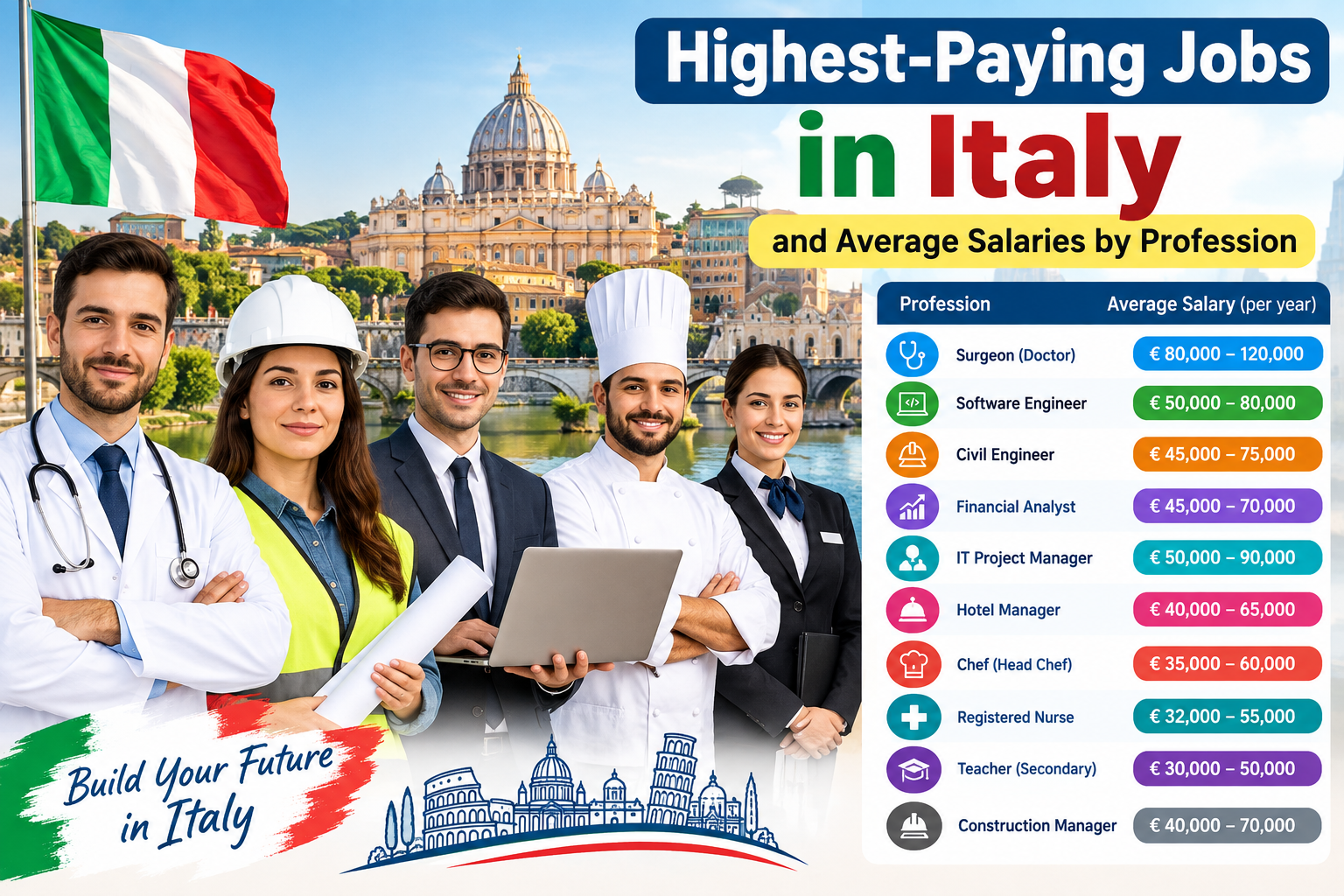
Highest-Paying Jobs in Italy: Profession by Profession
Below are the professions that consistently appear among the top earners. The ranges are gross annual figures and are indicative only. Salaries at the lower end usually reflect junior roles or smaller employers in less wealthy regions, while the upper end reflects senior roles in big cities or multinationals.
| Profession | Approximate gross annual range |
|---|---|
| Physician / medical specialist | €50,000 – €140,000+ |
| Senior manager / director | €70,000 – €150,000+ |
| Engineering manager | €58,000 – €140,000 |
| Investment banking / finance specialist | €50,000 – €120,000+ |
| Lawyer (private practice, large firm) | €45,000 – €110,000+ |
| Machine learning / AI engineer | €45,000 – €110,000 |
| Software architect / senior developer | €40,000 – €90,000 |
| Sales or marketing manager | €45,000 – €115,000 |
| Sustainability / energy transition manager | €50,000 – €120,000 |
| Data scientist / cybersecurity specialist | €35,000 – €85,000 |
One salary database lists physicians at the top of its Italian ranking, followed by engineering managers, investment banking analysts, and sustainability managers. Treat any single ranking cautiously, though. Public-sector doctors, for example, are paid according to national contracts, and their pay often differs from private-sector figures. jobmentis
Medicine and Healthcare
Doctors and specialists are among Italy’s highest earners, particularly surgeons, anaesthetists, and private-practice consultants. Public hospital doctors earn according to national agreements, and pay rises with seniority and specialisation. Nurses earn far less than doctors but remain in strong demand, with salaries commonly in the €25,000 to €38,000 range, rising with experience and overtime.
Important for foreigners: you cannot simply start work as a doctor or nurse. Your qualifications must be recognised by Italian authorities, and strong Italian is essential.
Management and Executive Roles
Directors, general managers, and department heads at large Italian and multinational companies command the biggest salaries. Pay often includes bonuses, company cars, and performance incentives on top of base salary. Milan, home to many corporate headquarters, offers the largest concentration of such roles.
Engineering
Italy has a strong industrial base, so engineers are valued, particularly in mechanical, automation, electrical, aerospace, automotive, and energy engineering. Engineers in northern manufacturing hubs can progress to well-paid managerial positions. Renewable energy and green-transition roles have been growing, adding new opportunities.
Finance, Banking, and Insurance
Roles in investment banking, asset management, risk, and insurance are well-paid, especially in Milan. Quantitative and data-driven finance roles often pay more than traditional back-office work. Professional certifications can significantly raise your earning power.
Information Technology
Salary platforms show that tech salaries in Italy can range from about €30,000 up to €90,000 a year depending on role, and some specialist posts pay more. Pay is usually higher at multinationals and fintech firms than at small local agencies. Remote and hybrid work can also help you access better-paying employers. shecodes
Law and Consulting
Lawyers at large firms and consultants at international consultancies can earn very well, though early-career pay is modest and progression depends on experience and reputation. Italian legal practice requires local qualifications, so it is not an easy field for foreign graduates to enter.
Average Salaries in Everyday Professions
Not everyone is aiming for a six-figure role, and that is fine. Here are typical gross annual ranges in other fields, again as rough guides.
- Teachers and educators: about €22,000 – €35,000
- Administrative and office staff: about €22,000 – €32,000
- Electricians, plumbers, and skilled tradespeople: about €22,000 – €40,000
- Truck and delivery drivers: about €22,000 – €36,000
- Hotel and restaurant staff: about €18,000 – €28,000
- Agricultural workers: about €15,000 – €25,000, often seasonal
- Factory and warehouse workers: about €20,000 – €30,000
Hospitality and agriculture usually sit at the lower end of the scale. Their pay is set by sector collective agreements, and a significant share of foreign newcomers start here, particularly through seasonal work routes.
Salaries by City and Region
Where you live in Italy can matter as much as what you do.
The North Pays More
Northern regions such as Lombardy, Veneto, Emilia-Romagna, and Piedmont tend to pay the highest wages, driven by industry, financial services, and multinational headquarters. Milan leads the country for corporate, finance, and tech salaries. sda
Central Italy
Rome and the central regions sit closer to the national average. Rome’s job market leans toward public administration, tourism, media, and international organisations. One estimate puts average pay in Rome at around €37,000 a year, compared with about €27,000 in Palermo. inedjobs
The South and Islands
Wages are generally lower in southern Italy, but so is the cost of living. Agriculture, tourism, and seasonal work dominate, although some tech and customer-service hubs are growing.
Cost of Living Matters
A €32,000 salary in a smaller northern city may stretch further than €38,000 in Milan, where rent is much higher. When comparing job offers, always weigh salary against rent, transport, and daily costs.
From Gross to Net: What You Actually Take Home
Gross salary and take-home pay can differ substantially. Three deductions matter:
- Social security contributions: deducted from your gross pay and funding pensions and benefits.
- IRPEF (income tax): a progressive tax, meaning higher income is taxed at higher rates.
- Regional and municipal surcharges: small additional taxes that vary by location.
As a rough guide, an employee on a gross salary of €30,000 might take home somewhere in the region of €1,850 to €2,100 per month depending on contract structure, number of payments, and family situation. Employers also pay contributions separately, and you accrue the TFR (trattamento di fine rapporto), a severance-style benefit paid when your job ends.
Tax rules and brackets change from year to year, and Italy adjusted taxes for middle earners in recent budgets. Use an official or reputable payroll calculator with your actual contract details before accepting an offer.
Can Foreigners Earn These Salaries?
Yes, but the route matters.
The EU Blue Card
Highly qualified professionals with a university degree and a job offer above a salary threshold set by Italian law may qualify for the EU Blue Card. This is often the best route for IT specialists, engineers, and other skilled professionals targeting top-paying roles.
Skilled Worker Permits
Other work permits tie you to a specific employer and rely on the yearly quota system known as the Decreto Flussi. Skilled and well-paid roles usually need employer sponsorship and complete documentation.
Recognition of Qualifications
In regulated fields such as medicine, nursing, law, and engineering, you must have your qualifications recognised and sometimes sit local exams. Start early, since it can take months.
Language Skills
English-speaking roles exist in IT, finance, and multinational firms, but the best-paying jobs generally require fluent Italian, particularly in healthcare, law, and public-facing management.
How to Increase Your Earning Potential in Italy
- Specialise in shortage skills such as cloud computing, AI, cybersecurity, automation, and healthcare
- Aim for multinational employers, which often pay above local benchmarks
- Consider Milan and northern hubs if high pay is the priority
- Learn Italian to at least B2 level for professional roles
- Get professional certifications in finance, project management, or technical fields
- Negotiate beyond the base salary: ask about bonuses, meal vouchers, remote work, training, and company health insurance
- Check the CCNL to confirm your contract meets sector minimums
- Build a strong LinkedIn profile so recruiters can find you
Common Salary Mistakes to Avoid
- Comparing a gross Italian offer with a net salary from another country
- Forgetting to check whether the offer includes 13 or 14 payments
- Ignoring local rent when choosing a city
- Accepting verbal promises without a written contract
- Trusting job ads promising unrealistically high pay with no interview, since these are often scams
Conclusion
The highest-paying jobs in Italy cluster in medicine, senior management, finance, engineering, law, and technology, with the best opportunities concentrated in the north, especially Milan. Meanwhile, everyday roles in hospitality, agriculture, and trades pay more modestly but can still offer a stable income and a good quality of life, particularly outside expensive cities.
The smartest approach is to treat salary as one piece of a bigger picture. Compare gross and net pay, check the collective agreement, weigh local living costs, and consider benefits and long-term career growth. With the right skills, language ability, and legal pathway, Italy can offer rewarding careers in both well-known professions and emerging fields.
Frequently Asked Questions (FAQ)
1. What is the average salary in Italy?
Estimates vary by source, but average gross pay is generally cited at roughly €33,000 to €36,000 per year. The median is lower, so typical earners often make less than the average.
2. Does Italy have a minimum wage?
There is no single national statutory minimum wage. Minimum pay is set by sector collective agreements (CCNL), which differ by industry.
3. Which city pays the most in Italy?
Milan generally offers the highest salaries, especially in finance, tech, and corporate roles, though it is also among the most expensive cities.
4. What are the highest-paying jobs in Italy for foreigners?
Medical specialists, engineers, IT and AI specialists, finance professionals, and senior managers typically earn the most, although regulated professions require recognised qualifications and good Italian.
5. What does RAL mean?
RAL stands for retribuzione annua lorda, your gross annual salary before taxes and contributions.
6. Why does my monthly pay look different from RAL divided by 12?
Many Italian contracts pay 13 or 14 monthly instalments, so the annual figure is divided differently. Taxes and contributions are also deducted.
7. Can I earn a high salary in Italy without speaking Italian?
In some cases, yes, particularly in IT, multinational companies, and international finance. For most other well-paid professions, strong Italian is expected.
8. Is a salary of €30,000 good in Italy?
It can be comfortable in smaller cities and the south, but tighter in Milan or Rome. Your lifestyle, rent, and family situation matter more than the number alone.
Disclaimer: Salary figures are indicative estimates from multiple public sources and vary widely by employer, region, and contract. Tax and contribution rules change frequently. Verify current data with official sources such as ISTAT or a qualified payroll adviser before making financial or relocation decisions.