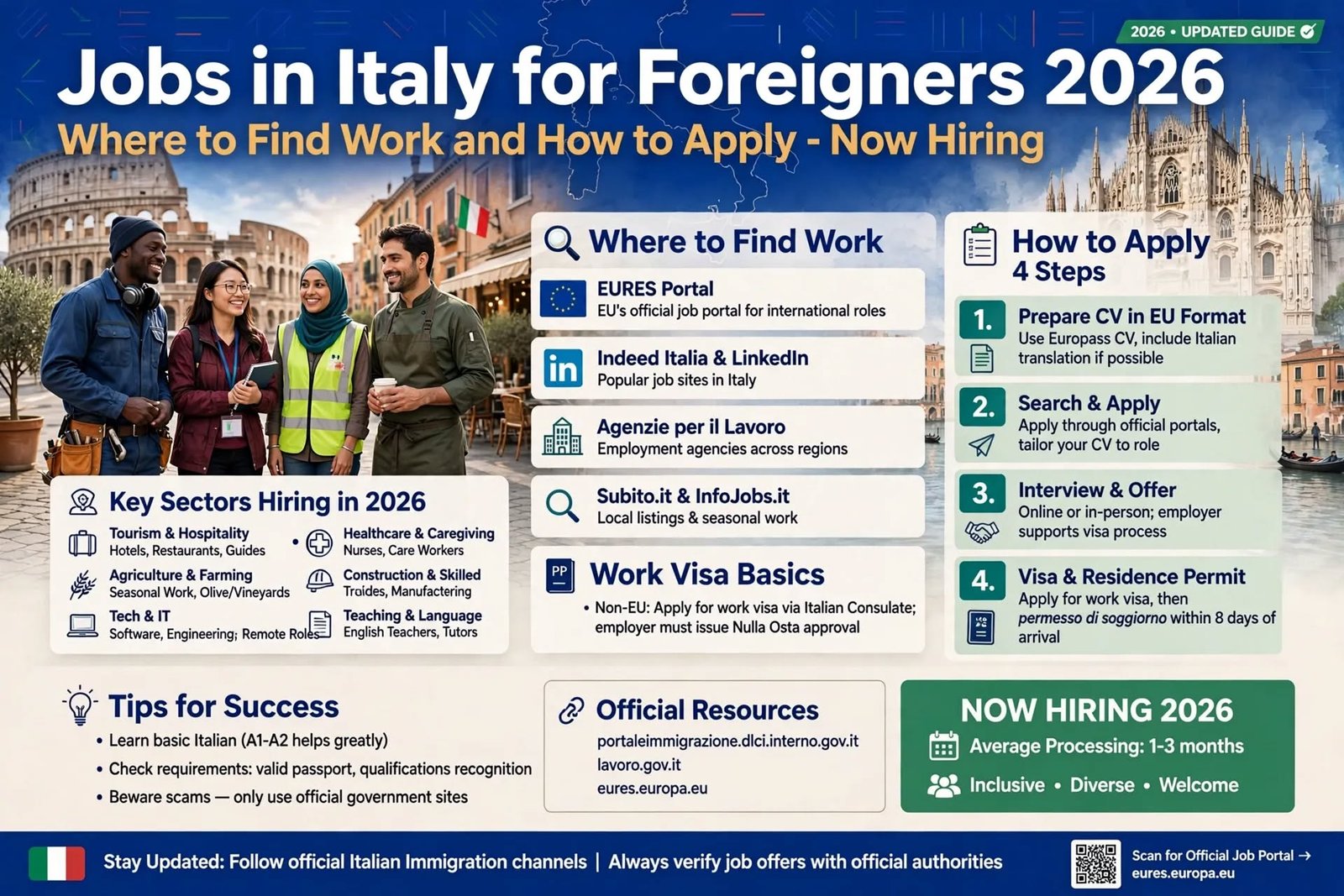
Italy is famous for its food, fashion, history, and coastlines. But beyond the postcard images, it is also the third-largest economy in the Eurozone, with a steady demand for workers in tourism, agriculture, healthcare, construction, and manufacturing. An ageing population and persistent labour shortages mean that employers increasingly look abroad to fill positions.
If you are searching for jobs in Italy for foreigners, the good news is that opportunities exist. The challenge is knowing where to look, which visa applies to you, and how to avoid the scams that target hopeful job seekers. This guide covers all of it in plain language: the sectors that are hiring, the legal routes to work in Italy, the best platforms for your search, realistic salary expectations, and a step-by-step application process.
One note before we begin: immigration rules, quotas, and deadlines change often. Treat this article as a roadmap, and always confirm current details on official government websites before you apply or pay anyone.
Read More: Farm Worker Jobs in Italy
Why Work in Italy in 2026?
Italy offers more than a paycheck. Here is why many foreigners choose it:
- Labour shortages: Hospitality, farming, construction, logistics, and care work regularly struggle to find enough staff.
- Quality of life: Public healthcare, long holidays, and a strong culture of family and food make daily life enjoyable.
- Gateway to Europe: Once you hold a residence permit, you can travel visa-free within the Schengen Area for short stays.
- Paid leave and worker protections: Italian contracts typically include paid holidays, sick leave, and a severance-style benefit called TFR (trattamento di fine rapporto).
- Pathway to residency: Long-term legal work can lead to a long-term residence permit and, eventually, citizenship for those who meet the requirements.
Who Can Work in Italy?
Your path depends largely on where you come from.
EU/EEA and Swiss Citizens
If you hold a passport from an EU or EEA country, or Switzerland, you can live and work in Italy without a work visa. You only need to register your residence with the local municipality (anagrafe) if you stay longer than three months.
Non-EU Citizens
If you come from outside the EU, you generally need a work visa and a work authorisation tied to a specific employer or a specific category of work. This is where most of the confusion arises, so the next sections explain it carefully.
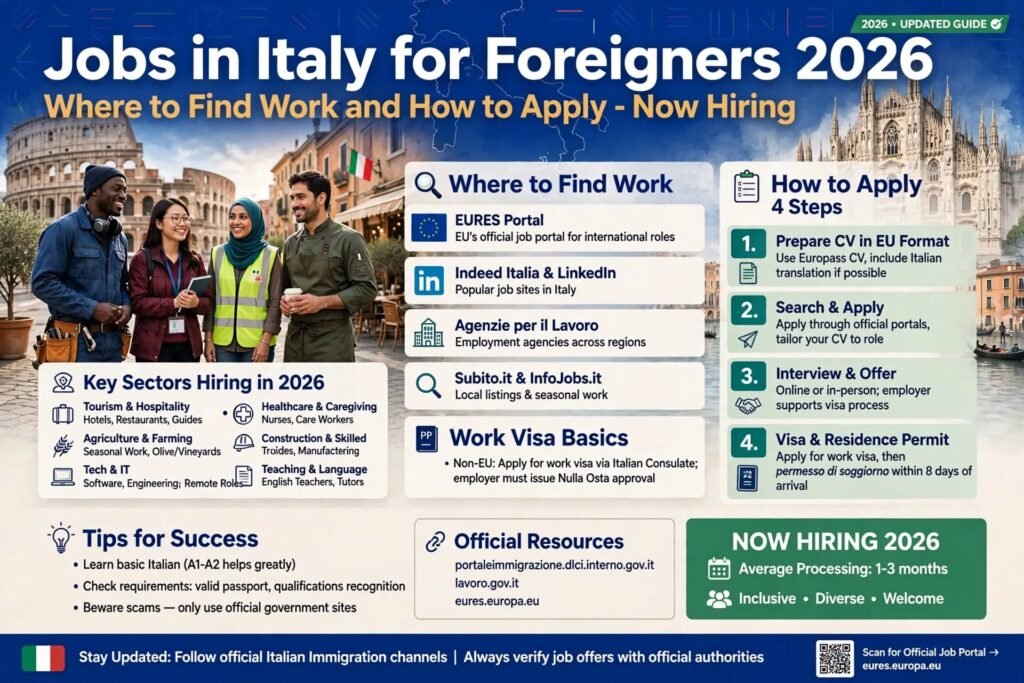
Top Industries Hiring Foreign Workers in Italy
1. Tourism and Hospitality
Italy welcomes tens of millions of visitors every year, and that creates constant demand for waiters, cooks, hotel receptionists, housekeepers, bartenders, and resort staff. Peak season runs roughly from spring to autumn, with winter openings in ski areas.
- Typical roles: kitchen assistant, chef de partie, front-desk agent, lifeguard, tour guide
- Best for: entry-level workers and those with hospitality experience
- Tip: knowing even basic Italian helps you stand out
2. Agriculture
Italy’s farms, vineyards, and orchards depend heavily on seasonal labour for planting and harvesting, from grapes and olives to tomatoes and citrus fruit. A large share of work permits issued under the national quota system goes to this sector.
- Typical roles: fruit picker, vineyard worker, greenhouse worker, farm machinery operator
- Work is physically demanding, so check accommodation and wages carefully
3. Healthcare and Elderly Care
An ageing population has created strong demand for nurses, caregivers, and care assistants (badanti and OSS workers). Foreign nurses often need their qualifications recognised by Italian authorities before they can practise.
- Typical roles: nurse, care assistant, home caregiver, physiotherapist
- Requirements: recognised qualifications and, usually, a good level of Italian
4. Construction and Skilled Trades
Electricians, welders, plumbers, bricklayers, and heavy-machinery operators are in demand, especially with ongoing renovation and infrastructure projects across the country.
5. Information Technology
Cities like Milan, Turin, Bologna, and Rome have growing tech scenes. Software developers, data analysts, cybersecurity specialists, and cloud engineers can find roles, often at international companies where English is the working language.
6. Manufacturing, Fashion, and Logistics
Northern Italy is an industrial powerhouse. Factories producing machinery, automotive parts, food, furniture, and textiles regularly hire. Warehousing and delivery services have also expanded with e-commerce.
7. Teaching and Education
Native or fluent English speakers can find work as language teachers, usually with a TEFL/CELTA certificate. Private language schools, international schools, and tutoring are the usual routes.
Understanding Italian Work Visas and Permits
This is the most important part of any guide to working in Italy as a non-EU citizen.
The Decreto Flussi (Annual Quota System)
Italy controls most non-EU labour migration through a government decree known as the Decreto Flussi. It sets quotas for how many foreign workers may enter each year, divided by category, such as seasonal work, non-seasonal subordinate work, and self-employment. The most recent multi-year decree covers 2026 to 2028 and allows several hundred thousand entries over the period, but you should confirm the exact numbers and application windows on official sources.
Applications are typically submitted online by the employer during designated “click days.” Because demand often exceeds the quota, timing and preparation matter.
How the Process Works
- The employer applies for authorisation (nulla osta) through the Sportello Unico per l’Immigrazione (One-Stop Shop for Immigration) at the local prefecture.
- Authorisation is approved if the quota is available, the employer meets the requirements, and checks are cleared.
- You apply for the visa at the Italian embassy or consulate in your home country.
- You travel to Italy and, within eight days of arrival, apply for your permesso di soggiorno (residence permit) at a post office kit or designated office.
- You obtain a codice fiscale (tax code), which you need for contracts, banking, and rent.
Main Types of Work Visas
- Seasonal work visa: For agriculture and tourism jobs, valid for a limited period (up to nine months in many cases).
- Subordinate (employee) work visa: For longer-term, non-seasonal employment under the quota.
- EU Blue Card: For highly qualified professionals with a university degree and a job offer above a salary threshold set by the government.
- Self-employment/freelance visa: For independent professionals who meet financial and licensing requirements.
- Intra-company transfer: For employees of multinational companies moved to an Italian branch.
- Student visa with work rights: Allows limited part-time work during studies.
Visa Sponsorship Jobs in Italy
Italian visa sponsorship works differently from some other countries. The employer must typically prove they have a genuine need and meet legal requirements, and an unfilled quota can make or break an application. It is easier when you have a skill that is hard to find locally, such as healthcare, IT, or specialised trades, or when you work within the seasonal sector.
Where to Find Jobs in Italy
Online Job Portals
- Indeed Italia and InfoJobs: Large general portals with listings across all sectors
- LinkedIn: Best for professional, corporate, and international roles
- Subito Lavoro: Popular for local and entry-level jobs
- Jooble and Monster Italia: Aggregators that collect listings from many sources
- EURES (European Job Mobility Portal): An official EU platform that lists vacancies across Europe
Recruitment Agencies
Agencies such as Randstad, Adecco, Manpower, and Gi Group place workers in temporary and permanent roles, especially in logistics, manufacturing, and hospitality.
Direct Applications and Networking
Many Italian employers, especially small and medium businesses, hire through contacts and direct approaches. Emailing hotels, restaurants, farms, or companies directly with a short, polite message in Italian can work better than you might expect.
Embassies and Official Channels
Your local Italian embassy or consulate can explain current visa categories. Some countries also have bilateral labour agreements with Italy, so check whether yours does.
How to Apply for Jobs in Italy: Step-by-Step
Step 1: Choose a Target Sector and Region
Italy’s job market is regional. The north (Lombardy, Veneto, Emilia-Romagna, Piedmont) has the most industrial and corporate jobs. The centre (Rome, Tuscany) has tourism, public services, and administration. The south has agriculture and seasonal tourism but fewer high-paying roles.
Step 2: Prepare an Italian-Style CV
Keep it clear and factual, ideally one to two pages. Include:
- Personal details and contact information
- Work experience in reverse chronological order
- Education and certifications
- Languages and skills
- A line authorising data processing under privacy law, which Italian employers commonly expect
The Europass format is widely recognised. A photo is optional.
Step 3: Write a Short, Tailored Cover Letter
Explain why you want the role, what you bring, and when you are available. If your Italian is limited, say so honestly and write in English or simple, correct Italian.
Step 4: Search and Apply
Apply to a manageable number of well-matched roles rather than mass-sending the same CV. Track each application and follow up politely after a week or two.
Step 5: Prepare for the Interview
Interviews are often by video call for overseas candidates. Be punctual, dress professionally, and research the company. Employers value reliability and willingness to learn.
Step 6: Complete the Legal Process
Once an employer decides to hire you, they will start the nulla osta process. Do not travel to Italy expecting to work without the correct authorisation.
Salaries and Cost of Living
Italy has no single national minimum wage. Pay is usually set by sector-wide collective agreements known as CCNL. As a rough guide, entry-level jobs in hospitality or agriculture often pay in the range of about €1,000 to €1,400 net per month, while skilled trades, nursing, and IT roles can pay considerably more, depending on experience and region. Milan and Rome pay better but cost more to live in.
- Rent: Considerably higher in Milan, Rome, and Bologna than in smaller towns and the south
- Food and transport: Moderate compared with Northern Europe
- Healthcare: Legal residents can usually register with the national health service (SSN)
Always read your contract carefully and confirm the applicable CCNL, working hours, and whether accommodation or meals are included.
Learning Italian: Your Biggest Advantage
You can find some jobs with English only, particularly in IT, international companies, and tourism hotspots. But even basic Italian (A2 to B1 level) opens far more doors, improves your negotiating position, and makes daily life easier. Free apps, community classes, and online courses can get you started well before you arrive.
Common Mistakes and Scams to Avoid
Unfortunately, many job seekers lose money to fraud. Watch for these warning signs:
- Agents who guarantee a visa or job in exchange for a large upfront payment
- Fake job offers with no interview, no contract, and unusually high pay
- Requests to pay for a “nulla osta” directly to an individual. The official process is handled by the employer through government channels
- Pressure to travel on a tourist visa and “sort out the papers later”
- Unverifiable companies with no website, address, or tax number
Before committing, verify the employer’s registration, ask for the offer in writing, and check official government websites for the correct procedure.
Tips to Improve Your Chances
- Target shortage occupations where Italy actively needs workers
- Get your qualifications recognised early if you work in a regulated profession
- Build a professional LinkedIn profile with a clear photo and keywords
- Learn basic Italian and show that effort in your application
- Stay flexible on location, since smaller cities often have more openings and cheaper rent
- Keep digital copies of passports, certificates, and references ready
Conclusion
Finding jobs in Italy for foreigners in 2026 is realistic, but it takes research, patience, and careful attention to the legal process. Focus on sectors with genuine demand, prepare a strong Italian-style CV, use trusted job portals, and understand how the Decreto Flussi and work visas operate. Above all, protect yourself from scams and never skip the official authorisation steps.
With the right preparation, Italy can offer more than a job. It can offer a new chapter of life, work, and culture.
Frequently Asked Questions (FAQ)
1. Can I get a job in Italy without speaking Italian?
Yes, but your options are limited. Roles in IT, international companies, tourism, and English teaching may not require fluent Italian. For most other jobs, at least basic Italian is expected.
2. Is it possible to find visa sponsorship jobs in Italy?
Yes, though the system works through employer applications under the annual quota. Seasonal work, healthcare, skilled trades, and IT are the most common routes.
3. Can I enter Italy on a tourist visa and look for work?
You cannot legally work on a tourist visa, and it generally cannot be converted into a work permit. Always obtain the correct work visa before starting any job.
4. How long does it take to get an Italian work visa?
It varies widely depending on quotas, the prefecture’s workload, and your consulate. The process can take several months from the employer’s application to your arrival, so plan well ahead.
5. What is the Decreto Flussi?
It is Italy’s government decree that sets annual quotas for non-EU workers by category. Employers apply for authorisation during set windows, and approvals depend on available quota.
6. Which jobs are most in demand for foreigners in Italy?
Seasonal agricultural work, hospitality, healthcare and elderly care, construction trades, logistics, and IT are among the sectors with consistent demand.
7. Can I bring my family with me?
In many cases, yes. Family reunification is possible once you hold a valid residence permit and meet income and housing requirements, though rules vary by permit type.
8. How much does it cost to apply?
Official fees apply for visas and residence permits, but a legitimate employer should not ask you to pay for the authorisation itself. Be cautious of anyone requesting large sums upfront.
Disclaimer: Immigration rules, quotas, and salaries change frequently. Verify current requirements with the Italian Ministry of the Interior, the Ministry of Foreign Affairs, or your nearest Italian embassy before applying.