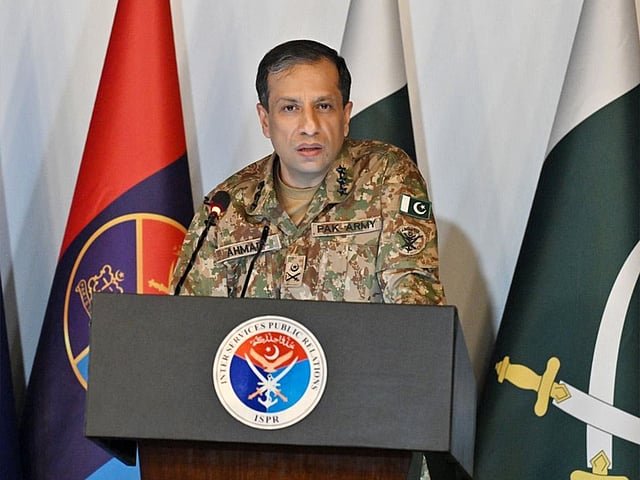
‘No Ifs or Buts’: DG ISPR Says Attack on Makkah Alliance Member State Will Trigger Collective Response
The Director General of Inter-Services Public Relations, Lieutenant General Ahmed Sharif Chaudhry, has said the Makkah Joint Defence Agreement (MJDA) between Pakistan, Saudi Arabia and Turkiye is purely defensive in nature and has no offensive intent — but warned that any direct or indirect attack on any of the three member states would trigger a collective response. In a DG ISPR Makkah alliance interview with Independent Arabia on 19 October 2026, the military spokesperson called the security of the Haramain Sharifain in Saudi Arabia paramount, non-negotiable and absolute as far as Pakistan is concerned.
Collective Deterrence Warning
Chaudhry said collective deterrence sent a clear message to “elements of instability” in the region: an attack on any one member state would be met with a collective response. The DG ISPR Makkah alliance statement comes amid escalating Houthi attacks on Saudi Arabia, and he added that if deterrence failed, it would have to be “re-established by all means available” to the three countries.
Haramain Sharifain Security ‘Non-Negotiable’
Reaffirming Pakistan’s commitment to Saudi Arabia’s sovereignty and territorial integrity, the military spokesperson said the security of the Haramain Sharifain was “paramount”, “non-negotiable” and “absolute” as far as Pakistan was concerned — and that whatever support was needed would be provided and would continue to be provided.
In the DG ISPR Makkah alliance interview, Chaudhry said Pakistan’s reaction to the Houthi targeting of Saudi Arabia and the holy sites — “from the streets, from a young boy or girl, up to our military leadership” — was one of anger, adding there could be “no negotiations… no ifs and buts” over threats to the holy places.
Houthi Attacks on Saudi Arabia
The DG ISPR Makkah alliance remarks came as the Houthis intensified attacks on Saudi Arabia. According to the Saudi-led coalition, the Houthis launched 20 attacks on King Khalid International Airport in Riyadh this month alone, killing 17 people and injuring 333 others; Abha airport was also targeted.
Chaudhry said Pakistan’s message to the Houthis — already delivered by the political leadership and Field Marshal Asim Munir — was that Muslims need to unite rather than fight: “We need to stop attacking each other.” He warned that no country gained from escalating the conflict and said a negotiated outcome was needed; if that failed, the alliance’s collective deterrence would come into play.
Coordination in All Domains
On specifics, the DG ISPR cited operational confidentiality, saying no alliance or military made tactical details public. He stressed that coordination between Pakistan and Saudi Arabia in all domains — including the military domain — has been in place for decades and continues today, reflecting deep Pakistan Saudi Arabia defence cooperation.
Alliance Open to New Members
Chaudhry said the leadership of Pakistan, Saudi Arabia and Turkiye had made clear that the alliance “is not only restricted to these three countries”. It was defensive in nature and did not displace or abrogate any existing military-to-military agreements. “The alliance remains open to all those countries that believe in collective deterrence, peace, stability and security of the region,” he said. The DG ISPR Makkah alliance interview returned to the point when Chaudhry was asked about reports of Egypt and Syria expressing interest in joining, saying such decisions rested with the political, strategic and military leadership.
He stressed the Makkah Joint Defence Agreement was “not country-specific” but based on principles of peace, stability and regional security — any actor threatening those principles, he said, would trigger the collective deterrence mechanism.
Iran, Yemen and a Negotiated Outcome
Asked whether Islamabad had warned Iran over the Houthi attacks on Saudi Arabia, Chaudhry said Pakistan’s politico-military leadership had for months been engaging all players in the conflict, including Iran, to reduce temperatures and bring the parties to a negotiated, peaceful outcome: “that is what we are doing and will continue to do.”
On possible military support to the Yemeni government, the DG ISPR Makkah alliance account said any official request would be evaluated and responded to by the government. He described the Houthi-Saudi escalation as a “sinusoidal pattern”, noting non-state actors responded “only to clear communication and where the intent is absolute and there is no hesitation” — and that from the Makkah alliance side, “there is no hesitation in our communication to them.”
What Happens Next
The DG ISPR Makkah alliance interview underscores how central the Saudi relationship has become to Pakistan’s defence posture in 2026: deterrence first — but a collective response remains on the table. This is a developing story; UrduPro will update this article as more details emerge.
Sources: The Express Tribune; Independent Arabia. This article will be updated as more information becomes available.
Related Posts
 Pakistan NewsFire Breaks Out at Garment Factory Warehouse in Karachi’s SITE Area
 Pakistan NewsPakistan Suspends Iran Border Trade at Taftan and Gabd-Rimdan Over Security Concerns
 Pakistan NewsPakistan Extends Airspace Ban on Indian Aircraft Until November 24, 2026
 Pakistan NewsLahore Smog 2026: Causes, AQI Levels and How to Stay Safe
 Pakistan NewsEhsaas Program 2026: Registration, Eligibility and 8171 Check
 Pakistan NewsPetrol Price in Pakistan: Latest Update and Price History
Most Popular
 How-ToPTA Tax Calculator 2026: Check Mobile Tax on Any Phone79 views
 BISPPunjab Driving License Scam Alert: Fake Websites & “Without Test” Fraud | UrduPro76 views
 Canada JobsTech Jobs in Canada: Roles, Salaries, and Skills Needed74 views
 BusinessTech Stocks Trillion Loss: $1 Trillion Wiped Out as Oil Hits $11066 views
 TechnologyTecno Mobile Prices in Pakistan 2026: Spark, Camon and Pova Series Compared57 views
 ShowbizWomen’s Fashion in Pakistan 2026: Trends, Brands and Style Guide52 views