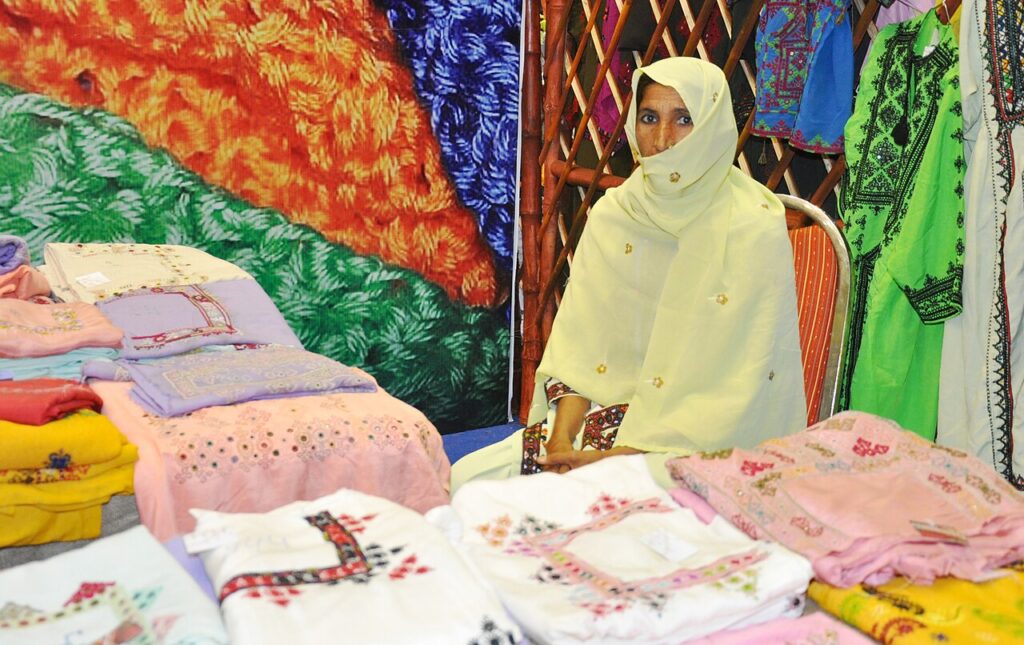
Ayesha Kamil holds a PhD in environmental science. Until recently she worked as a science coordinator at a school in Lahore. Today she runs a home-cooked food business through the food delivery platform Foodpanda — and in about eighteen months she has grown from eight or nine orders a day to three kitchens employing twenty-five women.
One day, she told Channel News Asia, she made Rs250,000 in sales from three hundred orders. It is the kind of figure that would be impressive for any small business in Pakistan. What makes it remarkable is who earned it, and how: a woman working from her own home, in a country where only about one in four women is in the formal labour force.
Kamil is not an exception. She is part of a growing number of Pakistani women who are turning to digital platforms — food delivery apps, Facebook shops, mobile wallets — to earn an income as internet connectivity spreads across the country. The shift is real, the numbers behind it are striking, and yet the women driving it say that earning money and controlling it are two very different things.
A PhD graduate, three kitchens and twenty-five women
Kamil left her job to sell home-cooked meals through Foodpanda’s HomeChef programme, which lets home cooks sell food through the delivery app. She started small, cooking from her own kitchen. Within eighteen months she was running three kitchens and employing twenty-five women — and she employs only women, deliberately.
That choice matters. By hiring women only, she has created work for women whose families might otherwise be reluctant to let them work alongside men. Among her employees is a young widow whose family agreed to let her work only because all her colleagues would be women.
Her story shows what digital platforms can do: they let a woman start a business without renting a shop, without a large loan, and without leaving her home. A phone, a kitchen and a delivery app were enough to build a business that now supports twenty-five families.
Forty million women are now online
The change is being driven by connectivity. Mobile internet use among adult women in Pakistan rose from 19 per cent in 2020 to 53 per cent in 2025 — about forty million women — according to figures from the mobile industry body GSMA.
Female labour-force participation has moved with it, rising from 21.4 per cent in 2020-21 to 24.4 per cent in 2024-25, according to government data. That is still far below the nearly 70 per cent recorded for men, but the direction is clear: more women are finding ways to work, and digital platforms are one of the main routes in.
Foodpanda’s HomeChef programme alone has around four thousand to five thousand people selling home-cooked food through the platform, and about 70 per cent of them are women, according to the company’s chief executive, Mutaqa Peracha, speaking on a podcast in August.
The pattern repeats on other platforms. In Islamabad, Saima Rauf, a 48-year-old former schoolteacher and single mother, runs a jewellery and artwork business and reaches customers through Facebook. Most of her sales come from exhibitions and pop-up events, and she receives payments through the mobile wallet JazzCash, which has also offered women entrepreneurs free stalls at its events.
The ‘time tax’ — and earnings hidden from husbands
But the women building these businesses describe a second reality that the sales figures do not show. Halima Iqbal, co-founder of the women-focused financial technology company Oraan, calls it a “time tax”: childcare and family emergencies constantly take priority over the business, disrupting enterprises that women have built single-handedly.
“At the grassroots level, there is no control,” Iqbal said, describing women whose businesses generate two million to three million rupees in monthly revenue but who have to hide some of their earnings from their husbands so they can support their own mothers.
Rauf’s experience fits the same pattern. Like many women her age, she found more time for paid work only once her children grew more independent — while still caring for ageing parents. As Iqbal put it, if you look at the life cycle of a woman, it is only at a later stage, when her children grow up or her relationship is stable, that she can work. Before that, she is often not allowed to work, or simply does not have the time.
Digital platforms help women get around some cultural and mobility barriers. But earning an income does not automatically mean having control over it — and for many women, that control is still missing.
What the government and the platforms are doing
The push to bring more Pakistani women into the digital economy is not new. In 2017, JazzCash partnered with Unilever and development organisations to train women from the consumer goods company’s Guddi Baaji network — women who sold products in rural communities — as mobile banking agents.

The government has also been pushing to digitise financial services. Its flagship Benazir Income Support Programme, which provides cash assistance to low-income women, has moved towards disbursing all payments to its ten million beneficiaries through mobile wallets this year.
Pakistan has also introduced its first National Women Entrepreneurship Policy in 2025, aimed at increasing the number of women entrepreneurs, boosting exports and improving access to finance. The need is stark: according to a report in The News, 92.7 per cent of women in Pakistan lack access to formal financial services, only one per cent of entrepreneurs are women, and women-owned businesses receive just 3.2 per cent of small business loans. At the same time, around 51 per cent of the income generated by women-led businesses now comes from online sales — a sign of how central digital channels have become.
Access is not the same as control
The story of Pakistan’s women entrepreneurs is genuinely encouraging: a PhD graduate building a food business from her kitchen, a single mother selling jewellery through Facebook, tens of millions of women coming online. Digital platforms have lowered the barriers to starting a business further than any government scheme could.
But the women at the centre of this change are clear about what is still missing. A phone and a mobile wallet can deliver income — they cannot, on their own, deliver the freedom to spend it. Until women have control over what they earn, as well as the chance to earn it, the financial freedom that digital platforms promise will remain only partly delivered.
Related Posts
 TechnologyFBI Investigating Suspected Breach of National Crime Database Used by Police Across America
 TechnologyAshton Kutcher’s $435 Million Anthropic Bet Is Now Worth $7 Billion
 TechnologyStanford Fires Back With All-Human Riemann Proof Hours After Claude’s Claim — Then Problems Emerge
 TechnologyPakistan’s First AI Satellite Imagery Service Launches: Novascope Turns 10-Metre Views into 1-Metre Detail
 TechnologyNCCIA Raids Lahore Call Centre Targeting UK Customers — Eight Arrested in Fake Phone Scam
 TechnologyPTA Inspects 226 Mobile Sites Across Pakistan, Finds Faulty Batteries and Failing Generators
Most Popular
 How-ToPTA Tax Calculator 2026: Check Mobile Tax on Any Phone421 views
 Pakistan NewsPIA Boeing 787 Lease Deal: What It Means for the Airline396 views
 Canada JobsTech Jobs in Canada: Roles, Salaries, and Skills Needed392 views
 SportsUEFA Champions League 2026-27: Format, Teams and Schedule390 views
 TechnologyPM Shehbaz Sets November Deadline for Alibaba AI and Digitalisation Projects in Pakistan370 views
 ShowbizWomen’s Fashion in Pakistan 2026: Trends, Brands and Style Guide366 views