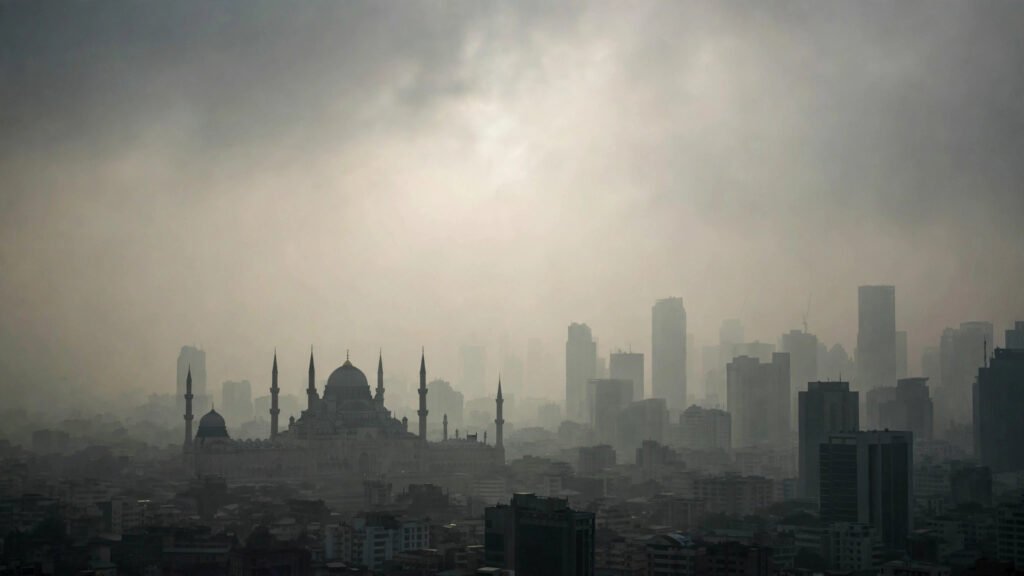
Air pollution Pakistan faces is costing the country around 6.5 per cent of its gross domestic product every year — and it is now driving foreign investors away, the country’s leading business chamber has warned.
The Overseas Investors Chamber of Commerce and Industry (OICCI) says dirty air is one of Pakistan’s most severe public health and economic challenges, contributing to more than 248,000 premature deaths a year, falling workforce productivity, disrupted businesses and rising healthcare bills.
The warning comes as winter smog settles over Lahore and other cities, and as Pakistan’s struggle to attract foreign money deepens. Net foreign direct investment fell 34 per cent to 1.64 billion dollars in the last financial year, while total foreign investment, including portfolio flows, plunged 74 per cent to just 451 million dollars.
The State Bank of Pakistan has primarily linked the weak inflows to governance concerns and policy uncertainty. But business leaders say air quality has become another layer of concern for international investors weighing where to put their money.
More than 248,000 premature deaths every year
The human cost sits behind the economic one. According to the State of Global Air, cited by the OICCI, air pollution contributes to more than 248,000 premature deaths in Pakistan annually.
The crisis has intensified over the past decade. National average concentrations of fine particulate matter, known as PM2.5, rose by 7 per cent between 2013 and 2023, while ground-level ozone increased by 16 per cent between 2010 and 2020.
Today, 92 per cent of Pakistan’s population lives in areas where PM2.5 levels exceed the World Health Organisation’s interim target of 35 micrograms per cubic metre. The entire population lives in areas that breach national air quality standards.
Children carry a disproportionate share of the burden: those under five account for 18 per cent of air pollution-related deaths.
Foreign investment falls as air quality worsens
For companies deciding whether to invest in Pakistan, air pollution Pakistan faces is now part of the calculation. Sajjeed Aslam, a partner at Sustainability LLC in the United States, told The Express Tribune that Pakistan’s struggle to attract foreign investment had several underlying causes, “with air pollution adding another layer of concern for international investors”.
High pollution levels make it increasingly difficult for companies to persuade foreign employees to relocate to major urban centres such as Lahore, Aslam said. Recurring winter smog and the closures that come with it also disrupt business operations and economic activity.
International investment funds with environmental and climate-related mandates now scrutinise air quality and sustainability indicators when allocating capital, he added.
The financial burden of air pollution Pakistan faces — through premature deaths, healthcare spending and lost productivity — is estimated at around 6.5 per cent of GDP, including the impact of lead exposure. Experts caution the actual burden could be higher, because many pollution-related health cases go unreported. The World Bank separately estimates that environmental degradation, with air pollution as its largest component, costs Pakistan nearly 6 per cent of GDP a year.
Air pollution Pakistan faces: almost the whole country breathes unsafe air
The University of Chicago’s Air Quality Life Index estimates that air pollution reduces average life expectancy in Pakistan by 3.8 years, with losses reaching as much as seven years in the most polluted areas.
Muhammad Toheed, acting director of the Karachi Urban Lab, said clean air was not merely an environmental demand but an economic necessity. Experts argue that stricter emissions standards, cleaner fuels and reliable public transport should be treated as economic investments rather than additional costs, because preventing pollution is considerably cheaper than managing its long-term consequences.
Toheed also cautioned against blaming vehicles alone. Fossil fuels are significant contributors through transport, power generation and industry, but household fuels, crop-residue burning, waste burning and industrial emissions all play a substantial role.
Lahore’s pollution: vehicles, industry and brick kilns
In Lahore, the country’s most polluted city, vehicles account for 35 per cent of fine-particle pollution, followed by heavy industry at 28 per cent and brick kilns at 17 per cent. Crop-residue burning adds to pollution levels during the winter months.
The OICCI stressed that addressing the crisis required stricter enforcement of industrial emissions standards, faster adoption of cleaner transport and greater support for the private sector to shift towards sustainable production.
International experience shows sustained action can work. Beijing reduced its annual average PM2.5 concentration from 89.5 to 58 micrograms per cubic metre between 2013 and 2017, with studies attributing about 80 per cent of the improvement to emissions reductions rather than favourable weather.
What is being done — and what experts say must change
Pakistan has begun taking steps. The World Bank-backed 300-million-dollar Punjab Clean Air Programme aims to reduce PM2.5 concentrations by 35 per cent over a decade, including through 600 electric buses and 5,000 super seeders to discourage crop-residue burning.
Experts say the country needs to accelerate the shift to cleaner fuels, with Euro-5 fuel available at all petrol pumps by 2027 and Euro-6 by 2030, alongside mandatory continuous emissions monitoring for major industrial units and public disclosure of pollution data.
The 6.5 per cent figure is not new: Federal Climate Change Minister Dr Musadik Malik cited the same estimate on 28 October when announcing a planned 10-million-dollar clean-air startup fund at the Pakistan National Clean Air Conference in Islamabad. What the OICCI statement adds is the business case — that dirty air is now a competitiveness problem, not just a health one.
As Toheed put it, much of the air pollution Pakistan faces comes from domestic sources, which means targeted policy action can work. The question is whether it comes fast enough to stop the next winter’s smog from costing lives, investment and growth all over again.
Related Posts
 BusinessJazzCash Q3 Profits Jump 297% to Rs8.9 Billion as Revenue Hits Rs43.4 Billion
 BusinessKSE-100 Gains 7,477 Points in Strongest Weekly Rally in Six Months as Oil Prices Tumble
 BusinessHafiz Naeem Demands Abolition of Petroleum Levy as Refineries’ Profits Surge 1,000%
 BusinessPakistan’s External Debt Nearly Doubles to $135 Billion in a Decade, World Bank Reports — China Is the Biggest LenderBusinessPakistan’s First SPAC Listing Crashes 34% in Four Sessions — Ningbo Green Falls to Rs13.82
 BusinessGovernment Announces New Auto Policy: Car Prices to Fall, EVs Get Big Tax Breaks and Rs10 Million Loans
Most Popular
 How-ToPTA Tax Calculator 2026: Check Mobile Tax on Any Phone419 views
 Pakistan NewsPIA Boeing 787 Lease Deal: What It Means for the Airline392 views
 Canada JobsTech Jobs in Canada: Roles, Salaries, and Skills Needed389 views
 SportsUEFA Champions League 2026-27: Format, Teams and Schedule386 views
 TechnologyPM Shehbaz Sets November Deadline for Alibaba AI and Digitalisation Projects in Pakistan367 views
 ShowbizWomen’s Fashion in Pakistan 2026: Trends, Brands and Style Guide362 views


One comment