Picture a grape harvest in Tuscany at golden hour, a beach club on the Adriatic in July, or a classroom in Milan full of eager English learners. For many people, these scenes are the starting point for a new chapter abroad, and seasonal jobs in Italy are often the most realistic way in.
Italy’s economy leans heavily on tourism and agriculture, and both sectors need extra hands at predictable times of the year. That creates genuine openings for newcomers, including people with little experience. But there is a catch: for non-EU citizens, “just turning up” does not work. The legal route runs through employers and annual quotas, and scammers know that hopeful job seekers are an easy target.
This guide explains the main seasonal and entry-level options in tourism, farming, and English teaching. You will learn what the jobs involve, how pay and conditions generally work, how the visa process fits in, and how to apply safely. Rules and quotas change, so confirm all details on official Italian government sources before you act.
Why Seasonal Work Is the Easiest Way to Start in Italy
Entry-level seasonal roles suit newcomers for several reasons:
- Predictable demand: Harvests and tourist seasons come around every year.
- Low entry barriers: Many roles accept workers without degrees or years of experience.
- A dedicated visa route: Seasonal work has its own quota under the Decreto Flussi system.
- Possible repeat contracts: Good performance can lead to rehiring in following years.
- A foot in the door: Seasonal work lets you learn Italian, build contacts, and understand the local market.
The trade-off is that contracts are temporary, work can be physically demanding, and earnings are usually modest compared with skilled professional roles.
How the Seasonal Work Visa Works
The Employer Applies First
For non-EU citizens, an Italian employer must request authorisation to hire you. That authorisation is called the nulla osta, and it is requested through the Sportello Unico per l’Immigrazione. The employer files the application online through the Ministry of the Interior’s ALI portal.
Quotas Under the Decreto Flussi
The Decreto Flussi sets how many foreign workers may enter each year. Under the 2026–2028 programme, the decree allocates 88,000 seasonal entries in 2026, rising in later years. The 2026 click days for seasonal work took place on 12 January for agriculture and 9 February for tourism. Applications can still be submitted until 31 December 2026, within the limits of remaining quotas.
Demand has not always matched supply. In 2025, around 72,238 seasonal applications were filed against 82,550 available places, a sharp fall from the 283,000 applications recorded in 2023. That does not mean the process is easy, but it shows that quotas are not always fully contested.
A Helpful Option for Returning Workers
The decree also includes a multi-year seasonal authorisation. It reserves 5,000 places in 2026 for workers who have entered Italy at least once in the previous five years and for whom the employer requests a multi-year permit. If you have worked in Italy before, ask your employer about this route.
After Approval
- You apply for the visa at the Italian embassy or consulate in your country.
- The nulla osta is valid for six months, so you must enter Italy and apply for a residence permit within that time.
- After arrival, you sign the contract of stay, which must be done within eight days.
- You apply for your permesso di soggiorno and obtain a codice fiscale (tax code).
A seasonal permit usually covers a limited working period, often up to nine months, and is tied to the job it was issued for.
Tourism and Hospitality Jobs in Italy
Why Tourism Hires So Many Workers
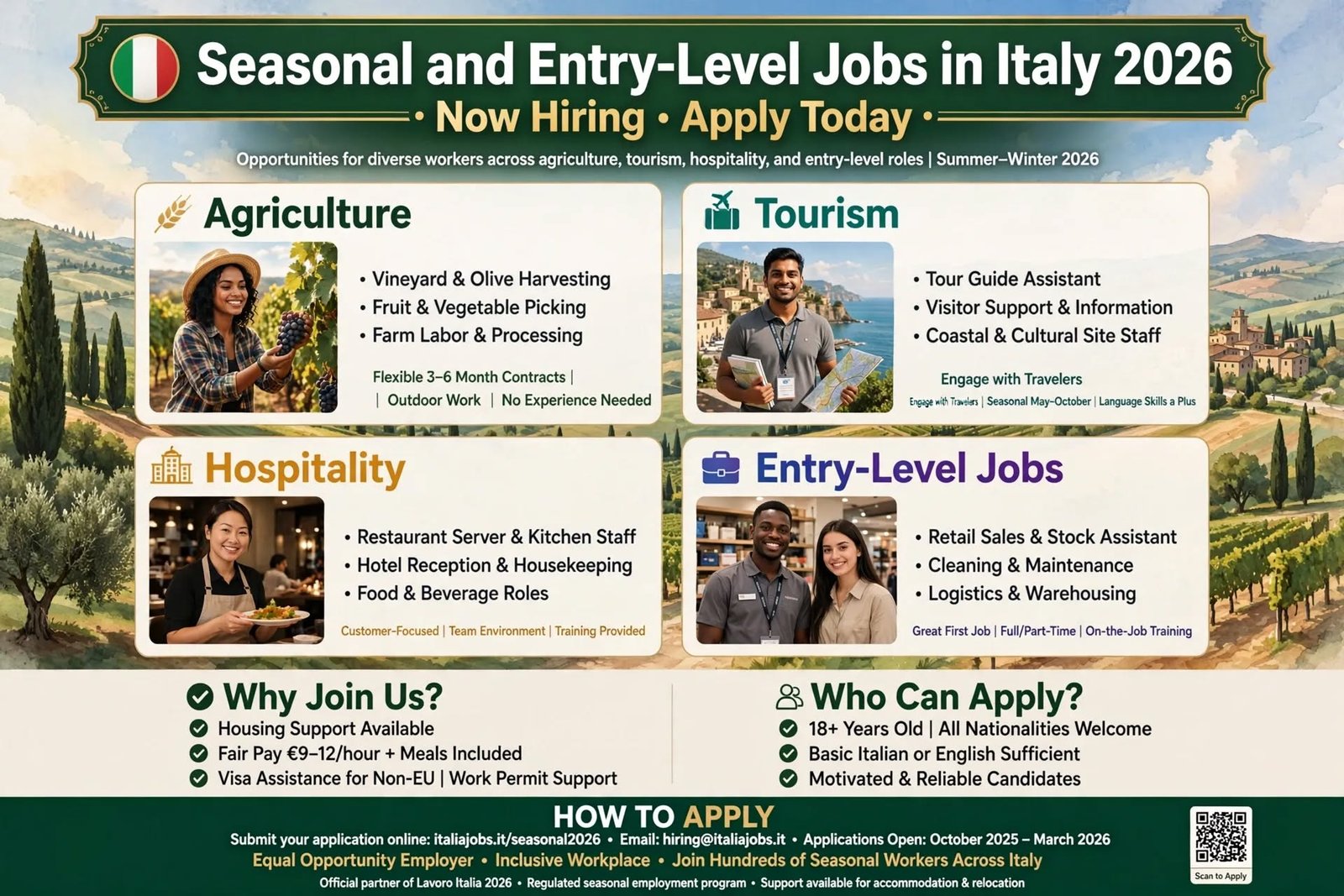
Italy is one of the world’s most visited countries. Hotels, resorts, restaurants, beach clubs, campsites, and tour operators ramp up hiring from spring through early autumn, with winter openings in ski areas such as the Dolomites and Alps.
Common Entry-Level Roles
- Waiter or waitress (cameriere/a)
- Kitchen assistant and dishwasher (aiuto cuoco, lavapiatti)
- Housekeeper or room attendant (cameriera ai piani)
- Bartender or barback
- Hotel receptionist (usually needs languages)
- Beach club and lifeguard staff (bagnino requires certification)
- Campsite and holiday-park staff
- Ski resort staff during winter
What Employers Look For
- Reliability and a positive attitude, since hospitality is demanding in peak season
- Languages: Italian is a big plus, and English, German, French, or Russian can raise your value
- Experience: helpful but not always required for entry-level roles
- Flexibility: long shifts, weekends, and holidays are normal
Pay and Conditions
Hospitality pay is generally set by sector collective agreements (CCNL), and entry-level roles tend to sit at the lower end of the salary scale. Some employers offer staff accommodation or meals, which can significantly reduce your living costs. Always check what is deducted from your salary for housing or food, and make sure the arrangement is written in your contract.
Best Regions to Target
Popular areas include the Amalfi Coast and Campania, Sicily, Sardinia, the Adriatic Riviera, the Italian Lakes, Venice and the Veneto, Tuscany, and the Alpine regions.
Farming and Agricultural Jobs in Italy
The Backbone of Seasonal Work
Italy’s farms, vineyards, and orchards depend on seasonal labour. A large share of seasonal work authorisations goes to this sector, and harvest periods create concentrated demand.
Typical Seasonal Calendar
- Spring: planting, pruning, and early vegetable harvests
- Summer: fruit picking, including peaches, apricots, and tomatoes
- Late summer to autumn: the grape harvest (vendemmia), apple harvest, and olive picking
- Winter: olive harvest in some regions, citrus fruit in the south, and greenhouse work
Common Entry-Level Roles
- Fruit and vegetable picker
- Vineyard worker (pruning, tying, and harvesting)
- Greenhouse operator
- Farm assistant (livestock, dairy, or general farm tasks)
- Tractor and machinery operator (needs experience or certification)
- Packing-house worker
Realities of Farm Work
Agricultural work is physically demanding, often outdoors in heat or cold, with early starts and long days. Conditions vary widely. Many farms treat workers fairly, but the sector has also been associated with exploitation in some areas. Protect yourself by checking these points before you accept an offer:
- Written contract with clear dates, wages, and hours
- Pay under the collective agreement, not a cash deal below the legal rate
- Safe, decent accommodation with clear terms
- No passport confiscation and no unexplained deductions
- Verified employer with a real address and registration
If anything feels wrong, contact the embassy, a trade union, or local authorities.
Agriturismo Opportunities
An agriturismo is a working farm that also offers accommodation and meals to guests. These properties often hire people who can combine farm tasks with hospitality, such as cooking, cleaning, and guest services. They can be a pleasant, small-scale way to start in Italy, and they often value cultural exchange.
English Teaching Jobs in Italy
Is Teaching a Good Option?
English teaching is one of the most popular entry-level paths for English speakers. Language schools, private tutoring companies, summer camps, and international schools all hire teachers, especially in cities like Milan, Rome, Turin, Bologna, and Florence.
Qualifications Employers Want
- A TEFL or CELTA certificate, commonly expected by language schools
- A university degree is preferred by many employers
- Native or near-native English fluency
- Some Italian, helpful for daily life and for dealing with students and parents
Public school teaching posts in Italy require specific Italian qualifications and exams, so they are generally not entry-level options for newcomers.
Types of Teaching Work
- Private language schools (scuole di lingue)
- Corporate training, teaching business English to employees
- Summer camps, popular from June to August
- Private tutoring, often found through local contacts and online platforms
- Online teaching for international clients, which may suit those with legal residence
The Big Visa Question
Teaching is where the legal side gets tricky, especially for non-EU citizens. Unlike the seasonal agricultural and tourism routes, English teaching does not have a simple, dedicated entry path for most newcomers. EU citizens can work freely. Non-EU teachers typically need an employer able to sponsor a work permit, a student visa with limited work rights, or another qualifying residence status. Because requirements differ by nationality and situation, check with your Italian embassy or consulate and ask any prospective school exactly which permit they can support. Never start teaching on a tourist visa.
Pay Expectations
Language schools often pay hourly, with total income depending on how many hours you get. Many teachers combine several part-time jobs. Pay is generally modest, enough for a comfortable life in smaller cities but tighter in Milan or Rome, so budget carefully.
Other Entry-Level Opportunities Worth Considering
- Logistics and warehouse work: growing with e-commerce
- Elderly care and home assistance: high demand, with a dedicated quota category and a strong need for Italian
- Cleaning and maintenance services: common in hotels and facilities management
- Retail and customer service: more common in cities and tourist areas
- Construction helpers and trades assistants: especially in renovation projects
- Au pair and cultural exchange programmes: these have their own rules and may suit younger applicants
How to Find Seasonal and Entry-Level Jobs in Italy
Job Portals
- Indeed Italia and InfoJobs: broad general listings
- Subito Lavoro: strong for local and entry-level jobs
- LinkedIn: useful for hospitality chains and corporate roles
- EURES: the official European job mobility portal
- Hospitality job boards and farm-work platforms: niche sites with seasonal listings
Try searching with Italian terms such as lavoro stagionale, cercasi personale, raccolta frutta, vendemmia, and stagione estiva.
Recruitment Agencies
Agencies like Randstad, Adecco, Manpower, and Gi Group hire for hospitality, logistics, and industrial roles. Use only licensed agencies, and remember that legitimate agencies do not charge candidates for placement.
Direct Applications
Many hotels, restaurants, farms, and family businesses prefer direct contact. A short, polite email in simple Italian with your CV can work well, especially if you apply a few months before the season starts.
Timing Your Search
- Summer tourism: start applying from late winter
- Harvest work: apply several months before the picking season
- Winter ski work: apply in early autumn
Remember that for non-EU workers, visa processing adds extra months to your timeline.
How to Apply Step by Step
- Pick your sector and region, based on your skills and the season you want.
- Prepare a clear one-to-two-page CV, ideally in Europass format, with a line authorising data processing.
- Write a short cover letter, explaining your availability and motivation.
- Apply to well-matched employers, instead of mass-mailing generic applications.
- Interview professionally, usually by video call. Show reliability and flexibility.
- Request a written offer before you make any plans or payments.
- Let the employer start the legal process, if you are a non-EU citizen.
- Prepare your documents, such as your passport, certificates, references, and any required police clearance.
Common Scams and Red Flags
Be cautious if you see any of the following:
- Guaranteed visas or jobs in exchange for upfront fees
- No interview and unrealistically high pay for simple work
- Requests to pay an individual for a nulla osta or “quota slot”
- Advice to arrive on a tourist visa and fix your papers later
- Employers with no address, website, or business registration
- Pressure to act immediately or keep things secret
Verify companies through official registries, insist on written contracts, and check procedures on official government websites.
Tips to Make the Most of Entry-Level Work in Italy
- Learn Italian from day one. Even A2 level changes how people treat you.
- Be punctual and dependable, since reputation spreads quickly in small communities.
- Save money during the season, especially if housing is provided.
- Network with colleagues and employers for future openings.
- Keep records of contracts, payslips, and permits.
- Plan your next step, whether that is another season, a longer contract, or training for a better-paid role.
Conclusion
Seasonal jobs in Italy offer a genuine way to start working abroad, whether you are picking grapes, serving guests at a lakeside hotel, or teaching English in a city classroom. Tourism and farming have clear, quota-based legal routes for non-EU workers, while teaching often requires extra planning around qualifications and permits.
Success comes down to preparation, patience, and caution. Choose a sector that fits your skills, apply early, learn some Italian, and make sure every step follows official procedures. Be wary of anyone who promises easy shortcuts, because legitimate opportunities never require you to bypass the rules or pay for a guaranteed visa.
With the right approach, an entry-level season in Italy can be the beginning of something much bigger.
Frequently Asked Questions (FAQ)
1. Can I get a seasonal job in Italy without experience?
Yes. Many agricultural and hospitality roles accept entry-level workers, though experience and some Italian can improve your chances.
2. Do I need Italian to work seasonally in Italy?
Not always, but basic Italian helps a lot. Farm and hospitality employers appreciate it, and it makes daily life much easier.
3. How does the seasonal work visa work?
The employer applies for a nulla osta under the Decreto Flussi quota. After approval, you apply for a visa at the Italian embassy or consulate, travel to Italy, sign your contract of stay, and apply for your residence permit.
4. How long can I work on a seasonal permit?
Seasonal permits are time-limited, usually up to around nine months. Check the exact duration in your authorisation.
5. Can I teach English in Italy without a degree?
Some language schools hire teachers with a TEFL or CELTA certificate but no degree, though many prefer degree holders. Visa rules for non-EU citizens still apply.
6. Is it possible to work in Italy on a tourist visa?
No. A tourist visa does not allow employment, and it generally cannot be converted into a work permit.
7. Does the employer provide accommodation?
Some do, especially in hospitality and agriculture. Always check the terms in writing, including any deductions from your pay.
8. How can I avoid job scams?
Never pay for a guaranteed job or visa, insist on a written contract, verify the employer, and use official government websites for procedures.
Disclaimer: This article is for general information only. Quotas, deadlines, wages, and visa rules change frequently. Verify current requirements with the Italian Ministry of the Interior, the Ministry of Foreign Affairs, or your nearest Italian embassy or consulate before applying.