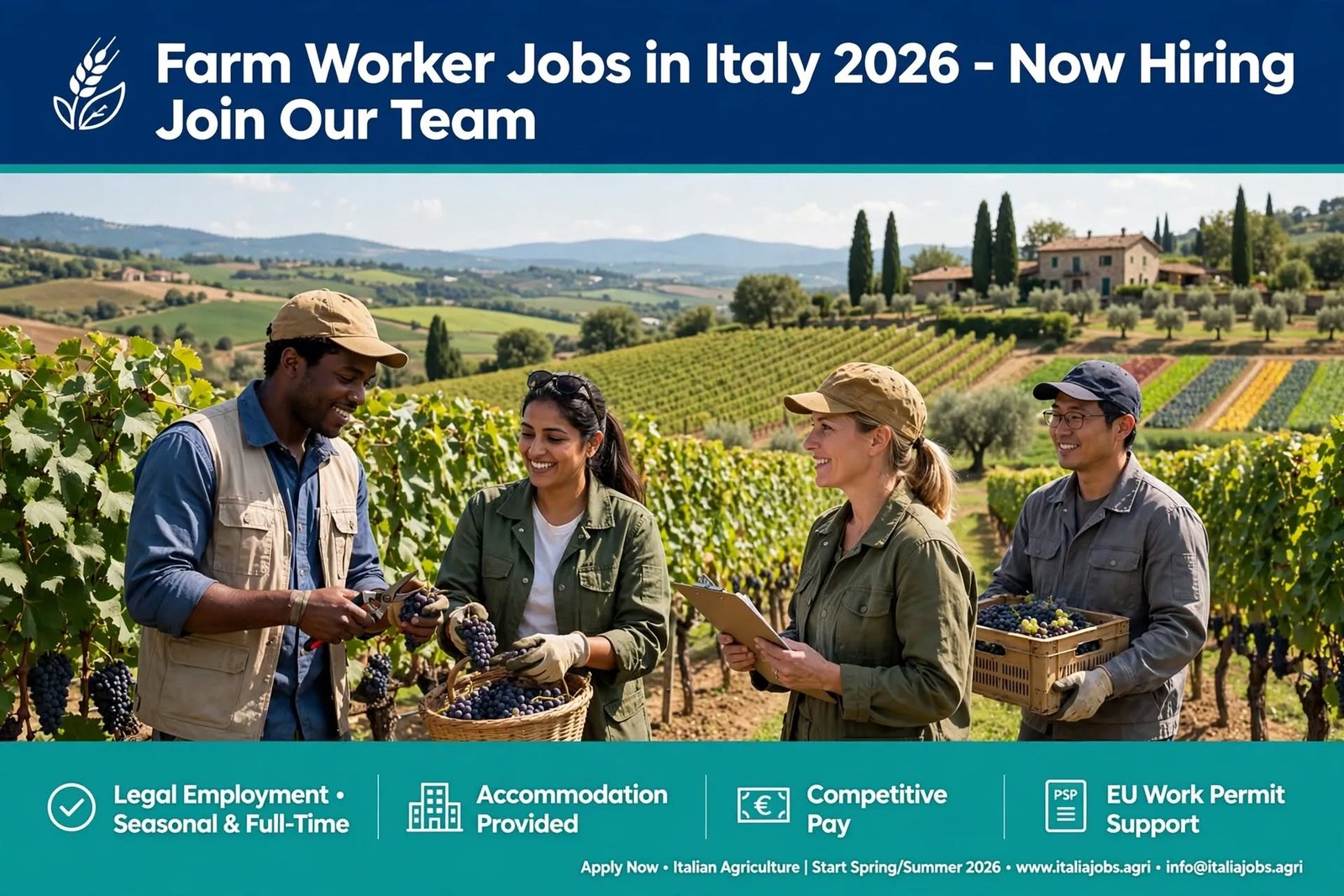
Italy is famous for its olive oil, wine, tomatoes, citrus, and apples. Behind every bottle and crate is a large workforce, and Italian farms depend heavily on foreign labor to bring in their harvests. That is why farm worker jobs in Italy attract thousands of applicants from outside Europe every year.
The path is legal, but it is not simple. It runs through a quota system, an employer-led application, and strict paperwork. It is also a favorite hunting ground for scammers who sell fake job offers. This guide explains how the system works, what the jobs involve, what you can expect to earn, and how to protect yourself.
Why Italy Needs Foreign Farm Workers
Italian agriculture is seasonal and labor-intensive. Many crops still need to be picked by hand, and the harvest window is short. At the same time, fewer young Italians want physically demanding farm work, so employers face a real shortage of labor during peak months.
The government responds with an annual programme that lets a fixed number of non-EU workers enter for agricultural and tourism jobs. This is why legal seasonal farm jobs in Italy exist at scale.
Understanding the Decreto Flussi: Italy’s Quota System
The Decreto Flussi (literally “flows decree”) is the law that sets how many non-EU workers may enter Italy each year. It is the foundation of almost every legal farm job offer for foreigners.
Read Also: Security Guard Jobs in Italy: Complete Guide
The 2026-2028 Quotas
The current three-year plan covers 2026 to 2028. A total of 497,550 third-country nationals will be admitted, with 164,850 in 2026. For seasonal work, the quotas are 88,000 for 2026, 89,000 for 2027 and 90,000 for 2028. A large share is earmarked for agriculture, with 47,000 per year reserved for applications submitted by agricultural employers’ organisations. Italy Approves 2026–2028 Immigration Quotas for Foreign Workers +2
In short, thousands of agricultural slots are available every year, but they are limited and competitive.
What “Click Day” Means
Quotas are handed out on a first-come, first-served basis through an online portal. Employers submit their applications at a set time, and this is called a click day. For 2026, the agricultural seasonal click day was January 12. The Ministry of Labour then assigned 40,075 agricultural seasonal quotas on that day. eiglawfiscal-focus
Here is what that means for you:
- You do not apply on click day. Your employer does.
- Employers had to pre-fill their applications in advance.
- Speed and correct paperwork matter, because the quota can run out.
What Happens to Unused Quotas
Not every slot is filled immediately. According to the Labour Ministry, after fifty days, unused quotas can be redistributed based on labour market needs. A separate guide notes that applications can be submitted until 31 December 2026, within the limits of the quotas. If you are researching this in late 2026, check the official portals for any remaining opportunities and for the 2027 schedule, which has not been confirmed in the sources I found. fiscal-focusdiritto
Who Can Apply? Eligible Countries
Eligibility depends on your nationality. The quota system gives priority to countries that cooperate with Italy on migration issues, so not every citizen of every country can apply. Italy’s official 2026-2028 instructions mention nationalities such as Pakistan, Sri Lanka, Bangladesh, and Morocco, among others. For some of these nationalities, including Bangladesh, Pakistan, Morocco and Sri Lanka, extra checks by the police headquarters and the labour inspectorate are required, and the silent-approval mechanism does not apply. diritto
In practice, applicants from these countries should expect longer processing times and a more careful review of the employer and the job offer. Always confirm your country’s status on the official Italian government sites before spending any money.
Types of Farm Worker Jobs in Italy
“Farm worker” covers a wide range of tasks. Here are the most common categories.
Harvesting and Fruit Picking
- Apples in Trentino and South Tyrol
- Grapes in Piedmont, Tuscany, Veneto, and Sicily
- Citrus in Sicily and Calabria
- Kiwi, peaches, and cherries in northern and central Italy
Vegetable and Tomato Work
- Tomato harvesting, especially in Puglia and Campania
- Greenhouse work for vegetables and flowers
- Sorting, washing, and packing produce
Olive Harvesting
- Hand-picking and net-collecting olives in the autumn and winter months
- Basic work at olive-pressing facilities in some regions
Livestock and Dairy
- Feeding and milking animals
- Cleaning barns and basic animal care, more common in non-seasonal contracts
Nurseries and Greenhouses
- Planting, pruning, and potting
- Packing and loading plants and flowers
Most seasonal roles are physically demanding. You will usually work outdoors in heat or cold, spend long hours on your feet, and lift or carry loads.
Seasonal vs. Non-Seasonal Agricultural Work
This is a key distinction for planning your future.
Seasonal Work Permits
- Tied to a specific harvest period
- Typically allow a stay of up to nine months, according to one industry guide
- Usually do not permit bringing family members
- Employers sometimes rehire workers in later seasons
Non-Seasonal (Year-Round) Work
- Longer contracts, such as livestock or greenhouse roles
- Subject to a separate and smaller quota
- A stronger basis for long-term residence
If you want a stable future in Italy, a seasonal contract can be a first step. Many workers return for several seasons and build a track record with the same employer.
Step-by-Step: How the Application Process Works
The process is employer-led. Here is the typical sequence.
- Find a genuine employer. The offer should come from a registered Italian agricultural business or an employers’ association, not a stranger on social media.
- The employer applies for a work permit (nulla osta). This is filed online through the Interior Ministry’s portal during the click day window.
- Authorities review the application. The Immigration Desk (Sportello Unico per l’Immigrazione), police, and labour offices check the employer and the offer.
- If approved, the nulla osta is issued. Your employer or association receives it.
- You apply for a visa. You submit the nulla osta and your documents at the Italian embassy or consulate in your country.
- You travel to Italy. After arrival, you sign the residence contract (contratto di soggiorno) and apply for a residence permit.
Documents You Will Typically Need
- A valid passport
- The approved nulla osta
- Proof of accommodation arranged by the employer
- A signed job contract or offer
- Passport photos and visa application forms
- Health insurance, where required
- A clean criminal record certificate, in some cases
Requirements can change, so always check the embassy’s current checklist.
Salary, Contracts, and Working Conditions
What You Can Expect to Earn
Agricultural wages in Italy are set by national collective agreements, which means employers cannot legally pay below the agreed minimum. Actual take-home pay depends on the region, the crop, hours worked, and whether accommodation costs are deducted. Many workers report earnings in the range of roughly €900 to €1,300 net per month for full-time seasonal work. Treat this as a rough guide, not a guarantee, and ask for the exact figures in writing.
Your Rights as a Worker
- A written contract in a language you understand
- Pay at least equal to the collective agreement minimum
- Social security contributions paid by your employer
- Rest days and limits on working hours
- Safe working conditions and protective equipment
- Proper accommodation if the employer provides it
Typical Working Day
Work often starts early in the morning, especially in summer, to avoid the heat. Expect six to eight hours of work, sometimes more during peak harvest. Weekends may be worked during busy weeks, but overtime must be recorded and paid.
Avoiding Scams: A Critical Warning
Because demand is high, fraud is widespread. Fake agents promise guaranteed jobs and visas in exchange for large payments. Some victims lose thousands of euros and never receive a legitimate offer.
Red Flags
- Guaranteed visa or job for a fee. Nobody can guarantee a quota slot.
- Requests for large upfront payments from “agents” or “consultants.”
- Offers received only through WhatsApp, Facebook, or TikTok.
- No named employer, no company registration number, or vague details.
- Pressure to pay quickly because “the quota is closing.”
- Fake documents such as forged nulla osta or embassy letters.
How to Protect Yourself
- Ask for the employer’s full legal name and tax number (partita IVA) and verify it independently.
- Remember that the employer files the application, not you. A worker should not pay for a job slot.
- Check official information on the Italian Ministry of Interior, Ministry of Labour, and embassy websites.
- Use licensed, registered recruitment services only, and keep every receipt.
- Never share your passport scans or bank details with unverified contacts.
If something feels too easy, it is probably a scam.
Practical Tips for Success
Prepare Physically and Mentally
Farm work is tiring. Build stamina before you go, and expect early starts, heat, and repetitive tasks.
Learn Basic Italian
A few hundred words go a long way. Greetings, numbers, tool names, and safety phrases will help you work better and avoid misunderstandings.
Budget Carefully
Calculate costs for travel, visa fees, insurance, and your first weeks of living expenses. Clarify what the employer covers and what will be deducted from your pay.
Keep Your Documents Safe
Never hand your passport to an employer or intermediary to hold. Keep copies of your contract, residence permit application, and pay slips.
Know Your Support Options
Italian trade unions and migrant-support organisations can help if you face unpaid wages or unsafe conditions. Learn their contact details before you travel.
Pros and Cons of Farm Work in Italy
Advantages
- A legal route to work and earn in Europe
- Contracts regulated by national agreements
- A chance to return in future seasons
- Experience that can help you build contacts and skills
- Possible pathways to longer-term work permits
Challenges
- Physically demanding labor
- Competitive and limited quotas
- Long processing times for some nationalities
- Risk of exploitation if you work with unscrupulous employers
- Seasonal income that may not be continuous
Weigh these honestly before you commit time and money.
Conclusion
Farm worker jobs in Italy are real, legal, and available every year, but only through the official quota system and a genuine employer. The Decreto Flussi 2026-2028 opens tens of thousands of agricultural slots, yet the process is competitive, document-heavy, and slow for certain nationalities. Your best strategy is to stay informed, verify every offer, and never pay for a “guaranteed” job. With patience and careful preparation, a seasonal contract can become a stepping stone to a stable future.
Frequently Asked Questions (FAQ)
1. Can I apply directly for farm jobs in Italy?
Not for the quota route. The employer submits the application for the work permit. You then apply for the visa once the permit is approved.
2. How many agricultural seasonal slots are available?
The 2026 seasonal quota is 88,000 across agriculture and tourism, with a large portion for agriculture. The first agricultural click day took place on January 12, 2026.
3. Is it too late to apply in 2026?
The main agricultural click day has passed, but applications can still be submitted until December 31, 2026, within remaining quotas, and unused slots may be redistributed. Check the official portals for the 2027 schedule.
4. Do I need to know Italian?
It is not usually a legal requirement for seasonal farm work, but basic Italian greatly improves your safety, communication, and employability.
5. How long can I stay on a seasonal permit?
Seasonal permits are tied to the work period and, according to one industry guide, last up to nine months. Family reunification is typically not allowed.
6. Can a seasonal permit lead to long-term residence?
Possibly. Repeated seasonal work and conversion to a non-seasonal contract can create a path, but rules change, so check current regulations.
7. Should I pay an agent?
Be extremely cautious. Legitimate employers apply on your behalf, and nobody can guarantee a quota slot. Verify any recruiter through official channels.
Disclaimer: Immigration rules, quotas, and dates change often. Confirm all details with the Italian Ministry of Interior, the Ministry of Labour, or the Italian embassy or consulate in your country before making decisions.