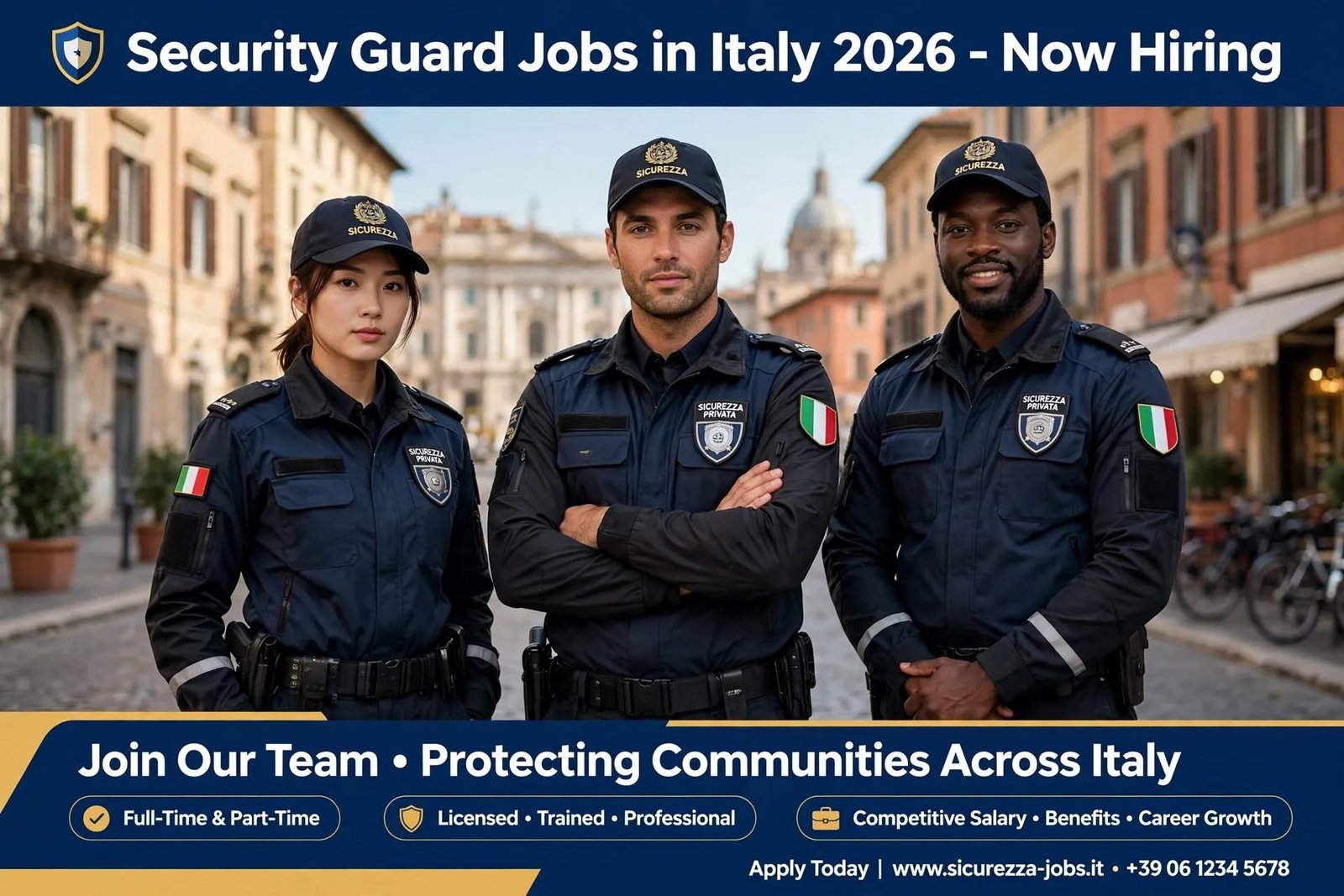
Every year, thousands of people search for security guard jobs in Italy. The reasons are easy to understand. Italy has a large tourism sector, busy cities, major retail chains, logistics hubs, and a steady demand for people who can keep places safe.
But there is a gap between what many websites promise and what is actually true. Social media is full of posts that claim “guaranteed security guard jobs in Italy with visa.” Most of these are exaggerated, and some are outright scams.
This guide gives you the honest picture. You will learn which security roles exist in Italy, which of them are open to foreigners, what the rules say about licences and language, what you can realistically earn, and how to approach the job search safely. Read it fully before you spend a single rupee, dirham, or euro on any “agent.”
Understanding the Private Security Sector in Italy
Italy’s private security industry is regulated far more strictly than in many other countries. Security is treated as a matter of public order, so the state controls who can work in it.
In practice, the sector splits into two broad groups:
- Armed or licensed security (vigilanza privata): work done by sworn guards who hold official authorisation.
- Unarmed or auxiliary security (servizi fiduciari and ancillary services): reception, access control, monitoring, and event stewarding.
Knowing this difference is the single most important step in your research, because the rules, eligibility, and pay are not the same for each.
Types of Security Guard Jobs in Italy
1. Guardia Particolare Giurata (Sworn Private Guard)
The guardia particolare giurata (GPG) is the closest thing to a “traditional” licensed security guard. These guards protect property, valuables, and transport, and some carry weapons. They must be approved by the local Prefettura (prefecture) and take an oath.
Read Also: Driver Jobs in Italy
Important: This role has strict eligibility rules, including citizenship requirements. In general, it is reserved for Italian and EU citizens, so most non-EU applicants cannot take this path.
2. Servizi Fiduciari (Unarmed Fiduciary Services)
This is the largest area for entry-level staff. Duties include:
- Front desk and reception security in offices, hospitals, and residential buildings
- Access control at gates and entrances
- CCTV and alarm monitoring
- Patrolling corporate premises
- Visitor registration and badge checks
These workers are not sworn guards and do not carry weapons, which makes the role more accessible. Employers still expect solid Italian, a clean record, and the right to work in Italy.
3. Event and Venue Security (Stewards and Door Staff)
Concerts, football stadiums, nightclubs, and festivals hire stewards and door staff. In Italy, people who work as door staff at entertainment venues generally have to be registered on an official list kept by the prefecture and complete a recognised training course. Stadium stewarding has its own training standards.
4. Retail and Shopping Centre Security
Supermarkets, malls, and fashion outlets hire guards to prevent theft and manage crowds. These are often part-time or shift-based.
5. Night Watch and Site Security
Construction sites, warehouses, and industrial areas need people overnight. These jobs are physically undemanding but involve long, isolated hours.
6. Port, Airport, and Transport Security
Airports and ports have specialised screening roles. These typically require additional certification, background checks, and, in many cases, European citizenship or long-term residence.
Who Can Work as a Security Guard in Italy?
Eligibility depends on the type of job, but the common requirements are:
- Age: at least 18 years old
- Clean criminal record: no serious convictions, and a certificate to prove it
- Right to work: Italian or EU citizenship, or a valid residence permit that allows employment
- Physical and mental fitness: a medical certificate may be required
- Education: usually a basic school-leaving level
- Training: a recognised course for the role
- Italian language skills: at least functional, since you will deal with the public and write reports
Can Non-EU Foreigners Work in Security in Italy?
This is the question most readers care about, so here is a direct answer.
- For sworn guard (GPG) roles, non-EU nationals are generally not eligible.
- For unarmed and auxiliary roles, a non-EU national can work only if they have a valid permit to work in Italy.
- Italian law does not allow someone to simply fly in on a tourist visa and start working. A tourist or visit visa does not permit employment.
If you are outside the EU, your realistic routes are described below.
How Non-EU Citizens Can Legally Work in Italy
The Decreto Flussi (Annual Quota System)
Italy issues a limited number of work entry permits each year through a government framework known as the Decreto Flussi. An Italian employer applies for a permit on behalf of a named worker, and quotas are divided into categories such as seasonal work, agriculture, construction, tourism, and domestic care.
Two points matter for security job seekers:
- Security guard work is not a typical quota category. Quotas focus on other sectors, so a direct “security guard visa” is rarely, if ever, what an employer can obtain.
- Applications open on specific dates, and demand is far higher than the number of places.
Always check the current decree and the official announcements, since the rules, quotas, and sectors change from year to year.
Other Legal Routes
If you want to end up in Italy’s security sector, consider paths that give you legal work rights first:
- Study visa: after studying in Italy, you may be able to convert your permit to a work permit in some cases.
- Family reunification: if a close relative is a legal resident, you may qualify to join them with work rights.
- EU Blue Card or skilled-worker routes: these target qualified professionals, not entry-level guards.
- Long-term residence: once you hold legal residence, you can apply for jobs that need the right to work.
- Moving through another EU country: an EU residence permit does not automatically give you the right to work in Italy, so check the rules before relying on this.
The honest summary: a direct path from a non-EU country to a security guard job in Italy is very hard to find legitimately. Anyone who tells you otherwise deserves suspicion.
Training and Licences You May Need
For Door Staff and Event Security
Italy requires people working at the entrance of entertainment venues to complete a recognised training course and be entered on a prefecture list. Courses typically cover:
- Laws and rules relevant to venues
- Conflict management and de-escalation
- Basic first aid
- Fire safety awareness
- Communication with the public
For Sworn Guards (GPG)
The process involves an application to the prefecture, background checks, qualification and training requirements, and the oath. Armed roles add weapons training and licensing.
Useful Extra Certificates
Even where not mandatory, these improve your chances:
- First aid and CPR certificate
- Fire safety (antincendio) certification
- Workplace safety training (D.Lgs. 81/2008 basics)
- Italian language certificate (A2 or B1 is a sensible target)
Security Guard Salary in Italy
Pay depends on the contract, the region, the employer, and the role. Many employees in this sector are covered by a national collective agreement, often called the CCNL for Servizi Fiduciari or the agreement for private security (vigilanza privata), which sets minimum pay by level.
As a rough orientation:
- Entry-level unarmed guards usually earn modest monthly wages, often in the range of around €900 to €1,300 net per month, depending on hours and overtime.
- Sworn guards (GPG) and specialised roles tend to earn more.
- Night shifts, weekends, and holidays attract premiums.
- Employees also receive benefits such as severance pay accrual (TFR), paid leave, and social contributions.
These are approximate figures and they change with contract renewals. Before accepting any offer, check the current collective agreement and the written contract.
Cost of Living Matters
A wage that looks decent on paper goes less far in Milan, Rome, or Bologna than in smaller towns in the south. Rent is usually your biggest expense. Compare the salary against local housing costs before deciding where to apply.
Where Are Security Jobs Most Common?
Demand is strongest in:
- Lombardy (Milan): corporate offices, fairs, retail, and events
- Lazio (Rome): government buildings, tourism, and hospitals
- Veneto and Emilia-Romagna: logistics and industrial zones
- Tuscany and Campania: tourism, hospitality, and ports
- Tourist coasts and islands: seasonal demand in summer
Skills That Help You Get Hired
Employers look for more than physical size. Strong candidates show:
- Good Italian communication, written and spoken
- Calm judgement under pressure
- Reliability and punctuality
- Observation and report-writing skills
- Basic tech comfort with CCTV, access systems, and scanning devices
- Customer service attitude
- Physical fitness and stamina
- Honesty, since you will be trusted with property and sensitive information
Other languages, especially English, are a bonus in hotels, airports, and international companies.
How to Find Security Guard Jobs in Italy Safely
Step 1: Confirm Your Legal Status
Before applying, be clear about whether you have the right to work. Employers must verify this and will not hire without it.
Step 2: Learn Italian
Even basic Italian opens doors. Aim for at least A2 and keep improving.
Step 3: Complete Relevant Training
Take recognised courses for your target role and keep your certificates organised.
Step 4: Search Through Reliable Channels
- Italian job portals such as Indeed Italia, InfoJobs, and Subito Lavoro
- Employment centres (Centri per l’Impiego) run by regional authorities
- Websites of established security companies that publish vacancies
- Staffing agencies (agenzie per il lavoro) that are authorised and registered
Step 5: Prepare an Italian-Style CV
Keep it clear and concise. Include your contact details, training, languages, and relevant experience. Italian employers often expect a short consent line for personal data processing.
Step 6: Verify Every Offer
Research the company, confirm that it really exists, and check that the contract matches what was promised.
Beware of Job Scams
Because the demand for work in Europe is so high, scammers target hopeful applicants. Watch for these red flags:
- Upfront fees for a “guaranteed” visa or job
- Offers with no interview, no contract, or no company details
- Messages only on WhatsApp or social media from unverified accounts
- Requests to pay through gift cards, crypto, or personal accounts
- Promises of a work visa for roles outside the quota system
- Pressure to decide quickly
Remember that a legitimate employer applying for a work permit follows an official process through Italian authorities. No agent can “buy” you a visa. If in doubt, contact the Italian embassy or consulate in your country, and check the official Italian immigration portal for the current procedure.
Pros and Cons of Working in Italian Security
Advantages
- Steady demand across many cities
- Regulated contracts with social protections
- Entry point into the Italian labour market for those who are legally eligible
- Career growth into supervisor, coordinator, or control-room roles
- Opportunities for training and specialisation
Challenges
- Strict eligibility rules, especially for sworn guards
- Language barrier
- Moderate starting wages
- Shift work with nights, weekends, and holidays
- Competition for quota-based permits
Career Growth in the Security Industry
With experience and training, a guard can move into roles such as:
- Team leader or shift supervisor
- Control room operator
- Security coordinator for events or facilities
- Risk and safety assistant
- Security manager (with further qualifications)
Some people also use security work as a stepping stone while they learn the language and build a path to other careers.
Conclusion
Security guard jobs in Italy exist, and the sector offers real opportunities for people who are legally allowed to work there and who prepare properly. But the picture is more demanding than many online posts suggest. Sworn guard roles are largely limited to Italian and EU citizens, unarmed and event roles require the right to work and often Italian language skills, and a direct “security guard visa” for non-EU applicants is not a realistic promise.
Your best strategy is simple. Secure legal work rights through a genuine route, learn Italian, earn the right certificates, search through trusted channels, and never pay anyone who guarantees a job or visa. Patience and verified information will protect both your money and your future.
Frequently Asked Questions (FAQ)
1. Can foreigners get security guard jobs in Italy?
Yes, in some unarmed and auxiliary roles, but only with a valid permit to work. Sworn guard (GPG) positions are generally restricted to Italian and EU citizens.
2. Is there a work visa specifically for security guards?
Not as a standard category. Work permits for non-EU citizens usually go through the annual Decreto Flussi or other legal routes, and security is not a typical quota sector. Check official announcements for current rules.
3. Do I need to speak Italian?
In practice, yes. You will interact with the public, read instructions, and write reports. Aim for at least A2 or B1.
4. How much do security guards earn in Italy?
Entry-level unarmed guards often earn roughly €900 to €1,300 net per month, depending on hours, location, and contract. Specialised roles can pay more. Figures change, so verify the current collective agreement.
5. Can I come to Italy on a tourist visa and look for work?
No. A tourist visa does not allow employment, and working without authorisation can lead to fines, deportation, and bans on future entry.
6. Do security guards in Italy carry weapons?
Only certain licensed sworn guards do, after specific authorisation and training. Most guards in fiduciary and event roles are unarmed.
7. How can I avoid fake job offers?
Never pay upfront fees, verify the employer independently, insist on a written contract, and use official channels such as embassies, regional employment centres, and registered agencies.
8. Which Italian cities have the most security jobs?
Large cities such as Milan and Rome lead, along with industrial areas in the north and tourist regions during summer.
Disclaimer: Laws, quotas, wages, and licensing rules in Italy change regularly. Confirm current requirements with official Italian government sources or the nearest Italian embassy before making any decisions.
1 thought on “Security Guard Jobs in Italy: Complete Guide”