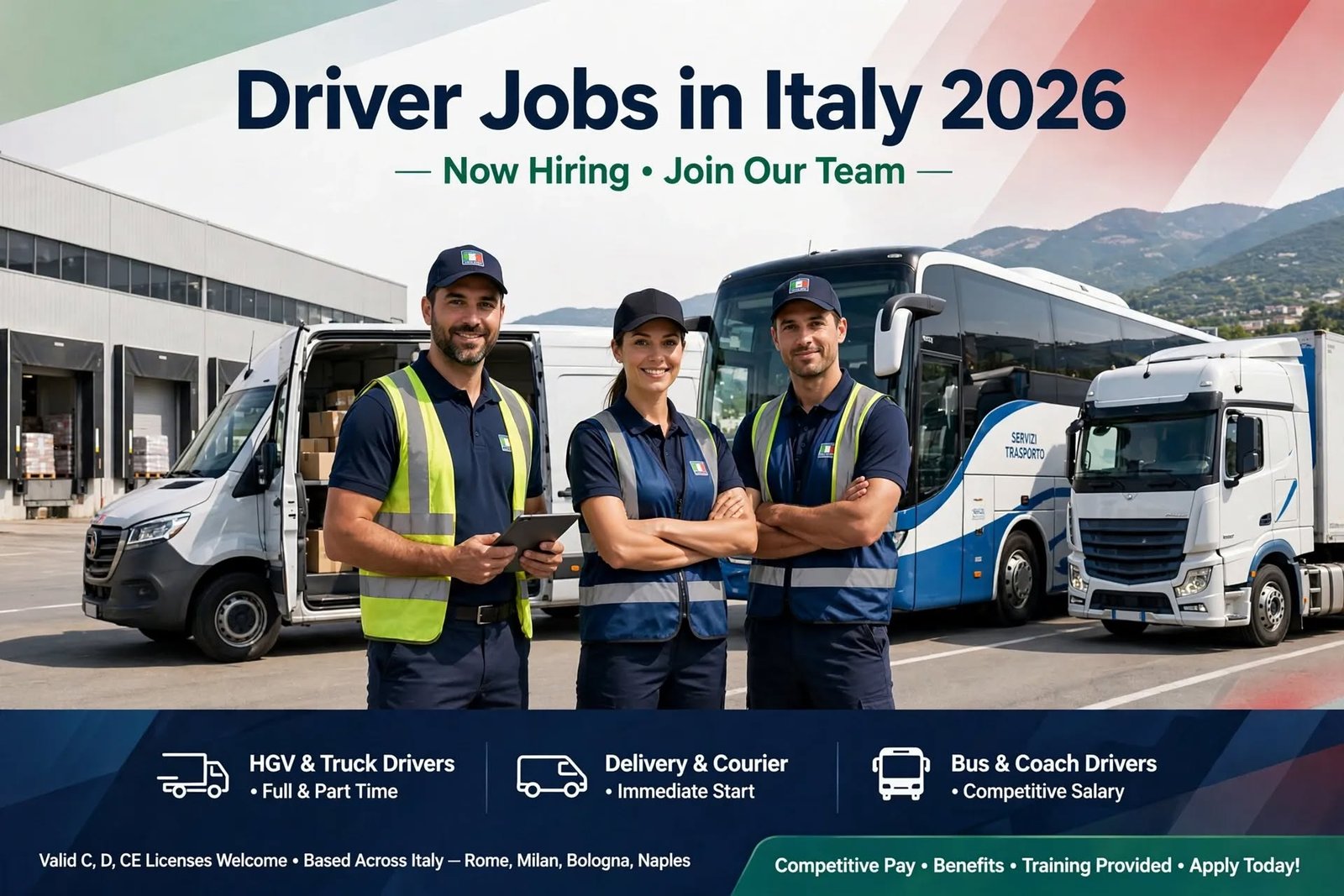
Every morning, thousands of trucks leave warehouses in Lombardy, Veneto, and Emilia-Romagna carrying fashion, food, machinery, and e-commerce parcels across Europe. Behind each one is a professional driver, and Italy does not have enough of them.
That is why driver jobs in Italy have become one of the most talked-about work opportunities for skilled workers from abroad. Italian transport associations have warned for years about a growing shortage of qualified drivers, while the country’s logistics sector keeps expanding with online shopping and cross-border trade.
But the opportunity comes with rules: licences, professional qualifications, work permits, and language expectations. There are also plenty of fake job offers online.
This guide explains how the system works, what employers expect, what you can realistically earn, and how to apply safely.
Why Italy Needs So Many Drivers
A Country Built on Road Transport
Italy moves most of its goods by road. Its geography, with mountains, long coastlines, and dense industrial districts, makes trucks the backbone of freight. From the northern manufacturing belt to the ports of Genoa, La Spezia, and Naples, roads connect nearly every supply chain.
Read Also: Packing Jobs in Italy
The Driver Shortage
Several factors have created a persistent gap in the workforce:
- An ageing workforce: many experienced drivers are retiring faster than young people are entering the profession.
- High training costs: getting a C or CE licence plus the professional qualification can be expensive for young Italians.
- Lifestyle concerns: long periods away from home discourage many local applicants.
- Growing e-commerce: parcel and last-mile delivery demand keeps rising.
For foreign workers, this shortage is a genuine opening, provided they follow the legal route.
Types of Driver Jobs Available in Italy
Not all driving jobs are the same. Here are the main categories.
1. Long-Haul and International Truck Driver Jobs
These drivers operate heavy vehicles (tractor-trailers and articulated lorries) between Italian regions or across Europe. This role usually pays the most because of overtime, travel allowances, and the responsibility involved. It requires a CE licence and a valid CQC.
2. Regional and Distribution Drivers
These drivers deliver goods within a region, often returning home daily or weekly. It suits people who want better work-life balance. The work includes supermarket supply, construction materials, and industrial distribution.
3. Delivery Van and Courier Drivers
With a standard category B licence, you can drive vans for courier companies and local delivery firms. Entry barriers are lower, but pay is generally lower too, and the work is physically demanding.
4. Bus and Coach Driver Jobs
Public transport companies and private tour operators hire bus drivers (category D). This work needs a CQC for passenger transport and often a stronger command of Italian, since you deal directly with passengers.
5. Specialised Drivers
- Tanker drivers (fuel and chemicals), who need an ADR certificate for dangerous goods
- Refrigerated transport drivers for food and pharmaceuticals
- Car carrier and heavy-haul drivers
- Private chauffeurs and NCC drivers (hire cars with driver)
Specialised roles usually pay more because they require extra certification.
Essential Requirements for Driver Jobs in Italy
Driving Licence Categories
| Category | Vehicle type |
|---|---|
| B | Cars and small vans |
| C | Rigid trucks over 3.5 tonnes |
| CE | Trucks with trailers (articulated) |
| D | Buses |
The CQC (Carta di Qualificazione del Conducente)
The CQC is the Driver Qualification Card, and it is mandatory for professional drivers of heavy goods vehicles and passenger vehicles. There are two versions, one for goods and one for passengers. It must be renewed periodically (every five years) through mandatory training hours.
Digital Tachograph Card
Professional drivers use a personal tachograph card to record driving and rest time. It is issued by the Italian authorities, usually through the local Chamber of Commerce.
ADR Certificate (If Applicable)
Anyone transporting hazardous materials needs this certification.
Medical Fitness
Professional drivers must pass medical checks, including vision and general health, to hold and renew their licence categories.
Italian Language Skills
You do not need to be fluent on day one, but basic Italian (A2 to B1 level) makes a big difference. Road signs, loading documents, communication with dispatchers, and police checks all happen in Italian. English alone will rarely be enough.
Can Foreign Drivers Use Their Home Licence in Italy?
This is one of the most misunderstood topics.
- EU/EEA licences are recognised across Italy.
- Non-EU licences can be converted to an Italian licence only if Italy has an agreement with the issuing country. Without such an agreement, you will generally need to pass Italian theory and practical exams.
- Even where conversion is possible, heavy vehicle categories and the CQC often require additional steps.
Rules and agreements change, so always confirm the current position with the Motorizzazione Civile (Italy’s vehicle licensing authority) or an Italian embassy before making plans. Do not rely on a recruiter’s word alone.
How Non-EU Citizens Can Get Driver Jobs in Italy Legally
Italy generally does not let non-EU citizens simply arrive and look for work. The usual path is through an employer sponsorship system.
The Decreto Flussi (Annual Quota System)
Each year, the Italian government issues a Decreto Flussi, which sets quotas of non-EU workers allowed to enter for employment. Transport and logistics have been among the sectors where employers seek workers. The process, in simplified form, looks like this:
- An Italian employer applies for authorisation during the official application windows (often called “click days”).
- The Sportello Unico per l’Immigrazione (one-stop immigration office) reviews the request and issues a nulla osta (work authorisation) if approved.
- You apply for a work visa at the Italian embassy or consulate in your country, using the nulla osta.
- You travel to Italy and sign the employment contract.
- You apply for a permesso di soggiorno (residence permit) within the legal deadline after arrival, typically eight working days.
Important Points
- The employer must initiate the process. A worker cannot apply for the quota alone.
- Quotas are limited and competitive, and rules can change each year.
- Having your driving qualifications ready in advance makes you far more attractive to employers.
Always check the latest details on official sources such as the Italian Ministry of Interior, the Ministry of Foreign Affairs (visa information), and your nearest Italian consulate.
Driver Salary in Italy: What Can You Expect?
Pay depends on the type of job, experience, region, and employer. As a general idea (figures are approximate and vary):
| Job type | Approximate monthly net income |
|---|---|
| Delivery van / courier driver | €1,200 to €1,700 |
| Regional truck driver | €1,400 to €1,900 |
| International long-haul driver | €1,700 to €2,500+ |
| Specialised (ADR, tanker, refrigerated) | Often higher |
What Affects Your Pay?
- Collective labour agreements (CCNL): the transport and logistics sector has national contracts that set minimum pay levels, overtime rates, and benefits.
- Travel allowances (indennità di trasferta): long-haul drivers often receive daily allowances on top of base salary.
- Overtime and night work: these increase earnings.
- Experience and certifications: more qualifications mean better offers.
Cost of Living Matters
Salaries look different depending on where you live. Milan and Rome are expensive, especially for rent, while smaller cities in the north and south offer cheaper housing. Many drivers save money because they spend long periods on the road with employer-paid or low-cost accommodation.
Working Conditions and Driving Rules
Italy follows EU driving time regulations, designed to keep drivers and roads safe. In broad terms:
- Maximum 9 hours of driving per day (extendable to 10 hours twice a week)
- A 45-minute break after 4.5 hours of driving
- Limits on weekly and fortnightly driving time
- Minimum daily and weekly rest periods
Your tachograph records all of this, and inspectors can check it at roadside stops. Violations lead to fines for both drivers and companies, so reputable employers take compliance seriously.
Other realities worth knowing:
- Italian toll roads (autostrade) are common, and companies usually handle toll costs.
- Heavy vehicles face weekend and holiday driving restrictions on certain roads.
- Mountain routes and winter weather need careful driving.
Best Regions and Cities for Driver Jobs in Italy
Northern Italy
The north is the economic engine of the country and offers the largest number of logistics jobs.
- Lombardy (Milan, Bergamo, Brescia): warehouses, distribution hubs, and manufacturing.
- Veneto (Verona, Padua, Treviso): strong export industries and a major logistics corridor.
- Emilia-Romagna (Bologna, Parma, Modena): food production, machinery, and a central transport crossroads.
- Piedmont (Turin): automotive and industrial freight.
Central and Southern Italy
- Rome and Lazio: distribution for the capital region.
- Campania (Naples): port-linked transport and food logistics.
- Puglia and Sicily: agricultural freight, though wages are often lower.
Ports
Genoa, La Spezia, Livorno, Trieste, and Naples employ many container and port-transfer drivers.
How to Find Driver Jobs in Italy
Where to Look
- Italian job portals such as Indeed Italia, InfoJobs, and Subito Lavoro
- Company career pages of logistics firms and transport cooperatives
- Temporary employment agencies (agenzie per il lavoro) that specialise in transport
- EURES, the European job mobility network, which advertises verified vacancies
- LinkedIn, especially for larger logistics companies
Prepare a Strong Application
- Write a clear CV with licence categories, years of experience, and vehicle types you’ve driven.
- Include certifications such as CQC, ADR, and tachograph experience.
- Add a short cover letter, ideally in Italian or at least simple English.
- Keep scanned copies of your documents ready.
- Be ready to demonstrate your driving skills or take a practical test.
Tips for Standing Out
- Learn basic Italian before applying, since it signals commitment.
- Gain international driving experience if you can.
- Show a clean driving record.
- Be flexible about location and shifts.
Beware of Job Scams
Because demand for drivers is high, fraudsters target hopeful applicants. Protect yourself:
- Never pay a recruiter or “agent” for a guaranteed job offer. Legitimate employers do not charge workers to hire them.
- Be suspicious of offers that arrive out of nowhere on WhatsApp or social media.
- Verify the company’s registration, address, and website independently.
- Confirm that the job offer is linked to the official Decreto Flussi procedure, and check the nulla osta status through official channels.
- Be wary of anyone promising a visa regardless of the legal process.
- Never send your passport copies or bank details to unverified contacts.
If it sounds too easy, it probably is.
Step-by-Step Roadmap to Becoming a Driver in Italy
- Check your licence situation: find out whether your category can be converted or whether you need Italian exams.
- Gain or document experience: especially with heavy vehicles.
- Learn basic Italian: aim for A2 first, then improve.
- Research verified employers: focus on companies familiar with hiring foreign workers.
- Follow the official work-visa route: employer application, nulla osta, visa, then residence permit.
- Complete required qualifications in Italy: CQC, tachograph card, and any other certification needed.
- Settle in: register your residence, open a bank account, and understand your contract and payslip.
Pros and Cons of Driving Jobs in Italy
Advantages
- Strong, ongoing demand for drivers
- Legal employment with contributions, healthcare access, and paid leave
- Opportunities for career growth into dispatch, fleet management, or your own transport business
- Chance to live and work in the European Union
Challenges
- Strict licensing and qualification requirements
- Language barrier in the early months
- Time away from family on long-haul routes
- Competitive and limited visa quotas
Conclusion
Driver jobs in Italy offer a real, legal pathway to stable work in Europe, backed by a genuine labour shortage. But success depends on preparation: understanding your licence status, earning the required CQC, learning some Italian, and following the official sponsorship process through a genuine employer.
Take it step by step, rely on official sources, and never pay for a “guaranteed” job. With patience and the right documents, a driving career in Italy can be both rewarding and financially worthwhile.
Frequently Asked Questions (FAQ)
1. Is there a shortage of drivers in Italy?
Yes. Transport associations have repeatedly reported a shortage of qualified truck and bus drivers, driven by retirements and low recruitment of younger workers.
2. Can I work as a driver in Italy without speaking Italian?
It is very difficult. Basic Italian is needed for safety, documents, and communication. Some employers may accept beginner-level Italian if you improve quickly.
3. What is the CQC and do I need it?
The CQC is the professional qualification card required for drivers of heavy goods vehicles and passenger transport. If you drive trucks or buses professionally, you need it.
4. Can I convert my foreign driving licence in Italy?
Only if Italy has a recognition agreement with the country that issued your licence. Otherwise, you will likely need to pass the Italian driving exams. Check with the Motorizzazione Civile.
5. How much does a truck driver earn in Italy?
Typically around €1,400 to €2,500 per month net, depending on whether the job is regional or international, plus allowances and overtime. Figures vary by employer and contract.
6. How can a non-EU citizen get a driver job in Italy?
Through an employer who applies under the annual Decreto Flussi quota, followed by a work visa and a residence permit.
7. Do I have to pay an agency to get a job?
No. Be very cautious of anyone asking for money in exchange for a job offer or visa.
8. Which Italian cities have the most driver jobs?
Milan, Bergamo, Brescia, Verona, Padua, Bologna, Turin, and the major port cities such as Genoa offer the largest number of opportunities.
Disclaimer: Visa rules, quotas, and licence recognition agreements change frequently. Verify current details with the Italian Ministry of Interior, the Motorizzazione Civile, or your nearest Italian consulate before making decisions.
1 thought on “Driver Jobs in Italy: The Complete Guide to Requirements, Salaries, and Visas”