Every day, thousands of people open Google and type the same kind of question: What are the best jobs in Canada right now? Some are students planning their futures. Some are professionals tired of their current roles. A large number are newcomers hoping to build a new life in one of the world’s most welcoming countries.
Canada’s job market is unusual. It has an aging population, a steady stream of immigration, and a long list of industries that struggle to find enough workers. That combination creates real opportunity, and it shapes what people search for online.
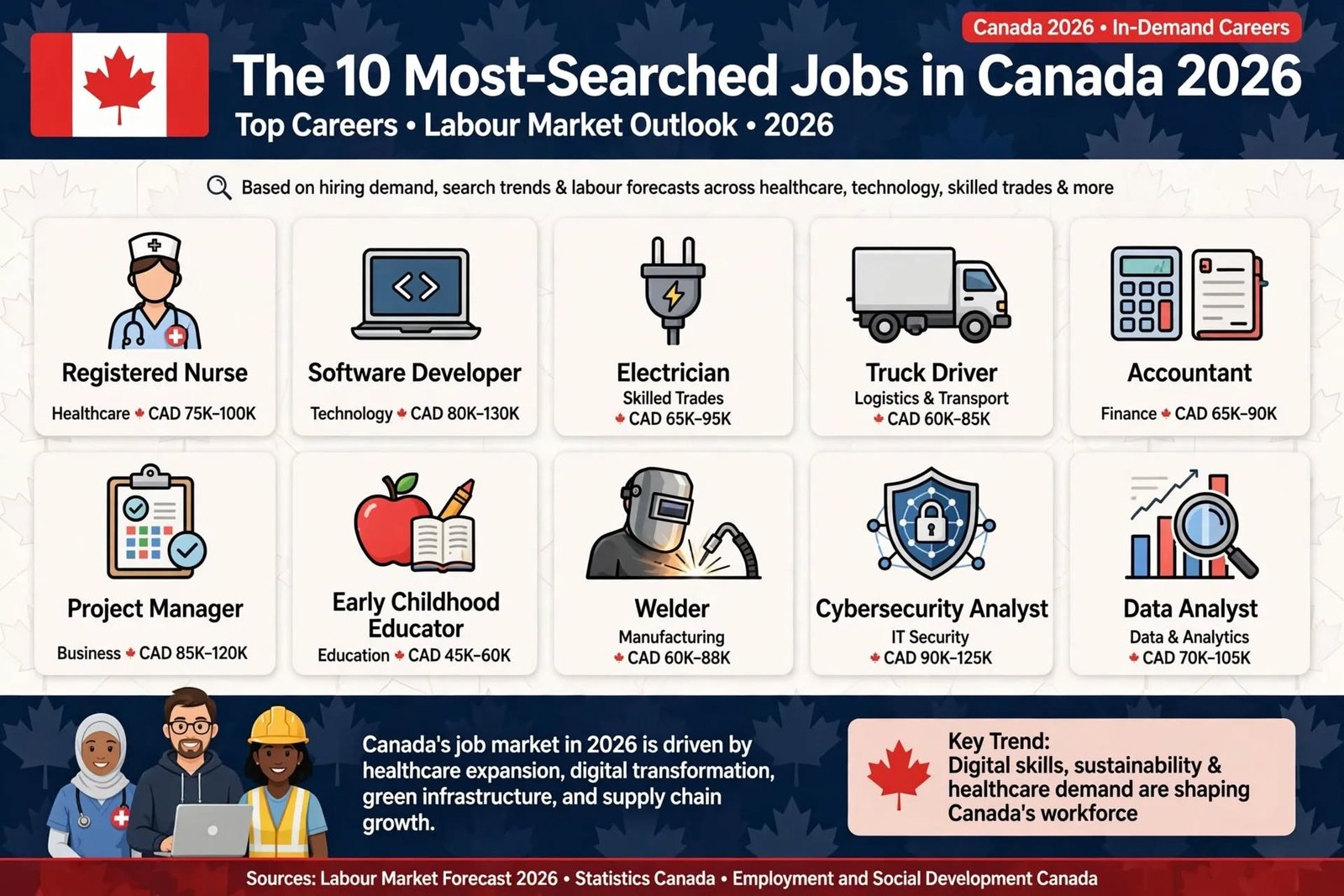
In this guide, we look at the 10 most-searched jobs in Canada this year. For each one, you’ll learn what the job involves, what it typically pays, why people are so interested, and what it takes to get started. Whether you’re searching for jobs in Canada for immigrants, high-paying careers, or jobs without a degree, you’ll find something useful below.
How We Chose These Jobs
This list is based on consistent online search interest, hiring demand reported by government sources such as Job Bank Canada, and the sectors that employers talk about most often when discussing labour shortages. Search interest changes by season and by province, so treat the order as a guide, not a fixed ranking.
Salary figures are approximate ranges and vary by province, employer, and experience. Always confirm current numbers on official sources before making career decisions.
Read Also: Highest-Paying Careers in Canada in 2026
Why Are Certain Jobs Searched So Often in Canada?
Three forces drive most of the interest:
- An aging population. More Canadians are retiring than entering the workforce, which creates constant demand in healthcare and skilled trades.
- Immigration. Newcomers actively research which occupations offer a pathway to work permits and permanent residency.
- Flexibility and remote work. Since the pandemic, many people search for roles they can do from home or with flexible schedules.
With that context, here is the list.
The Top 10 Most-Searched Jobs in Canada
1. Registered Nurse
Nursing is almost always at the top of any list of in-demand jobs in Canada. Hospitals, clinics, and long-term care homes across every province need more nurses than they can find.
- Typical pay: roughly CAD $75,000 to $110,000 per year, with overtime and northern postings often paying more
- Education: a nursing degree plus provincial licensing
- Why people search for it: strong job security, clear career growth, and priority treatment in many immigration programs
If you trained abroad, expect a credential assessment process. It takes time, but many provinces have been streamlining it.
2. Personal Support Worker (PSW)
Personal support workers help seniors and people with disabilities with daily care, either in homes or in care facilities. Because Canada’s senior population is growing quickly, this is one of the fastest-growing entry points into healthcare.
- Typical pay: about $20 to $30 per hour, depending on province and setting
- Education: a short college certificate, usually under a year
- Why people search for it: low barrier to entry, quick training, and abundant openings
Many people use PSW work as a first step toward nursing or other health careers.
3. Software Developer
Despite headlines about tech layoffs, software development remains one of the most-searched careers in Canada. Toronto, Vancouver, Waterloo, and Montreal all have thriving tech scenes.
- Typical pay: about $75,000 to $130,000 or more, with senior roles going well beyond that
- Skills in demand: Python, JavaScript, cloud platforms, and increasingly AI and machine learning
- Why people search for it: high salaries and the option to work remotely
The entry-level market is more competitive than a few years ago, so a strong portfolio matters.
4. Electrician
Skilled trades are having a moment, and electricians lead the pack. Construction, renewable energy projects, and the shift to electric vehicles all require qualified electrical workers.
- Typical pay: around $30 to $50 per hour, with strong earning potential for those who run their own business
- Training: a paid apprenticeship, usually four to five years, ending in a Red Seal certification
- Why people search for it: you earn while you learn, and student debt is minimal
The Red Seal designation lets you work across provinces, which adds flexibility.
5. Truck Driver
Canada is enormous, and almost everything you buy has traveled by truck at some point. Long-haul and local delivery drivers remain constantly in demand.
- Typical pay: about $25 to $40 per hour, with higher earnings for long-haul and specialized loads
- Requirements: a commercial licence (Class 1 or Class 3), plus a clean driving record
- Why people search for it: quick entry, steady work, and frequent employer sponsorship
Newcomers search this role heavily, but check rules around licence conversion and employer requirements in your province.
6. Warehouse Worker
The growth of online shopping has made warehouse and logistics jobs some of the most accessible jobs in Canada. Roles range from picking and packing to forklift operation and inventory control.
- Typical pay: roughly $18 to $28 per hour
- Requirements: usually none beyond a willingness to work shifts; a forklift certificate helps
- Why people search for it: fast hiring, no degree needed, and chances to move into supervisor roles
It is physically demanding work, but it is a common stepping stone for people new to the country.
7. Data Analyst
Businesses of every size want people who can turn numbers into decisions. Banks, retailers, hospitals, and government agencies all hire data analysts.
- Typical pay: around $60,000 to $95,000 per year
- Skills in demand: Excel, SQL, Power BI or Tableau, and basic statistics
- Why people search for it: good pay, remote-friendly options, and a lower barrier than software engineering
Many people enter the field through online certificates or a bootcamp rather than a full degree.
8. Customer Service Representative (Remote)
Searches for work from home jobs in Canada are consistently strong, and customer service is the most common remote category. Call centres, e-commerce companies, and banks all hire remotely.
- Typical pay: about $17 to $27 per hour
- Skills in demand: clear communication, patience, and bilingual ability (English and French) for premium roles
- Why people search for it: flexible schedules and no commute
Speaking French can noticeably increase your options and pay, especially for roles tied to Quebec or federal services.
9. Early Childhood Educator
With expanded child care programs across Canada, demand for early childhood educators (ECEs) has climbed. Daycares and preschools are actively hiring.
- Typical pay: about $18 to $30 per hour, with wages rising in several provinces due to government funding
- Education: a college diploma in early childhood education
- Why people search for it: meaningful work, growing wages, and strong public investment
If you enjoy working with children and want stable employment, this role deserves a close look.
10. Welder
Welders build and repair everything from pipelines to bridges to ships. Manufacturing, construction, mining, and energy all rely on them.
- Typical pay: around $25 to $42 per hour, with specialized and remote-site work paying more
- Training: a college program or apprenticeship, often leading to Red Seal certification
- Why people search for it: high earning potential and excellent demand in Alberta, Saskatchewan, and Ontario
Like electricians, welders can build a long-term career without a university degree.
Quick Comparison: Which Job Fits You?
- Want the fastest start? Warehouse worker, truck driver, or PSW
- Want the highest long-term pay? Software developer, registered nurse, or experienced electrician
- Want to avoid student debt? Electrician or welder (apprenticeships pay you to train)
- Want to work from home? Remote customer service, data analyst, or software developer
- Want meaningful, people-focused work? Nurse, PSW, or early childhood educator
Tips for Finding a Job in Canada
Knowing which jobs are popular is only half the battle. These practical steps help you turn interest into an offer:
- Use official resources first. Job Bank Canada lists openings, wages, and outlooks by occupation and region.
- Tailor your resume to Canadian standards. Keep it to one or two pages, skip photos and personal details like age or marital status, and highlight measurable achievements.
- Get your credentials assessed. Regulated professions such as nursing and trades require recognition of foreign qualifications.
- Network actively. LinkedIn, local meetups, and community organizations matter more in Canada than many newcomers expect.
- Consider Canadian experience. Entry-level or volunteer roles can open doors to better positions later.
- Improve your language skills. Strong English, and French where possible, improves your chances in every industry.
- Look at provincial programs. Many provinces run nomination programs that prioritize specific occupations.
Common Mistakes to Avoid
- Chasing only high salaries. A well-paid job in a city with extreme living costs may leave you with less than a modest job elsewhere.
- Ignoring licensing rules. Working in a regulated field without proper certification can cause serious problems.
- Trusting unofficial job offers. Be cautious of anyone asking for money in exchange for a job or an LMIA. Legitimate employers do not charge candidates for these.
- Skipping local research. Demand differs sharply by province. A trade in high demand in Alberta may be less so in the Maritimes.
Conclusion
The most-searched jobs in Canada reveal a clear picture of the country’s needs: caring for an aging population, building and powering new infrastructure, moving goods across a vast geography, and supporting a growing digital economy. Roles like registered nurse, electrician, software developer, and truck driver stand out because they combine steady demand with solid pay and long-term stability.
The best choice is not simply the most popular job. It is the one that matches your skills, budget, timeline, and goals. Start by researching two or three roles from this list, check the licensing and training requirements, and talk to people already doing the work. A little preparation now can save months of frustration later.
Frequently Asked Questions (FAQ)
What is the most searched job in Canada?
Healthcare roles, especially registered nurse and personal support worker, are consistently among the top searches, along with trades such as electrician. Exact rankings shift with the season and the province.
Which jobs in Canada pay the most without a degree?
Skilled trades like electricians, welders, and plumbers offer some of the best pay without a university degree. Truck driving can also pay well, particularly for long-haul or specialized work.
Can newcomers get these jobs easily?
Some, like warehouse work and customer service, are quick to start. Regulated roles such as nursing and electrical work require credential recognition or certification, which takes longer but leads to higher pay.
Are remote jobs common in Canada?
Yes, particularly in customer service, tech, and data roles. Availability varies, and some employers have recently pushed for hybrid or in-office schedules.
Where can I find reliable job listings?
Job Bank Canada is the official government platform. Company career pages, LinkedIn, and provincial job boards are also reliable.
Do I need French to work in Canada?
Not in most provinces, but French greatly improves your options in Quebec, New Brunswick, and federal government roles.
1 thought on “The 10 Most-Searched Jobs in Canada This Year”