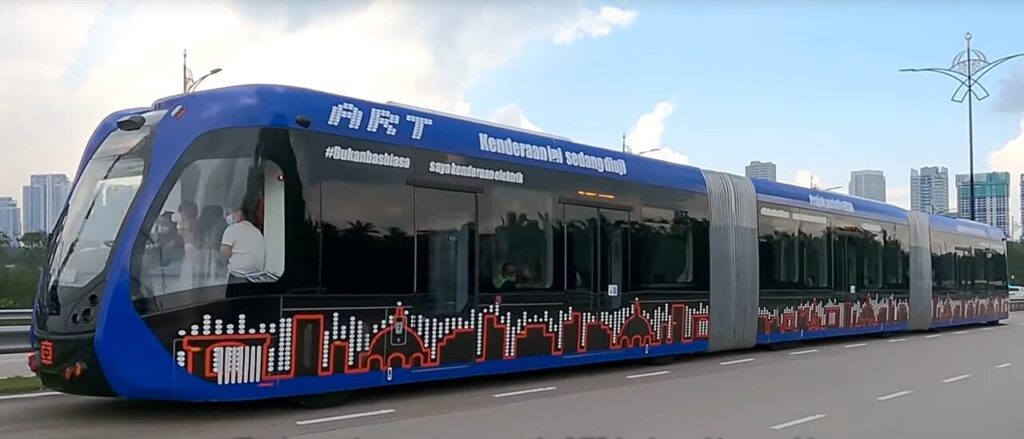
Lahore’s long-awaited trackless tram is finally about to carry passengers. Punjab Chief Minister Maryam Nawaz announced on Wednesday, 25 November, that the Lahore trackless tram will begin operating on the city’s roads next week, calling its arrival a milestone in the province’s push for cleaner and more modern public transport. Videos of the dark, articulated vehicle moving along Lahore roads spread quickly across social media after the announcement, giving many residents their first clear look at the tram in motion.
The announcement, made through the chief minister’s official social media account, is the clearest launch signal yet for a project that has been through testing, route revisions and delays. The Lahore trackless tram is not a conventional tram at all: it has no steel rails and no fixed track. Instead, it is a battery-powered vehicle that drives on ordinary roads while following a digitally mapped path.
What Maryam Nawaz Announced About the Lahore Trackless Tram
Maryam Nawaz said the Lahore trackless tram will begin service next week, presenting it as a step towards a modern, future-ready Punjab. The vehicle was imported from China and assembled locally, and preparations in recent weeks have included road testing and specialist tyre fitting. Promotional footage shared alongside the announcement shows the tram wrapped in Lahore heritage imagery, including the Badshahi Mosque and Lahore Fort, under the slogan “Lahore Beyond — Heritage Connected, Future Electrified.”
The tram is part of Punjab’s broader move towards next-generation, lower-emission urban transport, following the rollout of electric buses in the province. What the announcement did not include is just as important for commuters: no operational route, stop list or trial timetable has been published yet. Officials are expected to share those details as the launch approaches, and passengers will need them before the first public rides can be planned.
How the Lahore Trackless Tram Works Without Rails
The Lahore trackless tram uses Autonomous Rapid Transit technology, also known in Punjab’s project material as SART, or Super Autonomous Rapid Transit. Rather than running on metal rails, the vehicle travels on rubber tyres like a bus, while sensors, cameras and satellite positioning guide it along a virtual track mapped onto the road surface. Because there is no physical track to build, the system can be introduced on existing roads without the cost and disruption of laying rails or building elevated corridors.
That flexibility is the core selling point of the Lahore electric tram. A conventional tram or metro line locks a city into one corridor for decades, while a trackless system can, in principle, be rerouted as travel patterns change. The trade-off is that the tram shares road space with other traffic, so its speed and reliability will depend heavily on how its corridor is managed. A trained driver remains on board to supervise operations and take control if needed.
Capacity, Charging and Expected Fares
Each SART tram consists of three connected compartments and can carry roughly 250 to 300 passengers, several times the load of a standard city bus. Earlier project material put imported units at up to 320 passengers, with locally assembled versions closer to 250, so exact capacity will depend on the configuration that enters service. The vehicles are air-conditioned and fitted with security cameras, reflecting their role as high-volume commuter transport rather than a novelty ride.
The tram is fully electric. Reports indicate a range of about 25 to 27 kilometres after a fast charge of around ten minutes, a charging pattern designed to fit into short layovers at terminals so the service can keep running through the day. Passengers are expected to ride free during the initial trial phase, with early fare estimates of between Rs20 and Rs30 once regular commercial service begins. Those figures have not been confirmed in a formal fare notification, so commuters should treat them as indicative until Punjab publishes an official tariff.
The Route Question: Canal Road Plan Dropped
The biggest uncertainty hanging over the Lahore trackless tram is where it will actually run. The original plan envisaged a route of roughly 27 kilometres along Canal Road, from Thokar Niaz Baig to Harbanspura — one of Lahore’s busiest corridors and one that has lacked dedicated public transport for years. Canal Road was later dropped from the plan amid environmental concerns, including the potential cutting of trees along the canal, while technical issues and funding constraints also contributed to delays and revisions.
No replacement route was named in the latest announcement. That leaves the most practical questions — which neighbourhoods will be served, where passengers will board, and how the tram will connect with the Metrobus and Orange Line — still open. The route decision will also decide whether the tram relieves congestion on a major corridor or operates mainly as a demonstration service. Punjab is expected to confirm the operational route and trial schedule before the first public runs, and that confirmation is the announcement commuters should watch for next.
Why the Lahore Trackless Tram Matters
For Lahore, the stakes go beyond one new vehicle. The city regularly ranks among the world’s most polluted, and transport emissions are a visible part of that problem; UrduPro recently reported on Lahore topping the world pollution rankings again as AQI hit 538. A high-capacity electric service that can move 250 to 300 people at a time without exhaust emissions speaks directly to both the congestion and the air-quality arguments, provided it runs often enough and on a route people actually need.
The tram also sits within a wider provincial transport agenda, alongside the other key initiatives of the Maryam Nawaz government in Punjab. If the Lahore trial proves reliable, Punjab has previously spoken of extending the same SART technology to other cities, making next week’s launch a test case for trackless transit across the province. For now, the honest summary is this: the Lahore trackless tram is ready, the start date is next week, and the route announcement will decide whether it becomes a daily service commuters depend on.
Read more: Lahore Tops World’s Most Polluted Cities Again as AQI Hits 538 | CM Punjab 2026: Maryam Nawaz Government’s Key Initiatives
Related Posts
 TechnologyPunjab Zameen App: Download Your Land Fard Online in Two Minutes
 TechnologyOPPO A7 Pro 5G Pakistan Launch Set for November 30 With 8,000mAh Battery
 TechnologyHuawei Mate X8 Launched With Magnetic Crease Fix, 8.2-Inch Display and 6,200mAh Battery
 TechnologyNCCIA Launches Gen Z Cyber Zone to Help Young Pakistanis Spot Online Scams
 TechnologyHisense Smart TV Tracking Test: Viewing Data Sent to Ad Firm With Personalised Ads Off
 TechnologyPakistan Tells UN Nuclear Weapons Decisions Must Stay Under Human Control as AI Risks Grow
Most Popular
 How-ToPTA Tax Calculator 2026: Check Mobile Tax on Any Phone422 views
 Pakistan NewsPIA Boeing 787 Lease Deal: What It Means for the Airline401 views
 Canada JobsTech Jobs in Canada: Roles, Salaries, and Skills Needed395 views
 SportsUEFA Champions League 2026-27: Format, Teams and Schedule391 views
 TechnologyPM Shehbaz Sets November Deadline for Alibaba AI and Digitalisation Projects in Pakistan375 views
 ShowbizWomen’s Fashion in Pakistan 2026: Trends, Brands and Style Guide367 views