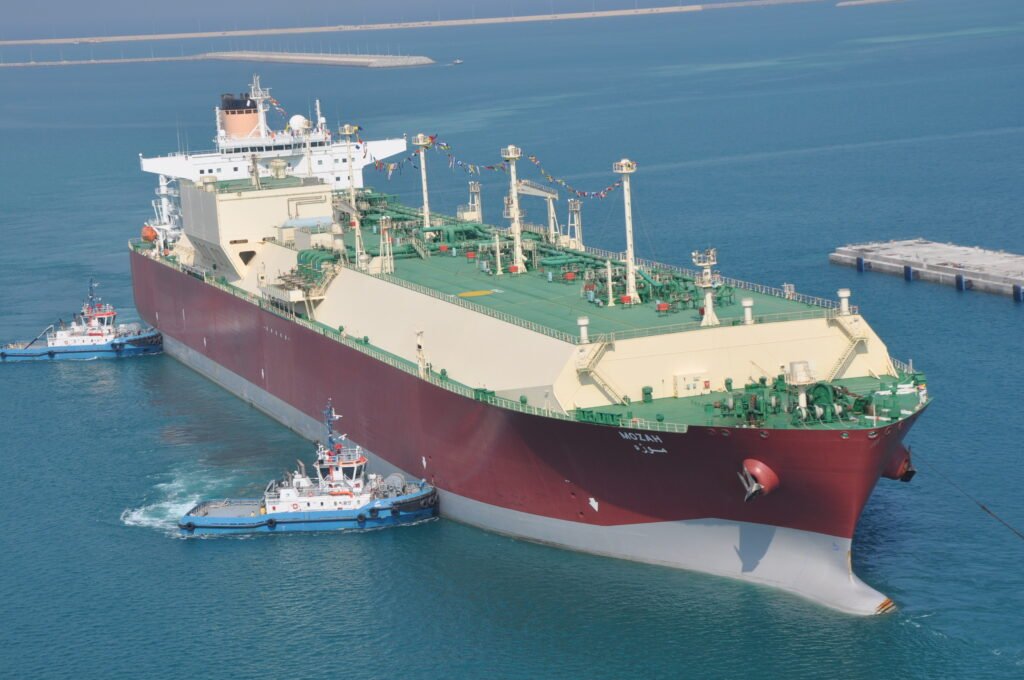
A vessel carrying fuel that was supposed to keep Pakistan warm this winter has been attacked in one of the world’s most sensitive waterways. The LNG carrier Al Mayeda — owned by Qatar’s Nakilat and bound for Pakistan with a cargo of liquefied natural gas — was struck by unidentified objects on the evening of Friday 30 October while sailing through Gulf waters near the Strait of Hormuz. All 25 crew members are safe, but the ship has turned back, and Pakistan now faces an uncomfortable question: will that gas ever reach its shores?
The incident has been confirmed by Nakilat itself. The Qatar-based shipping giant said the vessel was struck while transiting the Arabian Gulf, that the crew was unharmed, and that the ship remained safe and operational — though an assessment of the damage was still under way. No environmental pollution was reported. On 1 November, Qatar’s Foreign Ministry condemned the attack and said the relevant authorities had begun an investigation to determine the circumstances and those responsible.
What happened to the Al Mayeda

The Al Mayeda is a Marshall Islands-flagged LNG carrier operated by Nakilat, Qatar Gas Transport Company. On the evening of 30 October it was sailing with Qatari LNG loaded for Pakistan when it came under fire — struck, in Nakilat’s words, by “unidentified objects.”
Indian Shipping Minister Sarbananda Sonowal, who commented because six of the 25 crew members are Indian nationals, described it as a “projectile attack” and confirmed that all crew were safe. He gave no further details about the nature of the projectiles, and Nakilat’s statement did not describe them either — so the exact weapon used remains unknown.
Vessel-tracking data cited by Bloomberg shows the Al Mayeda reversed course after the attack and headed back toward the Arabian Gulf while its condition was assessed. Whether the vessel will resume its voyage to Pakistan, transfer its cargo to another ship, or require the cargo to be replaced remains unresolved.
Iranian clearance — hours before the strike

One of the most striking details comes from Bloomberg’s reporting: Pakistan had reportedly negotiated with Iranian officials to secure the Al Mayeda’s safe passage through the Strait of Hormuz, and people familiar with the discussions said Iranian authorities approved the voyage only hours before the attack.
This is important context and it must be stated carefully: the Iranian approval has not been officially confirmed by either Pakistani or Iranian authorities. But Bloomberg reports that Pakistan — apparently drawing on its ties with Tehran and its role in regional mediation — has been in direct communication with Iranian officials about the safety of several Qatari LNG shipments over the past month, and those earlier vessels crossed into the Gulf of Oman without incident.
The Al Mayeda is the first of these negotiated shipments to be hit. LNG shipments through Hormuz remained at roughly 30 percent of pre-war volumes during October, according to the Bloomberg reporting — a reminder of how fragile the corridor has become.
Why this matters for Pakistan’s winter

Pakistan’s gas supply is already under severe strain. As covered in our recent reporting, QatarEnergy extended its LNG force majeure for Pakistan to the end of 2026, suspending hundreds of millions of cubic feet of Qatari gas per day and forcing the government to plan roughly 22 LNG cargoes for the November-to-February winter stretch — around 10 of them bought on the expensive spot market.
If the Al Mayeda’s cargo does not reach Pakistan, the country may have to buy replacement LNG on the international spot market, where prices have reportedly climbed to more than three times their pre-war levels. Every disrupted cargo adds to a winter bill that was already projected above a billion dollars — and to the risk of household gas shortages in the coldest months.
Pakistan’s own gas fields hold reserves estimated at around 10.6 trillion cubic feet, but domestic production covers only a fraction of winter demand. The country has become structurally dependent on imported LNG, most of it from Qatar — and that supply now travels through a waterway where ships are being attacked.
Condemnation and investigations — but no attacker identified

Qatar’s Foreign Ministry condemned the attack on 1 November, said investigations had begun, and reserved the right to take all necessary measures under international law to protect its vessels and crews. On Monday 2 November, the UAE’s Ministry of Foreign Affairs also strongly condemned the attack, describing it as a serious threat to maritime security and global energy supplies and warning of potential environmental consequences.
No one has claimed responsibility, and no government has publicly identified the attacker. The incident comes amid a rise in security incidents involving commercial and energy-carrying vessels in regional waters and the Strait of Hormuz — including, separately, Houthi-claimed strikes on Saudi energy infrastructure and a tanker hit by explosive devices in the strait.
For Pakistan, the arithmetic is brutally simple: each cargo lost in the Gulf is a cargo bought at spot prices — or not bought at all. With winter demand rising and the Hormuz corridor under pressure, energy officials in Islamabad will be watching the Al Mayeda’s next move closely.
Read more: Houthis Claim Saudi Refinery Attack as Oil Prices Surge | Pakistan’s Responsible AI Maritime Security Pitch at the UN Security Council
Related Posts
 BusinessGold Price in Pakistan Crashes Rs10,800 Per Tola in Sharpest Drop of the Year
 BusinessMaryam Nawaz Launches Punjab PIVOT Economic Plan: Rs2 Trillion Investment Push for Exports and Jobs
 BusinessABHI Microfinance Bank Plans Rs3 Billion IPO on PSX — Book Building on 5–6 November
 BusinessFBR Misses October Tax Target by Rs156 Billion, Collects Rs975 Billion
 BusinessSBP SMEConnect Portal: Apply for SME Loans Online from 1 November 2026
 BusinessPM Forms Committee on LPG Policy as Govt Seeks to Shift Pricing Powers from Ogra to SOEs
Most Popular
 How-ToPTA Tax Calculator 2026: Check Mobile Tax on Any Phone373 views
 SportsUEFA Champions League 2026-27: Format, Teams and Schedule358 views
 Pakistan NewsPIA Boeing 787 Lease Deal: What It Means for the Airline351 views
 Canada JobsTech Jobs in Canada: Roles, Salaries, and Skills Needed343 views
 SportsBallon d’Or 2026: London Ceremony, Nominees and All-Time Records Ahead of 70th Anniversary330 views
 ShowbizWomen’s Fashion in Pakistan 2026: Trends, Brands and Style Guide320 views