Italy needs workers. Farms, hotels, care homes, and factories regularly struggle to find enough staff, and the government responds by opening legal entry routes for non-EU citizens each year. The catch is that the Italy work visa system looks nothing like applying for a job abroad in a country with a points-based or open-application visa.
In Italy, the process begins with your employer, not with you. The employer asks the authorities for permission to hire a worker from abroad. Only after approval can you apply for the visa. Most of this runs through a yearly quota law known as the Decreto Flussi.
This guide walks you through the whole journey in plain language: who needs a visa, how the quota system works, which documents you should prepare, the step-by-step process, the costs, and the mistakes that cost applicants time and money. Rules and dates change, so use this as a roadmap and confirm every detail on official Italian government websites.
Who Needs an Italy Work Visa?
EU, EEA, and Swiss Citizens
If you hold a passport from an EU or EEA country, or from Switzerland, you do not need a work visa. You can live and work in Italy freely and only need to register your residence if you stay beyond three months.
Non-EU Citizens
If you are from any other country, you need a work visa and a matching work authorisation before you start working. A tourist visa, a visa-free stay, or a visit to a friend does not give you the right to work, and it generally cannot be converted into a work permit once you are in Italy.
The Decreto Flussi Explained
What Is It?
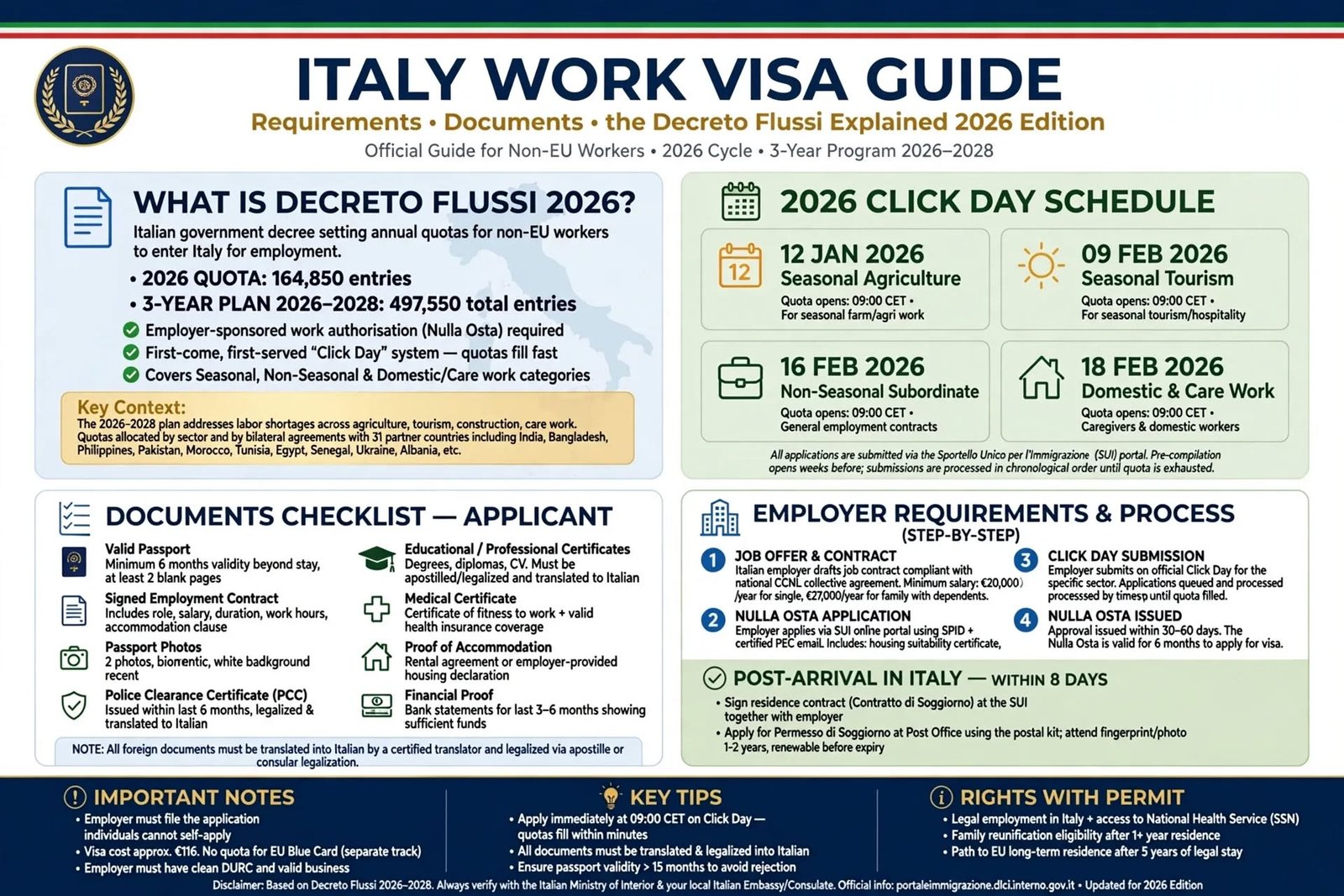
The Decreto Flussi is the Italian government decree that sets how many non-EU workers may enter Italy for work in a given period. It divides the total number into categories such as seasonal work, non-seasonal employment, and domestic or family care. Think of it as a yearly “ticket allocation”: once the tickets in a category run out, no more applications in that category are accepted.
The 2026–2028 Programme
The current decree, adopted on 2 October 2025, covers three years. It plans a total of 497,550 entries, with the annual quota rising from 164,850 in 2026 to 166,850 in 2028. Key categories include: arlettipartners
- Seasonal work: the decree allocates 88,000 places in 2026, 89,000 in 2027, and 90,000 in 2028. diritto
- Domestic and family care work: 13,600 places in 2026, 14,000 in 2027, and 14,200 in 2028. arlettipartners
- Non-seasonal employment: a smaller allocation for year-round jobs in sectors such as construction, logistics, and manufacturing.
- Preferred reserves: some places are set aside for workers from countries with which Italy signs new cooperation agreements, 18,000 in 2026, as well as a reserve for multi-year seasonal permits aimed at workers who have already entered Italy in the past five years. dequo
Certain categories, such as some highly qualified workers and specific care professionals, can enter outside the quota, which means they are not competing for the capped slots.
What Are Click Days?
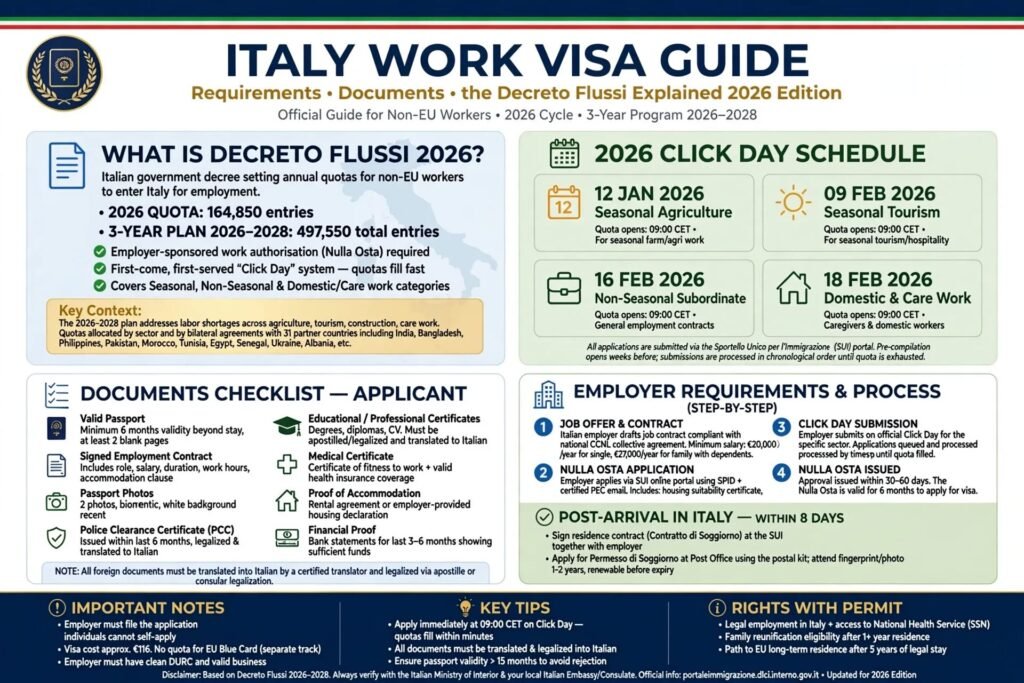
A click day is a fixed date and time when employers can submit their applications for a specific category. The 2026 click days ran at 9:00 on 12 January for agricultural seasonal work, 9 February for tourism seasonal work, 16 February for non-seasonal employment, and 18 February for family care. diritto
The process now has a preparation phase. Employers could pre-fill their forms on the Ministry of the Interior’s services portal from 23 October 2025 until 7 December 2025, and applications are filed through the ALI portal using SPID or CIE digital identity. italiahellodequo
What This Means If You Are Reading in Late 2026
The main 2026 click days have already passed. However, applications can still be submitted until 31 December 2026, within the limits of remaining quotas. Reports on the decree indicate that the same opening dates apply to each year of the 2026–2028 period, so employers looking ahead to 2027 can plan around the same calendar. Check the Ministry of the Interior’s announcements for confirmation. dirittoarlettipartners
Interestingly, demand does not always match supply. In 2025, only 72,238 seasonal applications were filed against 82,550 available places, compared with 283,000 applications in 2023. Quotas are not guaranteed to be oversubscribed every year, but strong sectors and regions still fill quickly. partitaiva
Main Types of Italian Work Visas
Seasonal Work Visa
This is the most common route for newcomers. It covers agriculture and tourism and is tied to a limited working period, usually up to nine months. Repeat seasonal workers may benefit from the multi-year authorisation option.
Non-Seasonal Subordinate (Employee) Visa
For permanent or long-term jobs. These are competitive because the quotas are smaller, and employers must prove a genuine need and a regular contract.
Domestic and Family Care Visa
For caregivers and household workers. This category has its own dedicated quota and its own click day.
EU Blue Card
For highly qualified professionals with a university degree (or equivalent professional experience in some fields) and a job offer above a salary threshold set by Italian law. It offers more flexibility and a smoother path to long-term residence than a standard permit.
Self-Employment and Freelance Visa
For independent professionals, entrepreneurs, and artists who meet financial, licensing, and business-plan requirements. Applicants usually deal with the immigration office through the local police headquarters (questura).
Intra-Company Transfer and Other Special Routes
Employees of multinational groups can be transferred to an Italian branch. Researchers and certain executives may also use special channels outside the standard quota.
Italy Work Visa Requirements
Each visa type has its own conditions, but most applicants must meet these core requirements:
- A genuine job offer or contract from an Italian employer who is legally allowed to hire foreign workers
- A valid passport with enough remaining validity and blank pages
- Employer eligibility: the employer must show they can pay the wages and that the job matches the relevant collective agreement (CCNL)
- Suitable accommodation arranged by the employer or documented by you
- A clean record: certain criminal convictions can lead to refusal
- Relevant skills or qualifications, especially for regulated professions like nursing
- Quota availability in your category, unless you qualify for an outside-quota route
Documents You Should Prepare
Exact lists vary by consulate and visa category, so always check your embassy’s checklist. As a general guide, prepare the following well in advance.
Documents From Your Side
- Valid passport, plus photocopies of the main pages
- Passport-size photographs following the consulate’s format
- Visa application form, completed and signed
- Nulla osta (work authorisation), issued after the employer’s application is approved
- Proof of qualifications and experience: degree certificates, trade certificates, reference letters
- Police clearance certificate from your home country, if required
- Proof of accommodation in Italy
- Travel or health insurance, where requested by the consulate
- Proof of payment of official visa fees
Documents From the Employer
- A signed job offer or residence contract proposal (proposta di contratto di soggiorno)
- The employer’s identification and company registration details
- Evidence of financial capacity to pay the salary
Translations and Legalisation
Many consulates ask for documents to be translated into Italian and legalised or apostilled. Start this early, since it can take weeks.
Step-by-Step: How to Get an Italy Work Visa
Step 1: Find an Employer
Search through job portals, recruitment agencies, and direct outreach. You will need an employer willing to go through the authorisation process. The more specific and relevant your skills, the easier this becomes.
Step 2: The Employer Applies for the Nulla Osta
The employer files the request online during the relevant window, through the Sportello Unico per l’Immigrazione. If the application is accepted within the quota, authorities carry out checks and, if everything is in order, issue the authorisation.
Step 3: Apply for Your Visa at the Embassy
With the nulla osta, you apply at the Italian embassy or consulate in your country. The nulla osta is valid for six months, so you must enter Italy and apply for a residence permit within that period. Do not delay your visa application. italiahello
Step 4: Travel to Italy
Once the visa is issued, you can travel and begin the final legal steps.
Step 5: Sign the Contract of Stay
The contract of stay must be signed within eight days after arrival, electronically. This links your employment contract with your residence status. diritto
Step 6: Apply for Your Residence Permit
Within eight days of arrival, you must apply for the permesso di soggiorno, normally through a post office kit or a designated office. You will be fingerprinted and given an appointment. Keep your receipt safe, since it proves you have applied legally while you wait for the card.
Step 7: Get Your Codice Fiscale
The codice fiscale is your Italian tax code. You will need it for payroll, banking, renting a home, and many everyday services. Often it is issued at the same time as your first residence documents or through the Revenue Agency.
Costs to Expect
Fees change, so verify them on official websites, but you should budget for the following:
- Visa application fee payable at the consulate (the amount varies by country and category)
- Residence permit fees, including stamp duty, the cost of producing the electronic card, and postal handling
- Document costs: translations, legalisation, police certificates, and photos
- Travel and initial living costs until your first salary arrives
A legitimate employer or agency should not charge you for the nulla osta itself. Anyone requesting thousands of euros for a “guaranteed slot” deserves suspicion.
How Long Does the Process Take?
There is no fixed timeline. The wait depends on the quota window, the workload of the local immigration office, and your consulate’s appointment availability. Expect several months from the employer’s application to your arrival in Italy, and sometimes longer. Plan your finances and notice periods accordingly, and avoid quitting your current job until you hold the visa.
Why Applications Get Rejected
Understanding common problems can save you months.
- Incomplete or inconsistent documents, such as mismatched names or dates
- Quota exhaustion, where the employer’s application falls outside available places
- Employer ineligibility, for example, insufficient income or irregular business status
- Unsuitable accommodation details
- Missing the six-month window after the nulla osta is issued
- Failed background checks
If a nulla osta application is denied, you cannot receive an entry visa, and a second attempt in the same year is not possible, although you can try again in a later year if the requirements are met. Careful preparation the first time really matters. italiahello
Scams and Red Flags
Work visa fraud targets hopeful applicants, so stay alert.
- Agents who guarantee a visa for a large upfront fee
- Fake job offers with no interview, no address, and unrealistically high pay
- Requests to send money to a personal account for the nulla osta
- Advice to enter Italy as a tourist and sort out papers later
- Pressure to act fast or keep the deal secret
How to protect yourself: insist on a written offer, verify the company in official registries, check procedures on government websites, and contact the embassy if anything seems off.
Tips to Strengthen Your Application
- Choose in-demand sectors like agriculture, hospitality, care work, construction, and IT
- Prepare an Italian-style CV (Europass format works well)
- Learn basic Italian, ideally to an A2 or B1 level
- Get qualifications recognised early if your profession is regulated
- Keep scanned copies of every document ready
- Stay flexible on location, since smaller towns often have more openings
- Track official announcements from the Ministry of the Interior and your embassy
Conclusion
The Italy work visa process rewards preparation and patience. It starts with an employer, runs through the quota system of the Decreto Flussi, and ends with your residence permit and tax code. For 2026–2028, Italy has set aside nearly half a million entries, which signals genuine demand for foreign workers, particularly in seasonal and care roles. But quotas, click days, and paperwork deadlines make timing and accuracy critical.
Focus on finding a genuine employer, assembling your documents early, and following the official procedure at every step. Avoid shortcuts and anyone who promises guaranteed results. Done correctly, the process can open the door to stable work and life in Italy.
Frequently Asked Questions (FAQ)
1. What is the Decreto Flussi?
It is the Italian decree that sets annual quotas for non-EU workers by category. The 2026–2028 programme was adopted in October 2025 and sets yearly entry numbers for seasonal, non-seasonal, and family care work.
2. Can I apply for an Italy work visa on my own?
For most employee categories, no. The employer must first obtain the nulla osta. Self-employment and some special categories follow different procedures.
3. What is a nulla osta?
It is the work authorisation issued by Italian authorities after an employer’s request is approved. You need it to apply for your work visa.
4. How long is the nulla osta valid?
It is valid for six months, so you must apply for your visa and enter Italy within that period.
5. Can I look for work in Italy on a tourist visa?
No. You cannot work on a tourist visa, and it generally cannot be converted into a work permit.
6. Which documents are most important?
Your passport, the nulla osta, the employer’s contract proposal, proof of qualifications, accommodation details, and the consulate’s required forms. Check your embassy’s checklist for the full list.
7. How much does the visa cost?
Costs vary by country and visa type. Expect consular visa fees, residence permit fees, and document costs. Never pay a third party to “buy” the authorisation.
8. Can my family join me?
Possibly, through family reunification, once you hold a valid residence permit and meet income and housing requirements. Conditions depend on your permit type.
Disclaimer: This article is for general information only. Quotas, deadlines, fees, and document requirements change frequently. Always verify current rules with the Italian Ministry of the Interior, the Ministry of Foreign Affairs, or your nearest Italian embassy or consulate before applying.
1 thought on “Italy Work Visa Guide: Requirements, Documents, and the Decreto Flussi Explained”