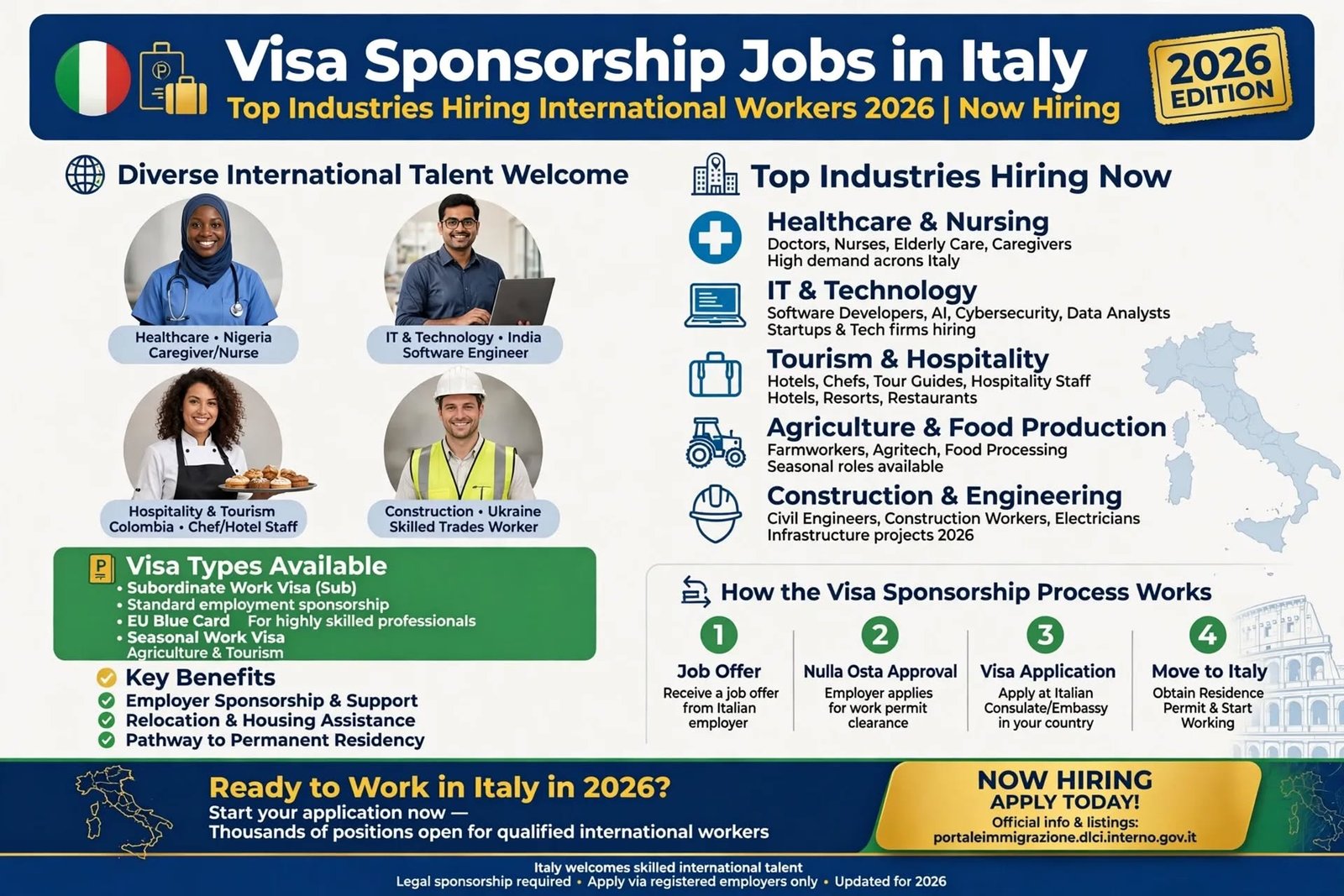
Every year, thousands of people search for visa sponsorship jobs in Italy, hoping to trade an uncertain job market at home for a contract under the Mediterranean sun. The dream is realistic, but the way sponsorship works in Italy surprises many applicants.
Unlike countries with a formal “sponsor licence” system, Italy handles foreign hiring through a quota-based process. An employer applies for permission to hire you, the government checks the request, and only then can you apply for a visa. Understanding this system is the difference between a smooth move and months of wasted effort, or worse, losing money to a scam.
This guide explains how employer sponsorship works in Italy, which industries are actively hiring international workers, how to find genuine employers, and what to avoid. Immigration rules and quotas change often, so use this article as a roadmap and confirm all details with official Italian government sources before acting.
How Visa Sponsorship Actually Works in Italy
It Is Employer-Led, Not Job-Seeker-Led
In Italy, you cannot simply buy or request a “sponsorship.” A legitimate sponsor is an employer or an authorised employer representative who formally asks the authorities to bring a named worker, or sometimes a worker from a specific country, into Italy. The key document they seek is called the nulla osta al lavoro, meaning work authorisation.
The Decreto Flussi Explained
Most non-EU hiring runs through the Decreto Flussi, a government decree that sets annual entry quotas by job category and, in some cases, by nationality. The current multi-year framework covers 2026 to 2028 and allows roughly half a million entries over the period, though exact figures and category splits should be checked on official portals.
Read Also: Security Guard Jobs in Italy: Complete Guide
Applications are submitted online during fixed windows, popularly called click days. Because demand often exceeds the number of available slots, employers who prepare early have a better chance.
The Step-by-Step Sponsorship Process
- Job match: You and an Italian employer agree on a role.
- Employer application: The employer submits a request through the Sportello Unico per l’Immigrazione (One-Stop Shop for Immigration) during the relevant window.
- Checks and approval: Authorities verify the employer’s eligibility, the contract terms, and the available quota. If approved, the nulla osta is issued.
- Visa application: You apply for the entry visa at the Italian embassy or consulate in your country, using the approved authorisation.
- Arrival and contract signing: Within a short period after arrival, you sign the residence contract at the local immigration office.
- Residence permit: You apply for your permesso di soggiorno, which allows you to live and work legally.
- Tax code: You obtain a codice fiscale, needed for banking, rent, and payroll.
Who Pays for What?
The employer should handle the authorisation process. Official fees exist for visas and residence permits, but nobody should charge you thousands of euros to “buy” a nulla osta. This single point protects you from most scams.
Types of Work Visas Linked to Sponsorship
Seasonal Work Visa
Designed for agriculture and tourism, this permit covers a limited season, often up to nine months. It is the most common entry point for foreign workers and often leads to repeat seasonal contracts in later years.
Non-Seasonal Subordinate Work Visa
For employees with longer-term contracts in industries like caregiving, logistics, construction, and manufacturing. These are subject to quota availability.
EU Blue Card
Aimed at highly qualified professionals with a university degree, or equivalent proven experience in certain fields, and a job offer above a government-set salary threshold. It offers more flexibility and a smoother route to long-term residence than standard permits.
Intra-Company Transfer
For employees of multinational firms sent to an Italian branch, usually managers, specialists, or trainees.
Highly Skilled and Specialised Categories
Some professions, such as qualified researchers, certain executives, and specialised technicians, may be handled outside the standard quota or through faster channels. Rules vary, so confirm the category that fits your profile.
Top Industries Hiring International Workers in Italy
1. Agriculture and Farming
Agriculture consistently receives a large share of the work authorisations in the yearly quotas. Italian farms need extra hands for harvests of grapes, olives, tomatoes, citrus fruit, apples, and more.
- Common roles: harvest worker, greenhouse operator, tractor driver, livestock assistant, vineyard worker
- Contract type: mostly seasonal, sometimes extended
- What to check: wage under the sector’s collective agreement, accommodation conditions, working hours, and transport
Agricultural work is physically demanding, and the sector has a reputation for exploitative practices in some areas. Research employers carefully, and never accept a job that offers no written contract.
2. Tourism and Hospitality
Italy’s tourism industry is one of its biggest employers. From the Amalfi Coast to the Dolomites, hotels, restaurants, and resorts hire large numbers of seasonal staff.
- Common roles: waiter, bartender, cook, kitchen assistant, housekeeper, receptionist, lifeguard, spa attendant
- Best for: people with hospitality experience or strong customer-service skills
- Advantage: employers sometimes provide staff housing or meals, reducing your living costs
Speaking some Italian gives you a real edge, and speaking additional languages such as German, French, or Russian can raise your value in popular tourist regions.
3. Healthcare and Caregiving
With one of Europe’s oldest populations, Italy needs a steady supply of nurses, care assistants, and home caregivers. Recent quota decrees have included dedicated space for family and elderly care workers.
- Common roles: registered nurse, care home assistant (OSS), live-in caregiver, physiotherapist
- Key requirement: foreign medical and nursing qualifications generally must be recognised by Italian authorities before you can practise in regulated roles
- Language: a working level of Italian is usually essential for patient safety and communication
4. Construction and Skilled Trades
Renovation projects, public works, and housing upgrades keep demand strong for tradespeople.
- Common roles: electrician, plumber, welder, bricklayer, tiler, crane operator, scaffolder
- Advantage: proven trade skills and safety certifications can speed up your hiring
5. Manufacturing and Industry
Northern regions such as Lombardy, Veneto, Piedmont, and Emilia-Romagna host factories producing machinery, automotive parts, furniture, food products, textiles, and luxury goods.
- Common roles: machine operator, assembly worker, quality-control technician, welder, maintenance engineer
- Tip: technical qualifications and experience with specific machinery are valuable
6. Information Technology and Engineering
Cities like Milan, Turin, Rome, and Bologna have growing technology and engineering sectors. International companies and start-ups often hire developers, data specialists, and engineers, sometimes with English as the working language.
- Common roles: software developer, DevOps engineer, data analyst, cybersecurity specialist, mechanical or electrical engineer
- Best route: the EU Blue Card or a standard skilled-worker permit
7. Logistics and Transport
E-commerce growth has increased demand for warehouse staff, forklift operators, and delivery drivers. Truck drivers with the proper licences and professional qualifications are especially sought after in freight transport.
8. Education and Language Teaching
Native and fluent English speakers can work in private language schools, international schools, and tutoring. A TEFL or CELTA certificate helps. Many of these jobs involve different hiring and visa arrangements, so check with the employer which permit they can support.
Where to Find Genuine Sponsorship Opportunities
Job Portals
- LinkedIn: best for corporate and professional roles
- Indeed Italia and InfoJobs: broad listings across sectors
- EURES: the official European job mobility portal
- Subito Lavoro: useful for local, entry-level positions
Use search terms such as “lavoro stagionale” (seasonal work), “assunzione dall’estero” (hiring from abroad), or “cercasi personale” (staff wanted), alongside English terms like “relocation support.”
Recruitment Agencies
Agencies such as Randstad, Adecco, Manpower, and Gi Group hire for hospitality, logistics, and industry. Check that any agency you work with is licensed and does not charge candidates placement fees.
Direct Outreach
Small and mid-sized Italian businesses often fill roles through direct contact. A short, polite email in simple Italian, attached with your CV, can open doors, especially with hotels, farms, and family-run companies.
Official and Bilateral Channels
Some countries have agreements with Italy that create dedicated labour migration routes or training programmes. Ask your nearest Italian embassy or consulate whether your country has one.
How to Become an Attractive Candidate
Build a Clear, Italian-Friendly CV
Use a clean one-to-two-page format, such as Europass, with reverse chronological work history, education, certifications, and language skills. Italian employers also expect a short data-processing consent line.
Show Reliability and Flexibility
Employers who sponsor a worker take on paperwork and risk. Demonstrate that you are dependable, willing to relocate, and open to different regions, since smaller towns often have more openings.
Get Qualifications Verified Early
If you work in a regulated profession, such as nursing, begin the recognition process before you apply. It can take months and may affect which roles you qualify for.
Learn Basic Italian
Even an A2 to B1 level shows commitment and makes day-to-day life far easier. Free language apps, online courses, and community classes can help you start immediately.
Prepare Your Documents
Keep scanned copies ready of your passport, degree certificates, experience letters, references, and police clearance. Delays often come from missing paperwork.
Salaries and Working Conditions
Italy does not have one national minimum wage. Pay is generally set by sector-wide collective agreements known as CCNL, which also define working hours, overtime, leave, and notice periods.
- Entry-level agriculture and hospitality: often in the range of roughly €1,000 to €1,400 net per month, varying by region, contract, and benefits
- Skilled trades, nursing, and IT: higher, depending on experience and location
- Typical benefits: paid holidays, sick leave, social-security contributions, and the TFR end-of-service payment
Always compare the offered pay against the relevant CCNL, and confirm whether housing, meals, or transport are included or deducted from your salary.
Red Flags and Scams to Avoid
Job fraud targeting foreign workers is common. Be alert to these warning signs:
- Guaranteed visas or jobs in return for large upfront payments
- Fake employers with no verifiable address, tax number, or website
- Offers with no interview and unrealistically high salaries
- Requests to pay an individual for a nulla osta or “quota slot”
- Advice to enter Italy as a tourist and sort out work papers later
- Pressure to act quickly or to keep the arrangement secret
How to Protect Yourself
- Ask for the job offer and contract in writing.
- Verify the company through official business registries and independent reviews.
- Check procedures on official Italian government websites.
- Contact the embassy or consulate if something feels wrong.
- Never share your passport copies or pay money before confirming the employer is real.
Common Mistakes Applicants Make
- Applying for hundreds of jobs with a generic CV
- Ignoring the timing of the Decreto Flussi application windows
- Assuming a tourist visa can be converted into a work permit
- Neglecting to learn any Italian
- Underestimating living costs in major cities
- Accepting verbal promises instead of written terms
Conclusion
Visa sponsorship jobs in Italy are available, but they work differently from what many applicants expect. The system rests on employers applying for authorisation within yearly quotas, so your task is to become a candidate worth sponsoring: skilled, prepared, flexible, and informed. Focus on sectors with real demand, such as agriculture, hospitality, healthcare, construction, manufacturing, logistics, and IT. Use trusted job platforms, build a strong Italian-style CV, and learn at least the basics of the language.
Above all, protect yourself. A genuine opportunity will never require you to bypass official procedures or pay for a guaranteed visa. With patience and preparation, Italy can become more than a destination; it can be the start of a stable career abroad.
Frequently Asked Questions (FAQ)
1. Can I get a sponsored job in Italy without experience?
Yes, in some sectors. Seasonal agriculture, hospitality, and housekeeping often accept entry-level workers. Regulated professions and skilled technical jobs normally require proven qualifications or experience.
2. Do I need to know Italian?
Not always, but it helps greatly. IT and international companies may use English, while most other roles expect at least basic Italian.
3. Who pays for the visa and the nulla osta?
The employer handles the authorisation process. You usually pay official visa and permit fees yourself. Be wary of anyone demanding large payments for the authorisation.
4. How long does the process take?
It depends on the quota window, the workload of the local immigration office, and your consulate. Expect several months from the employer’s application to your arrival.
5. Can I switch employers after arriving?
Rules depend on your permit type. Many permits allow changes under certain conditions, but you should check with the immigration office before leaving a job.
6. Can I bring my family?
Family reunification may be possible once you hold a valid residence permit and meet income and housing requirements. Conditions vary by permit.
7. Is it possible to work in Italy on a tourist visa?
No. A tourist visa does not permit employment, and working without authorisation can lead to fines, deportation, and future visa bans.
8. Which job offers the best chance of sponsorship?
Seasonal agricultural and tourism work, caregiving, skilled trades, and IT roles currently attract the most hiring from abroad, subject to quota availability.
Disclaimer: This article is for general information only. Immigration rules, quotas, salaries, and deadlines change often. Verify current requirements with the Italian Ministry of the Interior, the Ministry of Foreign Affairs, or your nearest Italian embassy before applying.