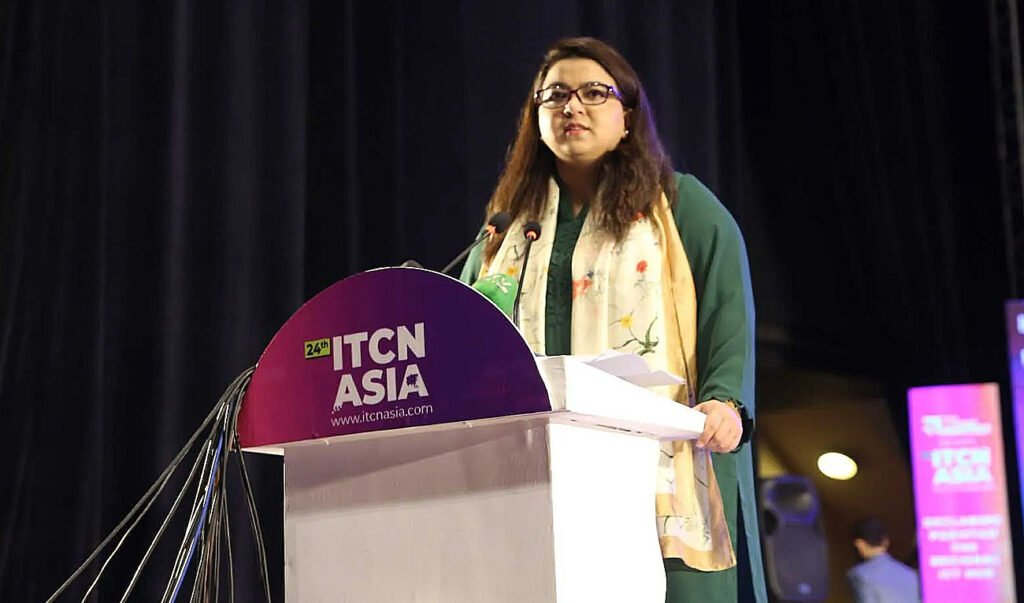
Pakistan’s government has unveiled plans for the Buraq Urdu AI model, a home-grown large language model trained on Urdu and regional languages that will run on computing hardware physically located inside the country. Federal IT Minister Shaza Fatima Khawaja made the announcement during a panel titled “Enabling Digital Government Service Delivery through DPI and AI” at the Global AI & Digital Summit 2026 in Seoul, which ran from October 19 to 22. The news was reported on October 21.
If built as described, the Buraq Urdu AI model would be the country’s first government-backed language model — an AI that understands the languages ordinary Pakistanis speak every day, and a bet on digital independence: keeping Pakistani data inside Pakistan.
What Buraq Actually Is: Sovereign Compute Plus a Home-Grown Model
The Buraq Urdu AI model is a two-track project under Pakistan’s National Artificial Intelligence and Emerging Technologies Development Programme. Track one is sovereign compute: buying AI computing capacity — servers and specialised chips — and installing it in Pakistan so sensitive data is processed at home. Track two is an Urdu LLM itself: a model trained primarily on Urdu along with the country’s regional languages, built for citizens and government departments alike.
The name evokes the winged steed of tradition, and the Seoul venue was a deliberate international stage for Pakistan’s digital-government pitch.
“AI Is the Last Layer, Not the First”
The most telling part of the announcement was not the model at all, but the minister’s framing. “AI is the last layer, not the first,” she said — her warning being that governments which skip the foundations get flashy pilots that never scale, and systems citizens do not trust.
She described four foundations this Pakistan Urdu AI push will stand on: digital identity — NADRA’s verified identity covers more than 100 million Pakistanis and is being extended into an online identity that records and enforces consent; payments — the State Bank’s Raast instant payment rail; data sharing — WASL, the national exchange layer of the Digital Public Infrastructure stack built under the World Bank-supported Digital Economy Enhancement Project, plus a citizen Super App and a National Open Data Ecosystem; and safeguards — a National Data Governance Policy as a single rulebook.
She had already set out this blueprint in her October 19 keynote, “Digital and AI Compacts: From Ambition to Action,” and Pakistan is set to become the first country to sign the Digital and AI Compact.
Why a Pakistani Urdu Model Matters
For Urdu speakers, the Buraq Urdu AI model solves two problems at once. The first is control: today, a question asked in Pakistan travels to servers in the United States or Europe and is governed by foreign laws. Sovereign compute would keep sensitive government, health, financial and telecom data inside Pakistan, under Pakistani rules.
The second is language. Urdu is spoken by more than 230 million people worldwide, yet it barely exists on the modern web — just 0.03 per cent of global web addresses in Common Crawl’s July 2026 data were in Urdu. Trained overwhelmingly on English, global models handle Urdu poorly. The Buraq Urdu AI model, built deliberately for these languages, could give citizens an assistant that truly understands them — in education, health information, government services and daily life.
A Record-Breaking IT Sector — and a Student Who Got There First
The Buraq Urdu AI model arrives as Pakistan’s tech sector gathers momentum: IT and telecom export remittances hit a record Rs1.2 trillion (about $4.6 billion) in FY 2025-26, and the National AI Policy 2025 targets three million AI-related jobs by 2030.
Pakistan is not starting from zero. Earlier in 2026, Taimoor Hassan — a Pakistani student in the United States — released “Qalb,” a model trained on 1.97 billion tokens and tested on more than seven international benchmarks. One young researcher showed what is possible; the question is whether the state can match that initiative at national scale.
An Honest Caveat: The Announcement Is the Easy Part
This Buraq Urdu AI model is an early-stage announced initiative, and that must be said plainly: the minister’s remarks did not establish that the planned computing resources are already purchased, installed or operational. Delivery will be the real test.
The honest measure of the Buraq Urdu AI model will be concrete: servers humming in Pakistani data centres, data genuinely staying at home, and ordinary people asking questions in Urdu — or Punjabi, Sindhi, Pashto or Balochi — and getting useful answers back. Until then, Buraq is a promising plan worth watching closely.
Sources: federal IT ministry announcements and national media reports.
Related Posts
 TechnologyPakistan Super App: Shaza Fatima Announces One App for All Government Services and Digital IDs
 TechnologyiOS 27.3 Beta Released: New Health App, Siri AI Upgrades and Release Date
 TechnologyKPITB AI Innovation Challenge 2026: Rs1 Million Prizes — Apply by 10 November
 TechnologySenate Panel Orders One Integrated E-Attestation System for PakistanTechnologyDigital Bill Deferred Again: NA Committee Sends E-Transactions Amendment Back Over PPP Objections
 TechnologySpotify Launches Audiobooks in Pakistan: Audiobooks+ Add-On Arrives
Most Popular
 How-ToPTA Tax Calculator 2026: Check Mobile Tax on Any Phone409 views
 Pakistan NewsPIA Boeing 787 Lease Deal: What It Means for the Airline385 views
 SportsUEFA Champions League 2026-27: Format, Teams and Schedule378 views
 Canada JobsTech Jobs in Canada: Roles, Salaries, and Skills Needed368 views
 TechnologyPM Shehbaz Sets November Deadline for Alibaba AI and Digitalisation Projects in Pakistan348 views
 ShowbizWomen’s Fashion in Pakistan 2026: Trends, Brands and Style Guide340 views


2 comments