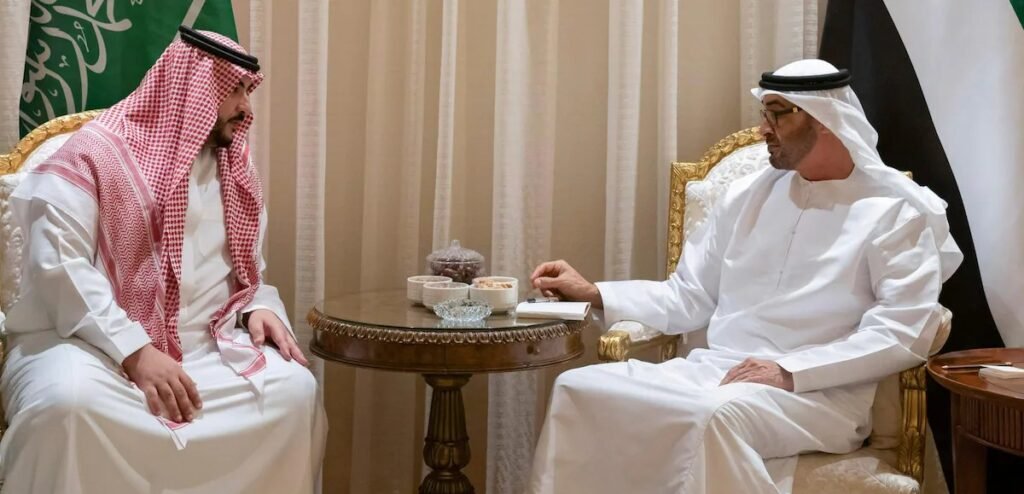
Saudi Defense Minister Prince Khalid bin Salman met UAE President Sheikh Mohamed bin Zayed Al Nahyan in Abu Dhabi on Sunday, October 18, 2026, for high-level talks on regional developments, bilateral cooperation, and joint Gulf action, as Middle East tensions continue to escalate.
The meeting took place at Qasr Al Shatie in Abu Dhabi at the direction of the Saudi leadership. Prince Khalid conveyed the greetings of the Custodian of the Two Holy Mosques, King Salman bin Abdulaziz Al Saud, and Crown Prince and Prime Minister Mohammed bin Salman bin Abdulaziz Al Saud to the UAE president.
Saudi Defense Minister Meets UAE President: Key Discussions
In a post on X following the meeting, Prince Khalid said the two sides “reaffirmed the depth of the fraternal and historic relations between our two countries and discussed regional developments and ways to strengthen cooperation and joint Gulf action.”
The UAE’s state news agency WAM reported that the meeting also addressed ways to expand cooperation in areas of mutual interest and exchanged views on efforts to strengthen regional security and stability and achieve lasting peace.
The meeting was attended by senior UAE officials, including Sheikh Mansour bin Zayed Al Nahyan, Vice President, Deputy Prime Minister and Chairman of the Presidential Court; Sheikh Tahnoon bin Zayed Al Nahyan, Deputy Ruler of Abu Dhabi and National Security Adviser; Sheikh Hamdan bin Mohamed bin Zayed Al Nahyan, Deputy Chairman of the Presidential Court for Special Affairs; and Sheikh Mohammed bin Hamad bin Tahnoon Al Nahyan, Advisor to the UAE President.
Meeting With UAE Vice President Sheikh Mansour
Earlier on Sunday, Prince Khalid also met UAE Vice President Sheikh Mansour bin Zayed Al Nahyan, who also serves as deputy prime minister and chairman of the Presidential Court.
The two officials reviewed bilateral relations and their shared commitment to strengthening cooperation and coordination across various sectors, according to WAM. Their discussions also covered regional developments and issues of mutual concern, with both sides emphasizing the importance of cooperation in supporting regional security and stability.
Saudi UAE Relations: A Pillar of Gulf Stability
Following the meetings, Anwar Gargash, diplomatic adviser to the UAE president, hailed Prince Khalid’s “successful” visit to Abu Dhabi, saying his meeting with Sheikh Mohamed bin Zayed underscored the depth and strength of Saudi-Emirati relations.
Gargash wrote on X that “our security and destiny are shared, and our partnership is one of the pillars of Gulf stability and prosperity,” adding that “the wisdom of the two leaderships and the sincerity of positions in times of adversity provide the most eloquent response to every bet against that.”
The visit reflects the continued close coordination between Riyadh and Abu Dhabi on strategic priorities. Sheikh Mansour had already travelled in the other direction in late September, visiting Riyadh at Prince Khalid’s invitation and meeting Crown Prince Mohammed bin Salman.
Regional Tensions and Yemen Conflict Context
The meetings come amid heightened regional tensions, including an escalation in Yemen and continued attacks by the Iran-backed Houthi militia on Saudi Arabia. In recent weeks, Yemen’s Houthi militia have launched repeated attacks targeting Saudi civil aviation infrastructure, including airports, as well as critical energy installations.
Saudi Civil Defence reported that a projectile hit a residential area in Najran on Sunday, injuring six Saudi citizens and damaging three homes and three vehicles. Houthi media had reported casualties from Saudi strikes in Yemen on Saturday, though those figures were not independently verified.
Saudi Arabia has led an Arab military coalition in Yemen since March 2015 against the Houthi militia, who seized control of the capital, Sanaa, and several other northern provinces in September 2014. The UAE officially withdrew from the Yemen coalition in 2020 and announced an end to its remaining military presence in December 2023, though Abu Dhabi continues to maintain influence through local allies.
The diplomatic engagements also take place against a backdrop of broader Middle East instability. Neither the Saudi nor the UAE statements announced any joint military action or decisions about American involvement, keeping the distinction between consultation and operational commitments intact.
What the Saudi Defense Minister UAE President Meeting Means
Analysts view the Saudi defense minister’s meeting with the UAE president as a significant signal of Gulf unity at a time of mounting regional pressure. The explicit reference in the Saudi account to consultations “on priorities for the coming period” suggests Riyadh and Abu Dhabi are aligning their positions ahead of potential further escalation in the region.
The coordination between the two Gulf powers carries weight beyond bilateral ties. Saudi Arabia and the UAE are the two largest economies in the Gulf Cooperation Council, and their alignment on defense and security policy shapes the broader regional posture. The visit demonstrates that despite past differences over Yemen policy, the two countries remain committed to joint Gulf action when facing shared threats.
Related Posts
 World NewsKatie Zacharia Fired After Five Days as White House Press Secretary
 World NewsStrait of Hormuz Closed: IRGC Declares Waterway Shut After Tanker Attacks
 World NewsClimate Change 2026: Latest Reports, COP Outcomes and Pakistan Impact
 World NewsUkraine War 2026: Latest Updates, Ceasefire Talks and Analysis
 World NewsUS Elections 2026: Midterms Guide, Key Races and Dates
 World NewsNarendra Modi 2026: Latest News, Policies and India Updates
Most Popular
 How-ToPTA Tax Calculator 2026: Check Mobile Tax on Any Phone84 views
 BISPPunjab Driving License Scam Alert: Fake Websites & “Without Test” Fraud | UrduPro79 views
 Canada JobsTech Jobs in Canada: Roles, Salaries, and Skills Needed75 views
 BusinessTech Stocks Trillion Loss: $1 Trillion Wiped Out as Oil Hits $11066 views
 TechnologyTecno Mobile Prices in Pakistan 2026: Spark, Camon and Pova Series Compared60 views
 ShowbizWomen’s Fashion in Pakistan 2026: Trends, Brands and Style Guide58 views