Petrol Price History in Pakistan: Year by Year Timeline
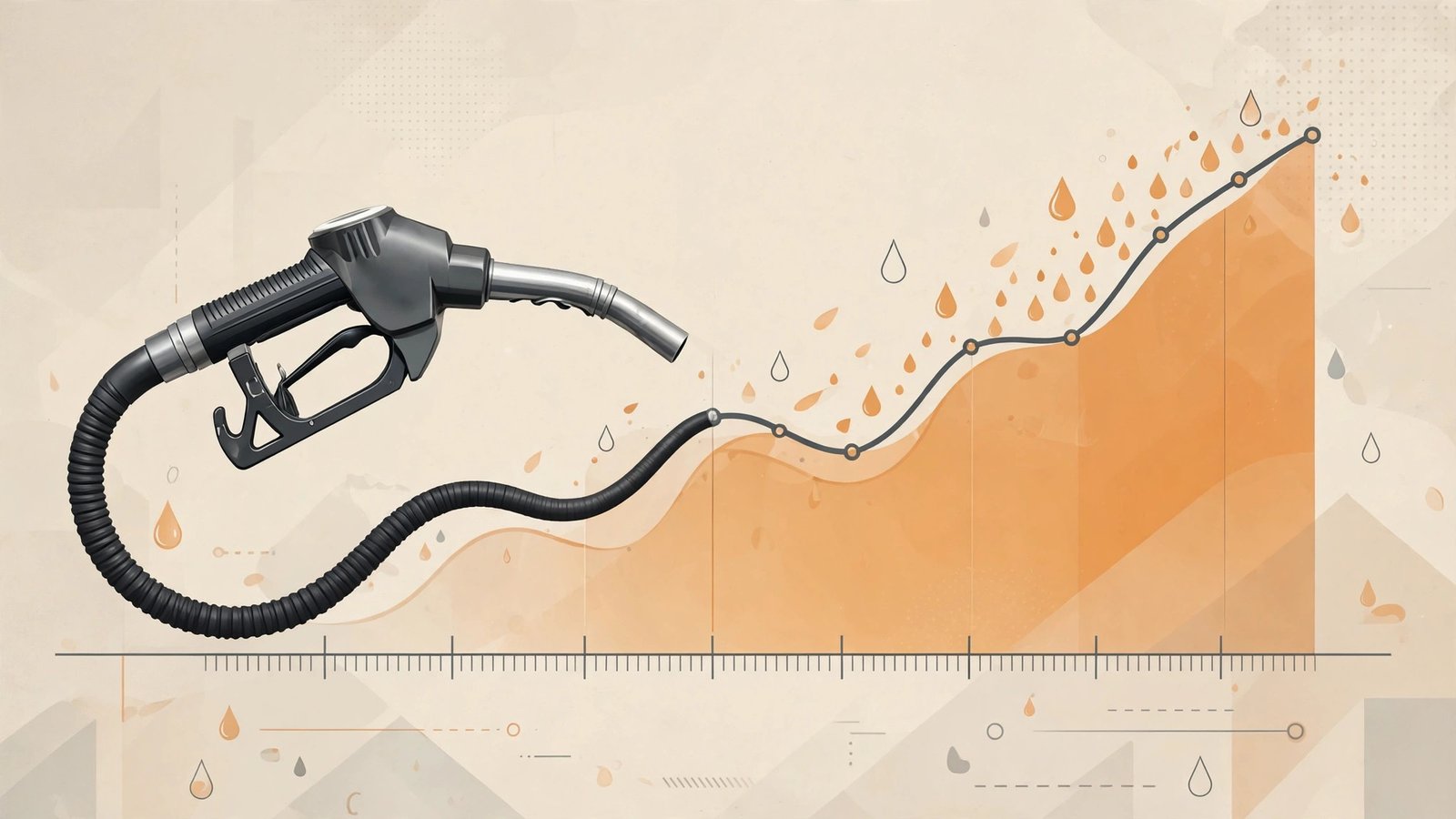
The petrol price history of Pakistan is a story of subsidies, IMF reforms, currency crises and global oil shocks. Today the price stands at Rs 393.86 per litre (15 October 2026) — but just six months ago it touched a record Rs 458.41. This timeline traces the record year by year.
Petrol Price History: 2018 to 2021 — The Era of Subsidies
In this era of the fuel-price record, rates were kept artificially low. In 2018, petrol sold between roughly Rs 75 and Rs 95 per litre. Through 2019 and 2020, the price hovered in the Rs 100–115 band, adjusted under IMF-linked programmes. By 2021, post-COVID demand recovery pushed it to Rs 117–125. Subsidised fuel hid the true international cost — a bill that came due in 2022.
The Historic High: 2022–2023
The 2022–23 chapter of the petrol price history marks Pakistan’s worst fuel crisis. Prices surged from around Rs 150 to Rs 272 and beyond, hitting an all-time high of approximately Rs 331.38 per litre in June 2023. Three forces drove this: Brent crude above $95 a barrel after the Russia-Ukraine war, a sharp rupee devaluation, and the IMF’s demand to remove fuel subsidies entirely. The petroleum levy was also raised. The June 2023 record devastated household budgets and fed double-digit inflation.
Slow Relief: 2024–2025
The 2024–25 stretch of the petrol price history shows gradual relief. Easing global oil prices and a stabilising rupee brought the price down through 2024. By June 2025, petrol was Rs 253.63 per litre — far below the 2023 peak, though still roughly triple the 2018 rate. Consumers hoped the worst of the long-term trend was behind them. Then came 2026.
2026 — The Record Rs 458.41
The most dramatic chapter of the petrol price history was written in 2026. Starting from around Rs 266 in early March, the price climbed sharply after the 28 February conflict in the Middle East and the Strait of Hormuz disruptions. On 3 April 2026, the government announced a record-breaking hike: petrol jumped 42.7% — Rs 137.23 per litre — to Rs 458.41, the highest petrol price in Pakistan’s history. The petroleum levy was raised to Rs 160 per litre.
To soften the blow, the government announced targeted relief: motorbike users received a Rs 100 per litre subsidy (up to 20 litres a month for three months), small farmers got Rs 1,500 per acre, and transport operators got monthly support. Early market closures were also ordered to save about 1,200 megawatts of electricity. Economists noted that the subsidies, while helpful, were temporary — and that the underlying drivers of the fuel-price record, from global crude markets to the rupee’s value, remained unresolved.
October 2026 — Volatile but Falling
Since the April record, the trend shows a bumpy decline. Petrol fell to Rs 398.96 on 9 October, then swung between Rs 392.66 and Rs 395.37 mid-month, settling at Rs 393.86 on 15 October 2026. The shift to daily OGRA pricing — announced on 17 July 2026 — means the price now tracks a seven-day average of international markets, producing the rapid October revisions. For consumers, the lesson is simple: the era of stable fortnightly prices is over, and checking the notified rate before a long trip is now a habit worth building.
Independent coverage of the same figures: PetrolPrice.net.pk’s full petrol price archive and Khabarwalay’s report on the record April hike.
Related reading: Check today’s petrol price, our diesel price update, the OGRA notification explainer and our LPG price guide.
FAQs
What is the highest petrol price in Pakistan’s history?
The highest figure in the petrol price history was Rs 458.41 per litre, recorded on 3 April 2026.
What was the rate in June 2023?
In June 2023, petrol hit Rs 331.38 per litre, a record at the time, driven by the IMF subsidy removal.
What was the rate in June 2025?
On 1 June 2025, petrol was Rs 253.63 per litre, before the 2026 crisis.
What is the price today?
Today’s price is Rs 393.86 per litre, effective 15 October 2026.
Why did it reach Rs 458.41 in April 2026?
The Middle East conflict, Strait of Hormuz disruptions, rising global oil prices and a record Rs 160 petroleum levy pushed it to its all-time high.
In-Depth Guide: Petrol Price History in Pakistan
Petrol price history in Pakistan tells the story of global oil markets, rupee depreciation and tax policy. This guide traces petrol price in Pakistan history, the petrol price 2020 Pakistan era, the petrol price trend Pakistan drivers, and the broader history of fuel prices Pakistan.
Petrol Price in Pakistan History: The Long View
Petrol price in Pakistan history shows a clear long-term upward slope driven by three forces: rising global crude prices over decades, steady rupee depreciation (Pakistan imports its oil in dollars), and growing petroleum levies as governments used fuel as a revenue source. Each decade’s history of fuel prices Pakistan chapter reflects the era’s economics — from subsidised stability to market-linked volatility.
Petrol Price 2020 Pakistan: The Crash and Rebound
The petrol price 2020 Pakistan episode remains the most dramatic in memory: global crude crashed during COVID lockdowns, Pakistani pump prices fell sharply — then rebounded violently as demand recovered and the rupee weakened. The lesson of 2020: Pakistani consumers feel global oil moves amplified by currency moves, in both directions.
Petrol Price Trend Pakistan: What Drives Changes
The petrol price trend Pakistan follows a formula anyone can understand: international oil price × exchange rate + petroleum levy + sales tax + dealer margins. When prices spike, check which component moved — global crude surges, rupee slides and levy hikes feel identical at the pump but have different causes and different policy fixes. Reading the petrol price history this way turns frustration into understanding — and better household budgeting, since fuel inflation eventually reaches every grocery bill.
Related Posts
 BusinessPakistan Introduces Electronic Power Monitoring System to Crack Down on Power Theft
 BusinessTech Stocks Trillion Loss: $1 Trillion Wiped Out as Oil Hits $110
 BusinessLululemon Chief Product Officer: Maggie Gauger Joins as President & CPO in Leadership Overhaul
 BusinessKOSPI Index Crash: South Korea’s KOSPI Suffers 7.57% Drop, Triggering Circuit-Breakers
 BusinessBlinkit Reliance Food Probe: Indian Regulators Name Executives in Expired Food Case
 BusinessHDFC Bank Profit Miss: Q2 Net Profit Rises 4.7% but Treasury Slump Disappoints
Most Popular
 How-ToPTA Tax Calculator 2026: Check Mobile Tax on Any Phone88 views
 BISPPunjab Driving License Scam Alert: Fake Websites & “Without Test” Fraud | UrduPro80 views
 Canada JobsTech Jobs in Canada: Roles, Salaries, and Skills Needed76 viewsBusinessTech Stocks Trillion Loss: $1 Trillion Wiped Out as Oil Hits $11066 views
 TechnologyTecno Mobile Prices in Pakistan 2026: Spark, Camon and Pova Series Compared62 views
 ShowbizWomen’s Fashion in Pakistan 2026: Trends, Brands and Style Guide59 views


One comment