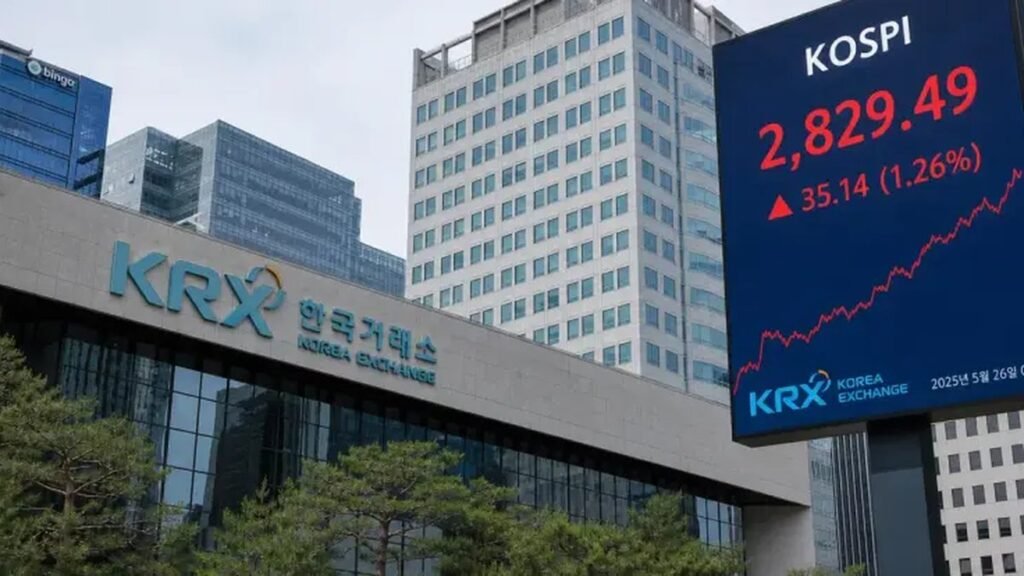
KOSPI Index Crash: South Korea’s KOSPI Suffers 7.57% Drop, Triggering Circuit-Breakers
The KOSPI index crash on October 15, 2026, will be remembered as one of the most violent sessions in South Korean market history. The benchmark KOSPI plunged 7.57 percent to close at 5,554.22, its steepest single-day decline since July and its seventh consecutive losing session. The KOSPI index crash triggered a Level 1 circuit breaker that halted trading for 20 minutes, while the KOSDAQ market’s own breaker tripped on the same day, something that had never happened before in a single session.
The KOSPI index crash wiped out nearly 376 trillion won in market value in a single day. Combined with the KOSDAQ, the two boards lost 410.9 trillion won. Over the seven-session losing streak, the KOSPI has shed more than 1.19 quadrillion won in value and fallen 20.7 percent from its record high of 7,003.74.
What Triggered the KOSPI Index Crash
The KOSPI index crash had two engines running at once. Overnight, US consumer price data showed September inflation at 3.7 percent, above the 3.6 percent forecast, with core inflation at 2.6 percent also beating expectations. The hot reading revived fears that the Federal Reserve could raise interest rates again, lifting financing costs for technology companies pouring money into AI infrastructure.
At the same time, doubts about returns on massive AI spending battered the semiconductor shares that dominate the KOSPI. CoreWeave’s bond rout in the United States, where its unsecured bonds fell below 80 cents on the dollar with yields approaching 15 percent, deepened questions about how AI infrastructure is being financed. Samsung Electronics and SK Hynix, the two giants that account for a huge share of the index, became the epicentre of the selling.
Foreign investors sold 3.63 trillion won worth of KOSPI shares on the day, extending their selling streak to eight consecutive sessions. According to one market report, foreign investors have sold more than 208 trillion won cumulatively this year, with 89 percent of that concentrated in Samsung and SK Hynix.
Samsung and SK Hynix Lead the KOSPI Index Crash
Samsung Electronics fell 9.48 percent to 210,000 won, while SK Hynix dropped 11.06 percent to 1.262 million won. Foreign investors were net sellers of a combined 2.57 trillion won in the two stocks on October 15 alone. The selling pressure centred on semiconductors amid doubts about returns on AI infrastructure spending, higher US inflation, and concerns about expanding memory-chip capacity in China.
The KOSPI opened 5.59 percent lower and at one point plunged 9.29 percent to an intraday low of 5,450.81 before recovering some losses late in the session. It finished at its lowest closing level since April 7.
The KOSPI index crash is notable because Samsung and SK Hynix are not struggling operationally. Taiwan’s TSMC reported record quarterly profit on the same day, with net profit up 68.7 percent. But the market is now pricing financing sustainability rather than earnings, and in a phase where good earnings do not lift stocks, the discount-rate debate beats the demand debate.
KOSPI and KOSDAQ Trigger Circuit-Breakers Together for the First Time
When an index drops past a set threshold in South Korea, trading halts for a fixed period. The pause is designed to stop panic selling from cascading. On October 15, the KOSPI’s breaker tripped at 12:38 PM, and the KOSDAQ’s own breaker fired in the same session, the first time both markets have triggered circuit-breakers on the same day.
It was the KOSPI’s 10th circuit breaker of 2026 and the first dual-market event of its kind. The country’s financial regulator convened an emergency meeting in the afternoon, and losses narrowed after the intervention.
Goldman Sachs noted that the seven-session losing streak is the longest since September 2024, and that over the past two decades the only comparable stretches without even a technical bounce were the early COVID-19 panic in March 2020 and the US credit-rating downgrade in August 2011.
How the KOSPI Index Crash Rippled Across Asia
The KOSPI index crash did not happen in isolation. Japan’s Nikkei 225 fell 4.90 percent to 64,425.95, and Taiwan’s Taiex dropped 3.41 percent to 46,969.9, with TSMC slipping about 2 percent despite its record quarter. The selloff tracked a global chip rout that began on Wall Street.
South Korea’s percentage decline was 2.66 percentage points steeper than Japan’s. Analysts attribute the gap to the Korean market’s extreme exposure to the semiconductor cycle and to foreign flows that amplify every turn.
The won-dollar exchange rate broke through 1,350 during the session, adding currency pressure to the equity selloff.
What Comes Next After the KOSPI Index Crash
The rebound came quickly. On Friday morning, October 16, the KOSPI rose 2.48 percent to 5,692.04, the Nikkei gained 1.56 percent, and the Taiex added 0.30 percent after US stocks recovered overnight. Whether the bounce holds depends less on Asia than on whether US chip stocks can end their eight-day losing streak.
Brokerages point to four potential triggers for foreign investors to return: uncertainty clearing after the November 3 US midterm elections, easing US-Iran tensions, buyback-burden relief after the mid-November Anthropic IPO, and late-October earnings from Samsung and SK Hynix alongside an assessment of China’s CXMT.
Analysts expect volatility to stay elevated, with no clear catalyst for a sustained rebound in sight. With fears of a supply vacuum now compounded by worries about credit risk at AI companies, the market is watching for return triggers, not the reasons for the selling.
FAQ: KOSPI Index Crash
Why did the KOSPI crash 7.57% on October 15, 2026?
The KOSPI index crash was driven by hotter-than-expected US inflation data, renewed doubts about returns on AI infrastructure spending, and concentrated foreign selling in Samsung and SK Hynix.
What is a circuit breaker in the Korean stock market?
When the KOSPI drops past a set threshold, trading halts for 20 minutes to prevent panic selling from cascading. October 15 marked the 10th such halt of 2026 and the first time both KOSPI and KOSDAQ breakers fired on the same day.
How far has the KOSPI fallen from its record high?
The index has fallen 20.7 percent from 7,003.74, erasing more than 1.19 quadrillion won in market value over seven sessions, its longest losing streak since September 2024.
Did the market recover after the crash?
On October 16, the KOSPI rebounded 2.48 percent to 5,692.04 as US markets stabilised, but analysts caution that volatility will remain elevated.