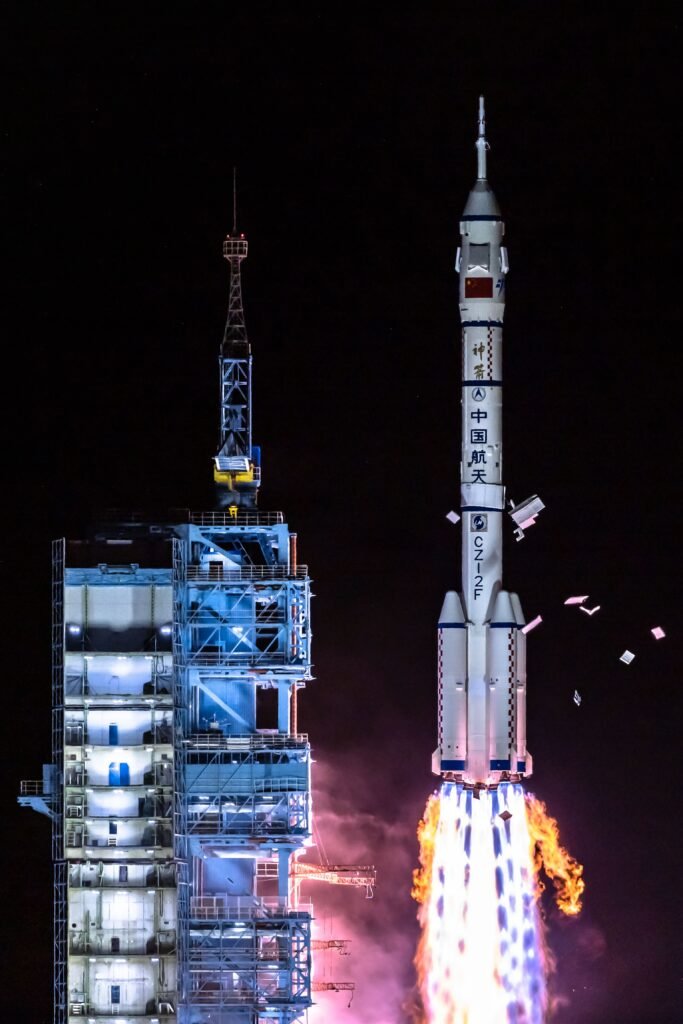
Pakistan is set to make history in space exploration as the country’s first astronaut prepares to embark on a space mission from China on November 25, 2026. The landmark announcement was made by Federal Minister for Planning, Development and Special Initiatives Ahsan Iqbal, marking a defining moment for the nation’s scientific ambitions.
Addressing the concluding ceremony of World Space Week 2026 in Narowal on Sunday, the planning minister revealed that the Pakistan first astronaut space mission would launch from a Chinese space centre, with the selected astronaut travelling aboard China’s Tiangong space station. The event was organised in collaboration with the Pakistan Space and Upper Atmosphere Research Commission (Suparco).
The Historic Announcement at Narowal
World Space Week 2026 was celebrated in Narowal for the first time under the vision of Ahsan Iqbal, in partnership with Suparco, with the aim of raising awareness among young people about space science, scientific research and modern technology. The closing ceremony drew students, scientists and officials, underscoring the government’s push to inspire a new generation of Pakistani space scientists.
“Cooperation with China will help Pakistan reach new heights in space exploration,” Iqbal said, expressing hope that the partnership would open new frontiers for the country’s scientists and engineers. The minister stressed that scientific research and space exploration were essential for technological advancement and the pursuit of knowledge.
The Pakistan first astronaut space mission represents the culmination of years of quiet preparation between Islamabad and Beijing in the field of human spaceflight, and officials say the Pakistan first astronaut space mission will open the door to deeper scientific collaboration.
Meet the Astronaut Candidates: Zeeshan Ali and Khurram Daud
The honour of becoming Pakistan’s first citizen in space will go to one of two Pakistan Air Force pilots — Zeeshan Ali and Khurram Daud — who were selected in April 2026 as candidates for China’s manned space programme. Both officers have since been undergoing rigorous astronaut training in Beijing.
Their training at the China Astronaut Research and Training Center covers spacecraft operations, Chinese-language communication, survival skills and preparation for the physical demands of spaceflight, including extended periods in microgravity. According to officials, the training programme is designed to prepare the candidates for every phase of the mission, from launch to docking and return.
Amer Gilani, who oversees human spaceflight cooperation at Suparco, told Reuters last month that a final astronaut selection decision was expected in mid-to-late October — meaning the name of Pakistan’s first astronaut could be revealed within days of the announcement.
Whichever candidate is chosen, the Pakistan first astronaut space mission will serve as a payload specialist aboard the Tiangong station, conducting scientific experiments during an approximately week-long stay in orbit — a profile that makes the Pakistan first astronaut space mission as much a science expedition as a national milestone.
Mission Details: A Week Aboard Tiangong
The Pakistani astronaut is expected to join a Shenzhou crewed mission to China’s Tiangong space station, the centrepiece of Beijing’s independent human spaceflight programme. As a payload specialist, the astronaut will carry out experiments in microgravity spanning material science, biotechnology and life sciences.
Researchers hope the findings will contribute to addressing challenges such as climate change and food security — areas where space-based research has already yielded practical benefits for agriculture and environmental monitoring on Earth.
The mission is being undertaken under a bilateral astronaut cooperation agreement signed between Pakistan and China in February 2025, formalising Islamabad’s entry into human spaceflight. The Pakistan first astronaut space mission is the most visible fruit of that agreement so far, and planners hope the Pakistan first astronaut space mission will pave the way for regular Pakistani participation in future crewed flights.
Pakistan’s Lunar Ambitions: Moon Landing by 2035
Looking beyond low-Earth orbit, Ahsan Iqbal also announced that Pakistan aims to achieve a lunar landing by 2035 as part of its longer-term space exploration plans. The ambitious target would place Pakistan among a small group of nations pursuing crewed or robotic missions to the Moon.
Pakistan and China are already collaborating on a Pakistani-built lunar rover expected to participate in China’s Chang’e 8 mission around 2028 — a stepping stone toward the 2035 lunar goal. The rover project gives Pakistani engineers hands-on experience with deep-space mission hardware.
The minister highlighted the growing importance of space technology in agriculture, communications, climate monitoring, education and national security, noting that satellite applications were becoming indispensable to the national economy.
Pakistan’s First Space Museum at Narowal
In a parallel announcement, Iqbal revealed plans to establish Pakistan’s first Space Museum at the University of Narowal to promote scientific awareness and encourage young people to pursue space science and technology. The museum is intended to inspire students to explore scientific fields and consider careers in space research.
He congratulated the university on securing first position at the Islamabad Science Festival, praising the talent and potential of Pakistani students. The minister noted that Muslim scholars had once made significant contributions to astronomy and scientific discovery, calling for renewed efforts to restore Pakistan’s leadership in knowledge and research.
He also observed that the Holy Quran encourages reflection on the creation of the universe, underscoring the importance of scientific curiosity, research and learning among young people.
Why the Pakistan First Astronaut Space Mission Matters
The Pakistan first astronaut space mission carries significance far beyond symbolism. Human spaceflight programmes drive advances in materials science, medicine, communications and computing — technologies that flow back into the civilian economy.
For Suparco, the mission validates decades of work in satellite development and space applications, elevating the agency from an applications-focused organisation to a participant in crewed spaceflight. For Pakistan’s youth, seeing a fellow citizen in orbit provides the most powerful possible motivation to pursue science, technology, engineering and mathematics.
The November 25 launch date is the most specific timeline publicly announced for the mission. While a corresponding final launch schedule and crew assignment from the China Manned Space Agency had not been independently confirmed at the time of the announcement, the minister’s statement signals that preparations are in their final stages.
As the countdown begins, Pakistan stands on the threshold of joining the select group of nations that have sent their citizens into space — a milestone that will be remembered as the moment the country’s space programme truly took flight.
Related Posts
 TechnologyWhatsApp New Features 2026: What’s Changed
 TechnologyDeepSeek V4.1 Flash Launched: Faster, Leaner Open-Source AI Model Takes on Claude and OpenAI
 Technology5G in Pakistan: Launch Status, Cities and Supported Phones
 TechnologyiPhone 16 Pro Price in Pakistan (October 2026)
 TechnologyiPhone 16 Price in Pakistan (October 2026)
Most Popular
 How-ToPTA Tax Calculator 2026: Check Mobile Tax on Any Phone75 views
 BISPPunjab Driving License Scam Alert: Fake Websites & “Without Test” Fraud | UrduPro75 views
 Canada JobsTech Jobs in Canada: Roles, Salaries, and Skills Needed70 views
 BusinessTech Stocks Trillion Loss: $1 Trillion Wiped Out as Oil Hits $11065 views
 TechnologyTecno Mobile Prices in Pakistan 2026: Spark, Camon and Pova Series Compared56 views
 ShowbizWomen’s Fashion in Pakistan 2026: Trends, Brands and Style Guide51 views