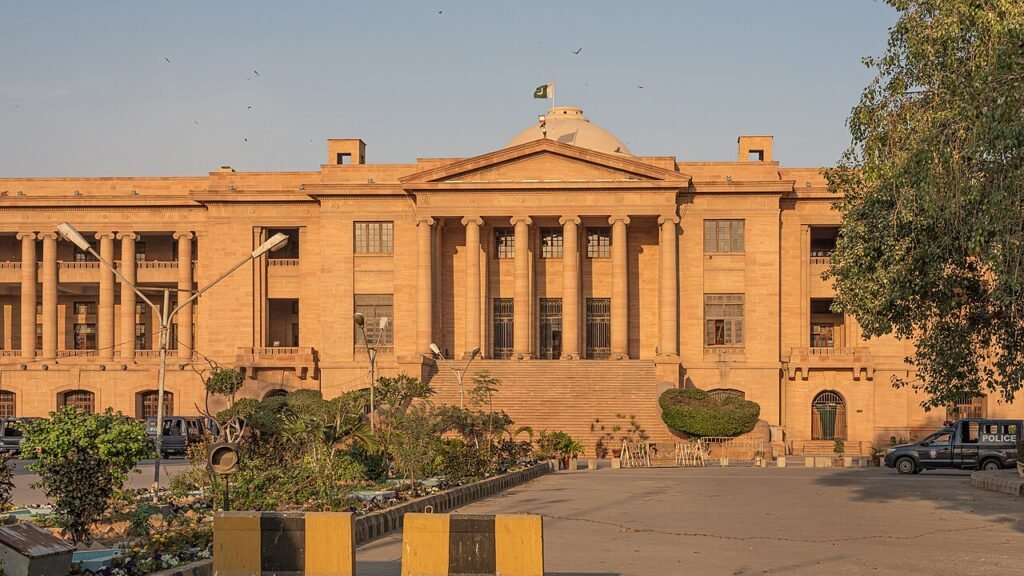
SHC Rules for Ghost School Film: Court Sets Aside Most Censor Cuts, Orders Fresh Certificate in 10 Days
The Sindh High Court has set aside most of the objections raised by the Board of Film Censorship against the public exhibition of the feature film Ghost School film in Sindh, directing the board to reconsider the film’s certification within 10 days.
A division bench of the SHC headed by Justice Yousuf Ali Sayeed ruled that once the petitioners excise Item No. 7 from the film, the board must reconsider certification and issue a certificate sanctioning Ghost School film for unrestricted public exhibition — without demanding any further cuts.
What the SHC Ordered in the Ghost School Film Censorship Case
The petitioners had challenged eight excisions and mutings specified in the censorship report, which had been imposed as conditions for granting the film a Universal (U) category certificate. The SHC’s division bench observed that the board failed to justify most of these demands and ordered that the remaining objections be dropped.
Under the order, the board must act within 10 days of the filmmakers removing Item No. 7 and grant Ghost School film a certificate for unrestricted public exhibition. The court was explicit: no further excisions can be required in this reconsideration, and the board’s review must be confined to the objections already identified — it cannot invent new ones.
The court also built in a safeguard. If the board believes that retaining any identified excision would warrant a category higher than U, it must first give the petitioners a personal hearing and then pass a speaking order linking each specific concern to Rule 11 of the censorship framework. Vague, unexplained cuts will no longer stand.
A Film About a Haunted Village School
At the heart of the case is Ghost School film, a fictional feature about a ten-year-old girl who discovers that the only school in her village has shut down because of rumours that it is haunted. The story, framed around childhood curiosity and the loss of a village’s only classroom, sought a Universal certificate so it could reach all audiences.
The film is made by British-Pakistani filmmaker Seemab Gul, with Muhammad Yousuf Rehman as associate producer. The two approached the court after the Sindh Board of Film Censors declined to clear the film for screening in the province, naming the Culture, Tourism, Antiquities and Archives Department of the Sindh government and the board as respondents.
Their counsel, Mirza Moiz Baig, argued that the rejection violated Section 6 of the Sindh Motion Pictures Act and Rule 16(2)(h), noting that no show-cause notice was issued to the filmmakers before the adverse decision — a procedural lapse that became a recurring theme in the court’s scrutiny of the board.
An Earlier Hearing That Warned the Censor Board
The October ruling follows an earlier round in August, when a two-member SHC Constitutional Bench led by Justice Adnan-ul-Karim Memon took up the challenge. The board’s secretary appeared but could not explain why the filmmakers’ application had been rejected. The judges expressed open displeasure and warned they might summon the board’s chairman if needed.
The bench then ordered the board to revisit the application within 15 days after hearing the parties and to pass a reasoned speaking order unaffected by its earlier rejection. The petitioners’ counsel told the court that although the board had technically allowed the film to be shown, it had effectively confined its exhibition to the cantonment areas of Karachi by refusing a certificate for release across Sindh.
What This Means for Film Censorship in Pakistan
The Ghost School film ruling reaches beyond one independent production. The SHC has tightened the procedural discipline around film certification in Sindh: every cut must be justified with reference to specific rules, a personal hearing is required where a higher category is contemplated, and the board must assign the least restrictive category that addresses any genuine concern.
For independent filmmakers like Seemab Gul, the order offers predictability. A board can still object to content, but it must do so on the record and through reasoned orders rather than unexplained refusals. Read our related coverage: Udta Teer Banned in Nepal and Mango Jutt Gets Mixed Public Verdict.
What Happens Next for Ghost School Film
The next step belongs to the filmmakers: excise Item No. 7 as directed. Once that is done, the 10-day clock starts for the Sindh Board of Film Censors to reconsider certification and issue the certificate for unrestricted public exhibition of Ghost School film. If the board attempts to retain any other excision on the ground that the film deserves a category higher than U, it must hear the petitioners first and pass a speaking order for each item — a process that will itself be open to judicial review.
For now, the filmmakers have won the central point they came to court for: the bulk of the censor board’s cuts have been set aside, and the path to a clean, unrestricted release of Ghost School film in Sindh is finally open.
Sources: The News International; KSE / court reporting. To send a correction or a tip, please use the Contact page.
Related Posts
 ShowbizMango Jutt: Hareem Farooq and Faysal Quraishi’s Punjabi Film Gets Mixed Public Verdict
 ShowbizHasan Raheem Submits ‘Bewajah’ for 2027 Grammy Awards in Two Categories
 ShowbizImran Ashraf, Kinza Hashmi to Star in Punjabi Film on Eid 2027
 ShowbizRamayana World Premiere in Los Angeles: Ranbir Kapoor and Yash’s Epic to Screen at Academy Museum
 ShowbizTom Holland Penthouse Thriller: Spider-Man Star to Lead and Produce New Film
 ShowbizJumanji Open World Release Date Confirmed: Dwayne Johnson’s Final Game Set for Christmas 2026
Most Popular
 How-ToPTA Tax Calculator 2026: Check Mobile Tax on Any Phone129 views
 Canada JobsTech Jobs in Canada: Roles, Salaries, and Skills Needed109 views
 TechnologyTecno Mobile Prices in Pakistan 2026: Spark, Camon and Pova Series Compared98 views
 BISPPunjab Driving License Scam Alert: Fake Websites & “Without Test” Fraud | UrduPro92 views
 ShowbizWomen’s Fashion in Pakistan 2026: Trends, Brands and Style Guide87 views
 TechnologyRedmi K100 Launching on 28 October: 10,000mAh Battery, 185Hz Display and Full Specs82 views