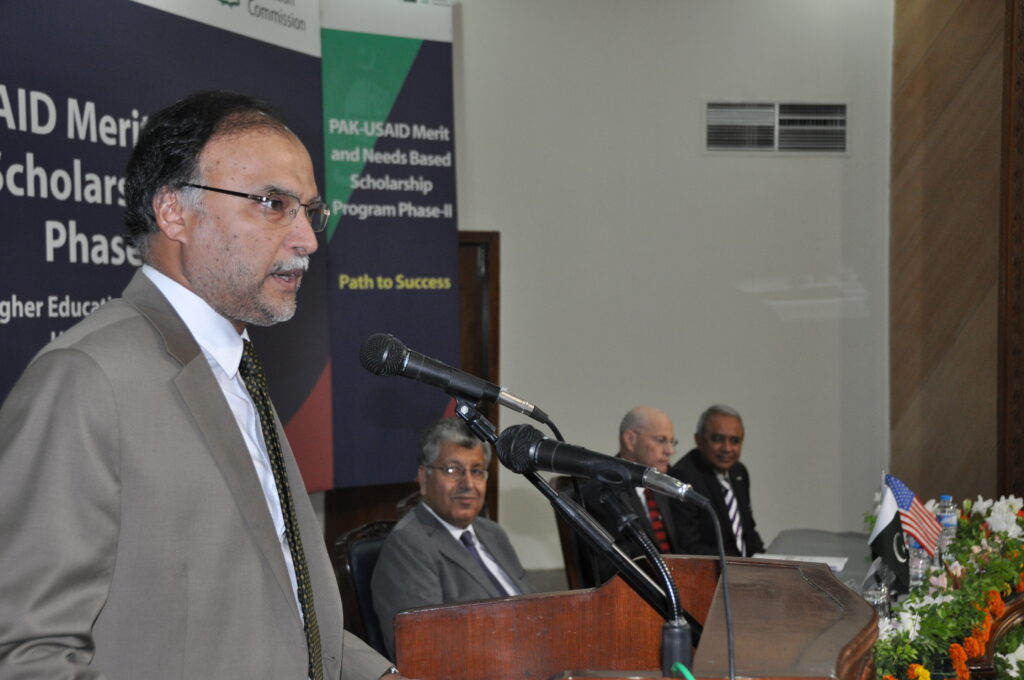
Pakistan will set up 10 National Catapults to turn university research into commercial products, Federal Minister for Planning, Development and Special Initiatives Professor Ahsan Iqbal announced on Friday. The 10 National Catapults are designed to close the long-standing gap between research and industry, so that ideas developed in Pakistani laboratories can reach the market as finished technologies instead of remaining on paper.
The minister announced the initiative after visiting IRADA, the organisation that will lead the first of the 10 National Catapults. The network will be launched under the Science, Technology and Engineering for Development programme, known as STED, a flagship initiative of URAAN Pakistan, the government’s economic transformation plan.
What Are National Catapults?
A National Catapult is a shared centre where universities, start-ups and manufacturers can develop, test and refine new technologies together before committing to full commercial production. Each catapult provides access to testing facilities, prototyping infrastructure and pilot production lines that a single university or small company could rarely afford on its own.
The idea is borrowed from successful international models, including the United Kingdom’s Catapult Network, Germany’s Fraunhofer Institutes, Manufacturing USA and Singapore’s A*STAR. In each of those countries, catapults act as a bridge between academic research and industry, helping new ideas survive the difficult middle stage between a laboratory result and a product customers will buy. Pakistan’s version will focus on Technology Readiness Levels 4 to 7, the stages that run from laboratory validation to a prototype demonstrated in a real operational setting.
The 10 National Catapults Pakistan Will Build
The 10 National Catapults will cover Semiconductor and Advanced Electronics; High-Value Manufacturing and Industry 4.0; Digital Economy and Artificial Intelligence; AgriTech and Food Technology; Health Technology and MedTech; Clean Energy and Climate Technology; Mines, Minerals and Materials; Defence Technology and Dual-Use; Space Technology; and Chemicals and Composites.
The list deliberately spans the sectors where Pakistan already has research strength or urgent national need. The Digital Economy and Artificial Intelligence catapult, for example, connects with the country’s push to build digital skills and AI capacity, while the semiconductor catapult links directly to the growing national focus on chip design and electronics manufacturing. The AgriTech and Clean Energy catapults address food security and energy, two areas where locally developed technology can reduce dependence on imports.
IRADA to Lead the First Catapult for Semiconductors

IRADA will become the first state-owned enterprise formally designated to lead a National Catapult, and it will spearhead the Semiconductor and Advanced Electronics Catapult. The choice signals where the government sees the most urgent opportunity: chips and advanced electronics sit at the heart of almost every modern product, from smartphones to solar inverters, and Pakistan currently imports nearly all of them.
The semiconductor focus also builds on momentum already visible in the sector. Pakistan recently launched free chip design training with a monthly stipend under the INSPIRE programme, showing that the government is trying to build the skilled workforce a semiconductor industry would need. A dedicated catapult would give those trainees and researchers somewhere to test real chip designs with industry engineers, rather than stopping at classroom theory.
Shared Labs, Prototypes and Pilot Lines
The practical value of the 10 National Catapults lies in what they will let people do. University researchers will be able to refine prototypes alongside industry engineers. Manufacturers will be able to test new processes before investing in production facilities. Investors will be able to assess technologies under real operating conditions before putting money into them.
The catapults will also help universities commercialise their intellectual property, identify emerging technologies and map the workforce the country will need in the years ahead. Businesses, meanwhile, will be able to validate a technology before committing to the heavy cost of full-scale production. The network is also expected to attract foreign direct investment and risk capital, and to contribute to the regulations, standards and certification frameworks that new technologies need before they can be sold at home or abroad.
Jobs, Exports and How Success Will Be Measured
Ahsan Iqbal said the initiative was central to URAAN Pakistan’s vision of expanding exports by developing and manufacturing higher-value products. The 10 National Catapults are expected to help Pakistani firms meet international standards, develop competitive local alternatives to imported technologies, and create skilled employment for young engineers, scientists and technicians.
The minister was specific about how the network will be judged. Its performance will be measured by the number of technologies that reach commercial production, the number of Pakistani firms that gain access to new markets, and the number of skilled jobs created. That focus on measurable results matters: Pakistan has announced research programmes before, but a catapult network will only earn its keep if prototypes actually become products, factories and pay cheques.
No timeline for the remaining nine catapults has been announced yet, and the government has not said how much funding the network will receive. For now, the first step is clear: IRADA will lead the semiconductor catapult, and the model — shared labs, industry partnerships and a hard test of commercial readiness — will be proven there before it is rolled out across the other nine sectors. If it works, the 10 National Catapults could become the missing link between Pakistan’s universities and its factories.
Related Posts
 TechnologyChip Design Training Pakistan — Free Course with Rs 50,000 Monthly Stipend, Apply by 6 December
 TechnologyToyota Land Cruiser 300 Hybrid Launched in Pakistan at Rs 11.20 Crore
 TechnologyPakistan and Google Sign Landmark MoU — Free AI Tools for Students, 150,000 Career Certificates and a $30 Billion Digital Goal
 Technology2027 Hyundai Elantra Hybrid Unveiled at LA Auto Show with 157 PS and a 53 MPG Target
 TechnologyJPMorgan, Visa and Mastercard Hit by Cyberattack on Vendors as Hackers Leak Customer Data
 TechnologyKarachi Safe City Phase-II: Sindh Cabinet Approves Rs5.766 Billion for 2,300 AI Cameras
Most Popular
 How-ToPTA Tax Calculator 2026: Check Mobile Tax on Any Phone421 views
 Pakistan NewsPIA Boeing 787 Lease Deal: What It Means for the Airline396 views
 Canada JobsTech Jobs in Canada: Roles, Salaries, and Skills Needed392 views
 SportsUEFA Champions League 2026-27: Format, Teams and Schedule390 views
 TechnologyPM Shehbaz Sets November Deadline for Alibaba AI and Digitalisation Projects in Pakistan370 views
 ShowbizWomen’s Fashion in Pakistan 2026: Trends, Brands and Style Guide366 views