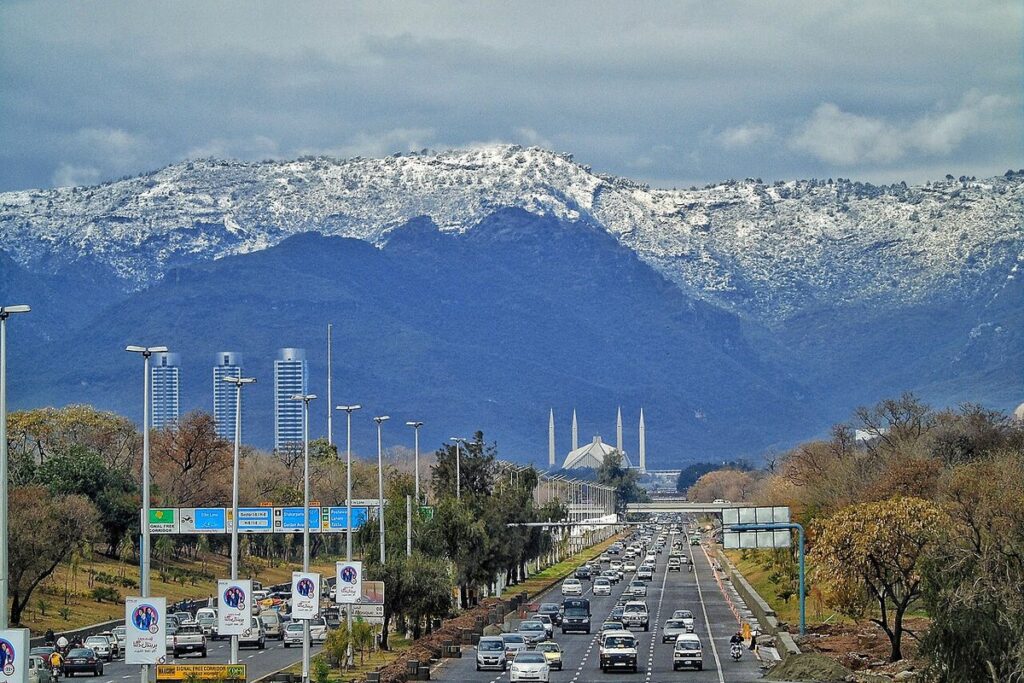
Strong earthquake tremors shook Islamabad and several cities in Khyber Pakhtunkhwa late on Sunday night, sending frightened residents out of their homes and into open areas. The earthquake in Islamabad measured 5.3 on the Richter scale, according to the Seismological Centre, and struck at 10:49 p.m. on 15 November 2026.
No casualties or property damage had been reported from any part of the country in the initial hours after the quake, according to information shared by the administration and rescue agencies. The tremors were felt across the federal capital and much of northern Pakistan, and the earthquake in Islamabad quickly became the most searched topic in the country overnight.
Where the tremors were felt
The earthquake in Islamabad was felt clearly across the capital, where buildings swayed and residents rushed outdoors. Tremors were also reported in Swabi, Shabqadar, Chitral and Lower Dir, along with nearby areas of Khyber Pakhtunkhwa.
People in the affected cities described a sudden, strong jolt that lasted several seconds. As the tremors began, many residents recited the Kalima and hurried out of their homes and buildings towards open ground. Even after the shaking stopped, many people stayed outside for some time as a precaution, unwilling to go back indoors until they were sure the tremors had passed.
Tremors from the same earthquake were also reported across the border in parts of Jammu and Kashmir and Punjab, according to Indian media reports, a reminder of how widely a deep Hindu Kush quake can be felt across the region.
What the Seismological Centre reported
According to official details issued by the Seismological Centre, the earthquake originated at a depth of 84 kilometres, with its epicentre in Afghanistan’s Hindu Kush region. The Hindu Kush is one of the most seismically active mountain ranges in the world, and tremors that begin there are routinely felt across Pakistan’s northern and upper regions.
The United States Geological Survey recorded the same event at magnitude 5.0, placing its epicentre about 74 kilometres north of Parun in Afghanistan at a depth of around 101 kilometres. Slight differences between agencies are normal in the first hours after an earthquake, as each uses its own network of monitoring stations and measurement methods. The Seismological Centre’s figure of 5.3 remains the official Pakistani reading.
The timing of the earthquake in Islamabad, close to 11 p.m., meant that many families were at home when the tremors struck. That is one reason the shaking was so widely noticed and why social media filled within minutes with reports from Islamabad, Peshawar and the northern districts.
No damage reported so far
According to initial information received from the relevant administration and rescue agencies, no casualties or property damage had been reported from any part of Pakistan so far. Emergency teams in the affected districts were alerted as a precaution, and officials said they were monitoring the situation.
The depth of the earthquake is one reason the damage appears to have been limited. At 84 kilometres deep, the quake’s energy had to travel a long way to the surface, which usually spreads the shaking over a wider area while reducing its destructive force at any single point. Shallow earthquakes of the same magnitude, by contrast, tend to cause far more damage near the epicentre.
Authorities have not issued any evacuation orders after the earthquake in Islamabad, and life in the capital and the affected KP cities returned to normal within hours. Officials, however, advised residents to stay alert for aftershocks, which are common after an earthquake of this size.
Why the Hindu Kush shakes so often
Earthquakes are a regular feature of life in northern Pakistan because the country sits on the boundary of the Indian and Eurasian tectonic plates. The two plates are slowly colliding, pushing up the Himalayas and the Hindu Kush, and the pressure they build up is released in earthquakes.
The Hindu Kush region of Afghanistan is particularly active. Its deep earthquakes are felt across a huge area, from Kabul and Jalalabad in the east to Islamabad, Peshawar and Lahore in Pakistan, and sometimes as far as New Delhi. Most of these quakes cause alarm rather than damage, but the region has also seen devastating events. A shallow 6.0-magnitude earthquake in eastern Afghanistan in August 2025 destroyed mountainside villages and killed more than 2,200 people, while the 7.6-magnitude Kashmir earthquake of October 2005 claimed more than 73,000 lives in Pakistan and Pakistan-administered Kashmir.
For the latest updates on tremors in the country, see our earthquake in Pakistan today page.
What to do during an earthquake
Experts advise a few simple steps when the ground starts shaking. Indoors, drop to the ground, take cover under a sturdy table or desk, and hold on until the shaking stops. Stay away from windows, mirrors and heavy furniture that could fall. Do not use lifts during or immediately after a tremor, and use the stairs once it is safe to move.
If you are outside, move to open ground away from buildings, trees, street lights and power lines, and stay there until the shaking ends. If you are driving, pull over to a clear area and stop, avoiding bridges, flyovers and overhead wires.
After the shaking stops, check yourself and those around you for injuries, and check your home for gas leaks, damaged wiring and cracks in walls. Keep a torch, drinking water, medicines and important documents in an easy-to-reach emergency bag, and agree on a family meeting point outside the home in case a stronger tremor or aftershock follows.
Sunday night’s earthquake in Islamabad was a sharp reminder that northern Pakistan lives with seismic risk every day. This time the country was fortunate: a strong jolt, frightened residents, but no reported loss of life or property. The Seismological Centre and rescue agencies continue to monitor the situation, and any further updates will be shared as they come in.
Related Posts
 Pakistan NewsMr Patlo Arrested for ‘Threatening Victim’s Family’ to Force Settlement in Sialkot Stampede Case
 Pakistan NewsTarbela T-5 Project Suspended After Protective Bund Breach Floods Tunnel FivePakistan NewsMr Patlo Arrested in Sialkot Stampede Case After Second FIR — TikToker Taken Into Custody at Motra Police Station
 Pakistan NewsMaryam Nawaz Bans Market Closures During Official Visits After Jhelum Exam Row
 Pakistan NewsLahore Smog: AQI Hits 563 as City Tops World’s Most Polluted List Again
 Pakistan NewsKhawaja Asif Backs Up to 12 Provinces — But Only on Administrative Grounds
Most Popular
 How-ToPTA Tax Calculator 2026: Check Mobile Tax on Any Phone420 views
 Pakistan NewsPIA Boeing 787 Lease Deal: What It Means for the Airline394 views
 Canada JobsTech Jobs in Canada: Roles, Salaries, and Skills Needed391 views
 SportsUEFA Champions League 2026-27: Format, Teams and Schedule388 views
 TechnologyPM Shehbaz Sets November Deadline for Alibaba AI and Digitalisation Projects in Pakistan368 views
 ShowbizWomen’s Fashion in Pakistan 2026: Trends, Brands and Style Guide365 views