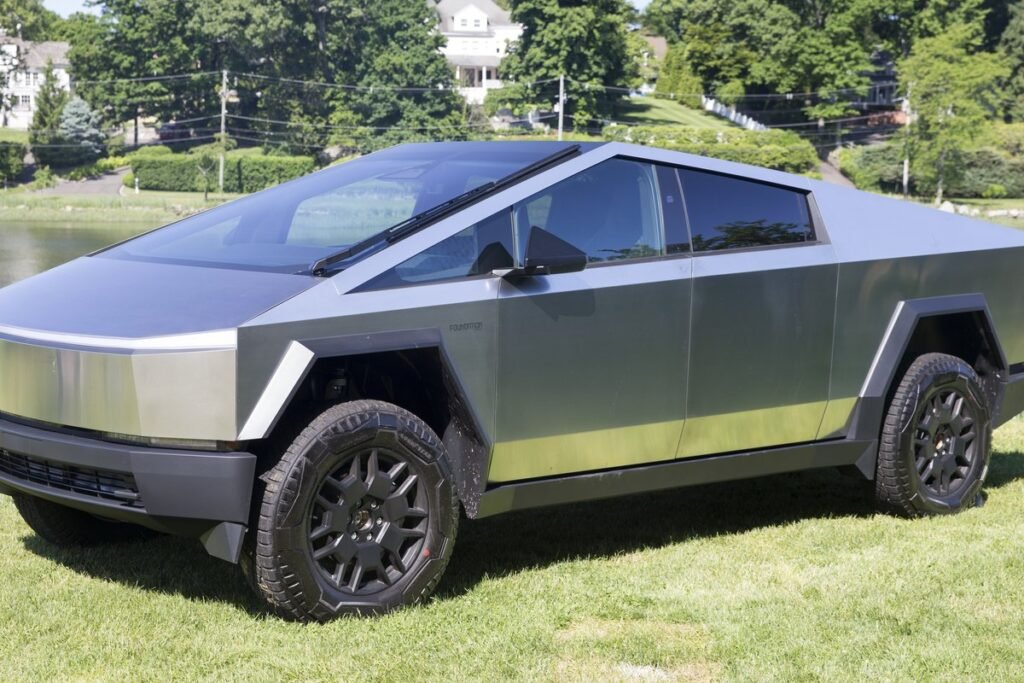
Tesla Cybertruck production ends in 2027. Elon Musk has confirmed that Tesla will wind down production of its angular stainless-steel pickup at Gigafactory Texas around the middle of next year, clearing the factory floor for the company’s self-driving Cybercab. Announced in a post on X on Friday 6 November 2026 and reported by Reuters and the BBC, it ends one of the most talked-about vehicles of the decade — a truck that spent less than four years on sale after taking four years to reach customers. For Tesla, the message is blunt: the future is the robotaxi, not the pickup.
What Musk announced — and what he did not say
“Tesla will be winding down production of the Cybertruck at Gigafactory Texas around the middle of next year to make room for increased Cybercab production,” Musk wrote. Reuters and the BBC both carried the announcement on 6 November.
It means Tesla Cybertruck production ends at the company’s Austin plant, the only factory in the world that builds the truck. He gave no firm end date beyond “around the middle of next year”, no word on whether production could move to another plant, and no final special edition to mark the truck’s departure. Cybercab production had already begun at the same plant, and Tesla aims to deliver the first Cybercabs to customers by the end of 2026. The BBC’s report notes that the Texas line, the only one that builds the truck, is being handed over to the Cybercab.
The sales collapse behind the decision
When Musk unveiled the Cybertruck in November 2019, he claimed pre-orders had crossed one million and set a production target of at least 250,000 trucks a year. Tesla built a line at Gigafactory Texas with capacity for more than 125,000 trucks a year — yet it has been running at roughly a tenth of the promised volume. That gap is the simplest reason Tesla Cybertruck production ends.
Estimates from Cox Automotive put United States Cybertruck sales at 38,965 in 2024, falling to 20,237 in 2025, and just 11,586 in the first nine months of 2026 — down 28 percent year on year. Tesla’s own “other models” deliveries — the bucket holding the Cybertruck — fell to 8,295 in the third quarter of 2026 from 12,364 in the second.
Price was part of the problem. Unveiled with a promised 39,900-dollar starting price and up to 500 miles of range, the truck arrived years late carrying an 80,000 to 100,000 dollar price tag. A cheaper dual-motor trim launched at 59,990 dollars in February 2026 — the lowest price the truck ever sold for — then rose to 74,990 dollars in August. A day before Musk announced the wind-down, Tesla raised prices again: the Premium trim now lists at 92,490 dollars and the Cyberbeast at 102,490 dollars, while the dual-motor trim is no longer orderable.
The truck’s troubled run included 11 recalls since it went on sale in late 2023, according to the National Highway Traffic Safety Administration. In October 2026 Tesla cancelled the Cybertruck for Australia and New Zealand, refunding reservation holders’ deposits after seven years of waiting. Reuters’ factbox on the truck’s bumpy run traces the story from the cracked “Armor Glass” windows at the 2019 unveiling to the 11 recalls that followed.
From pickup to robotaxi: Tesla’s new priority
Tesla Cybertruck production ends because the Cybercab has become the company’s priority. The Tesla Cybercab robotaxi is a purpose-built two-seater with no steering wheel or pedals, which Tesla aims to sell for under 30,000 dollars. Tesla’s latest filing names the Cybercab and the Tesla Semi among its new product launches and describes autonomy as central to its manufacturing plans.
The shift is not limited to the Cybertruck: Tesla has also decommissioned the Model S and Model X lines at its Fremont factory. Lead engineer Wes Morrill posted that the truck “lives on through Cybercab” — a sign Tesla sees the pickup’s engineering feeding into the robotaxi rather than into another truck.
Only a day before Elon Musk’s announcement, BYD’s Yangwang U9 Xtreme became the first production car to pass 500 kilometres per hour. BYD’s record shows how quickly rivals are closing the gap — and how little room there is now for a 90,000-dollar pickup that sells in the low tens of thousands.
What it means for owners — and for buyers in Pakistan
Tesla Cybertruck production ends with questions still unanswered for the roughly 70,000 people who already own one — above all, about support rather than sentiment. Morrill has said Tesla will keep supplying spare parts and that service will continue. Even so, there is no word yet on outstanding orders, on how long Tesla will keep selling trucks already built, or on resale values now that the model has an end date. The Cybertruck’s official X account posted a video of the truck driving into the sunset on the morning of the announcement — a farewell that felt final.
In Pakistan, the news lands differently. Tesla has no official presence in the country, so every Cybertruck here arrived through grey-market imports at prices far above the American sticker — our Tesla price in Pakistan guide tracks what buyers actually pay. Few Pakistanis will ever have driven one, but its exit is a useful signal: even Tesla is walking away from the big, expensive electric pickup to bet everything on autonomy. With BYD’s Pakistan plant due to start operations and electric models such as the Mercedes CLA now launching locally, the most interesting new cars are getting cheaper, not dearer — and the Cybertruck, for all its fame, ended up on the wrong side of that trend.
Tesla Cybertruck production ends not with a grand farewell but with a factory retooling. The truck meant to redefine the American pickup will be remembered as one of the most hyped vehicles of its era: a million reservations, a shattered window on stage, 11 recalls and around 70,000 sales. What replaces it — a small, cheap, driverless two-seater — says everything about where Tesla thinks the future lies.
Related Posts
 TechnologyBYD Yangwang U9 Xtreme Becomes First Production Car to Pass 500 km/h at 503.17 km/h
 TechnologyBalochistan Launches Digital Nikah Registration via NADRA and Pak ID
 TechnologyNational CERT Warns Banks of AI-Powered Cyberattacks in Pakistan
 TechnologyBinance Reopens Withdrawals for More Assets After $6.3 Billion Hack — HYPE, INJ, APT, NEAR and LTC Targeted by Next Week
 TechnologySBP Core Banking Network Goes Live as Cisco Data Centre Switches On in Karachi
 TechnologyJaecoo J5 EV Pakistan Price Announced — Ex-Factory Price, Variants, Bookings and Delivery
Most Popular
 How-ToPTA Tax Calculator 2026: Check Mobile Tax on Any Phone417 views
 Pakistan NewsPIA Boeing 787 Lease Deal: What It Means for the Airline389 views
 Canada JobsTech Jobs in Canada: Roles, Salaries, and Skills Needed387 views
 SportsUEFA Champions League 2026-27: Format, Teams and Schedule384 views
 TechnologyPM Shehbaz Sets November Deadline for Alibaba AI and Digitalisation Projects in Pakistan364 views
 ShowbizWomen’s Fashion in Pakistan 2026: Trends, Brands and Style Guide360 views