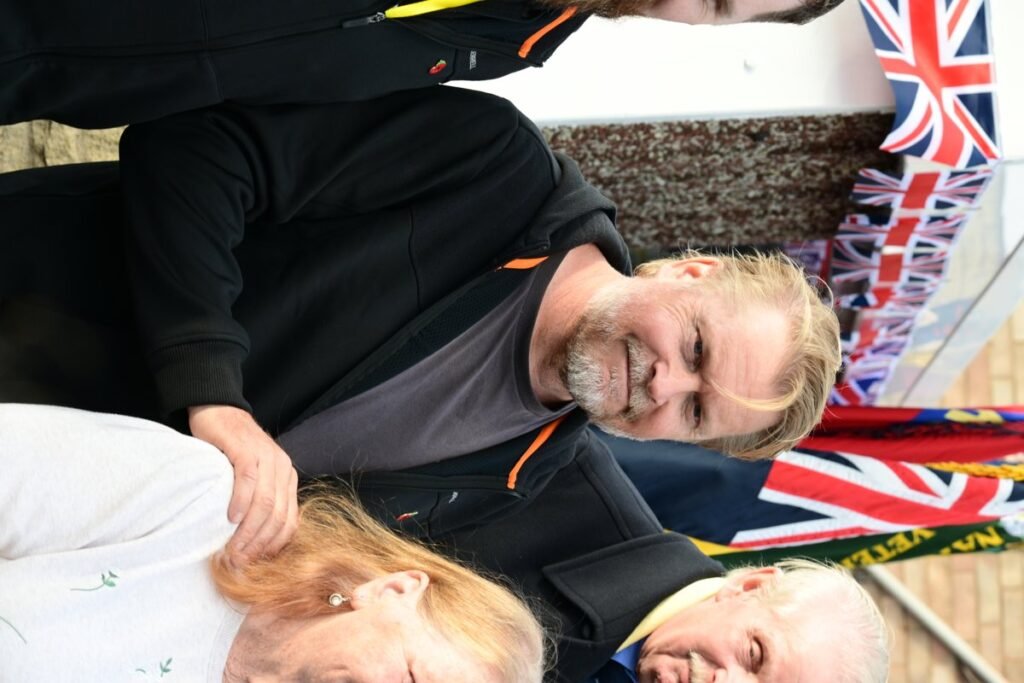
He left home at 29 with a handcart, a tent and two rules. On Monday, 2 November 2026, Karl Bushby knocked on his mother’s front door in Hull, England — 28 years after setting out from the southern tip of Chile — and finished one of the longest journeys ever made on foot. The Karl Bushby 28-year walk covered roughly 31,000 miles (50,000 kilometres) across four continents and around 30 countries, ending at his mother’s front door in Hull.
Bushby, a 57-year-old former British paratrooper, was welcomed by hundreds of people in Hull city centre before walking the final stretch to his mother’s house, where a banner read “Welcome Home Son”. His first request after nearly three decades away was tea and biscuits, already poured. The Karl Bushby Hull homecoming has since become one of the most searched human-interest stories in Pakistan this week.
“I’m back”: the homecoming in Hull
The Karl Bushby 28-year walk reached its final morning in Queen Victoria Square, in the centre of Hull, where crowds had gathered under a banner reading “Welcome home Karl”. Pushing the two-wheeled cart he nicknamed “The Beast”, Bushby stopped in the square at around 11 a.m. and said two words: “I’m back.”
The Lord Mayor of Hull, Maria Coward, welcomed him at a civic reception at City Hall, telling him: “For 28 years – 10,229 days – Hull has been waiting for your return.” He then walked the last five kilometres to his mother’s house. The two embraced — they had not seen each other for roughly a decade — and, according to the Associated Press, her first question to him was: “Where have you been?” The homecoming was covered in detail by the Glasgow Times and Happy News of the Day.
Waiting at the house were his 36-year-old son, Adam, and a granddaughter he had never met. The day before, Bushby had walked over the Humber Bridge with his father and brother on the penultimate leg of a journey that had begun before his granddaughter was born, and before many of the people cheering him in Hull had even started school.
Two rules and 31,000 miles: the Goliath Expedition
Bushby began the Karl Bushby 28-year walk — known as the Goliath Expedition — in Punta Arenas, Chile, on 1 November 1998. He set himself two uncompromising rules: he would never use motorised transport to move forward, and he would not return home until the route connected all the way back to Hull under his own power. He expected the walk around the world to take about 12 years. It took 28.
The route ran north through Chile, across the Atacama Desert, then through Peru, Ecuador and Colombia, up through Central America, Mexico, the United States and Canada to Alaska, then across Siberia, Central Asia and Europe to England. Of the 28 years, only about 15 were spent actually travelling on foot. The rest was consumed by paperwork, visas, money troubles, injuries and the pandemic.
That is part of why the Karl Bushby 28-year walk has captured so much attention. It was not a race, and it was not a stunt with a film crew and a support convoy. It was a man walking, year after year, through deserts, jungles and frozen seas, because he had promised himself he would not come home any other way.
Ice, jungle and open water: the hardest crossings
Some stretches of the Karl Bushby 28-year walk tested Bushby in ways that no amount of training could prepare him for. In 2001 he crossed the Darién Gap, the roadless stretch of jungle and swamp between Colombia and Panama, and spent 18 days in detention in Panama after crossing a restricted border corridor.
In March 2006, Bushby and French explorer Dimitri Kieffer became the first people known to walk across the frozen Bering Strait from Alaska into Russia — 14 days zigzagging across moving pack ice and open stretches of freezing water. He was detained in Russia the same year, and visa battles there stalled the expedition for years. Later, refused entry to Iran, he found another way around: in 2024 he swam 288 kilometres across the Caspian Sea over the course of a month, alongside adventurer Angela Maxwell.
He crossed the Gobi Desert with a camel caravan in 2017, reaching Ulaanbaatar, the capital of Mongolia. His final major obstacle was the English Channel. Eurotunnel authorities refused him permission to walk through the Channel Tunnel service bore, so he swam it instead, coming ashore at Shakespeare Beach near Dover on 5 October 2026 after about 20 hours in the water spread over three days. From Dover he walked the final 400 kilometres to Hull — the last steps of a journey that had taken more than half his life.
What 28 years cost — and what comes next
Bushby left Hull at 29, shortly after his marriage had broken up. He returns at 57, to a family that has grown without him and a hometown that turned out in force to welcome him. He has said he does not yet know what the rest of his life looks like. Ahead of him are a speaking tour around England, a sequel to his memoir Giant Steps, and a feature-length documentary about the journey by German filmmaker Werner Herzog, titled Walk of Life.
For readers in Pakistan, the story sits alongside other moments of quiet endurance in the news this week — from Maliha Ali‘s run at the MMA world championships to Misbah Arshad carrying Pakistan’s flag onto the Miss Universe stage. But Bushby’s journey belongs in a category of its own: no prize money, no medal, no trophy — just a front door, a mother, and a cup of tea.
The Karl Bushby 28-year walk began with a simple promise made in 1998, and it ended with that promise kept. Twenty-eight years, 10,229 days, four continents and 31,000 miles later, he is home — closing one of the longest walks in history.
Related Posts
 World NewsTürkiye Ratifies Makkah Defence Pact With Pakistan and Saudi Arabia — Attack on One Now Means Attack on All
 World NewsUN Security Council Adopts Pakistan’s Diplomacy Statement: Talks Must Go On Even During War
 World NewsHoax Bomb Threats Hit at Least 25 Flights Across Europe as Fighter Jets Scramble
 World NewsParaguay Bank Collapse: Ueno Bank Seized as 3 Million Customers Locked Out
 World NewsUS Sanctions Indian Couple Over Fake Flags for Iran’s Shadow Fleet — Nine Firms and a Turkish Ground Handler Also Hit
 World NewsStrait of Hormuz on Fire: Two Oil Tankers and a Tugboat Ablaze After Mine Strike
Most Popular
 How-ToPTA Tax Calculator 2026: Check Mobile Tax on Any Phone417 views
 Pakistan NewsPIA Boeing 787 Lease Deal: What It Means for the Airline389 views
 Canada JobsTech Jobs in Canada: Roles, Salaries, and Skills Needed387 views
 SportsUEFA Champions League 2026-27: Format, Teams and Schedule384 views
 TechnologyPM Shehbaz Sets November Deadline for Alibaba AI and Digitalisation Projects in Pakistan364 views
 ShowbizWomen’s Fashion in Pakistan 2026: Trends, Brands and Style Guide360 views