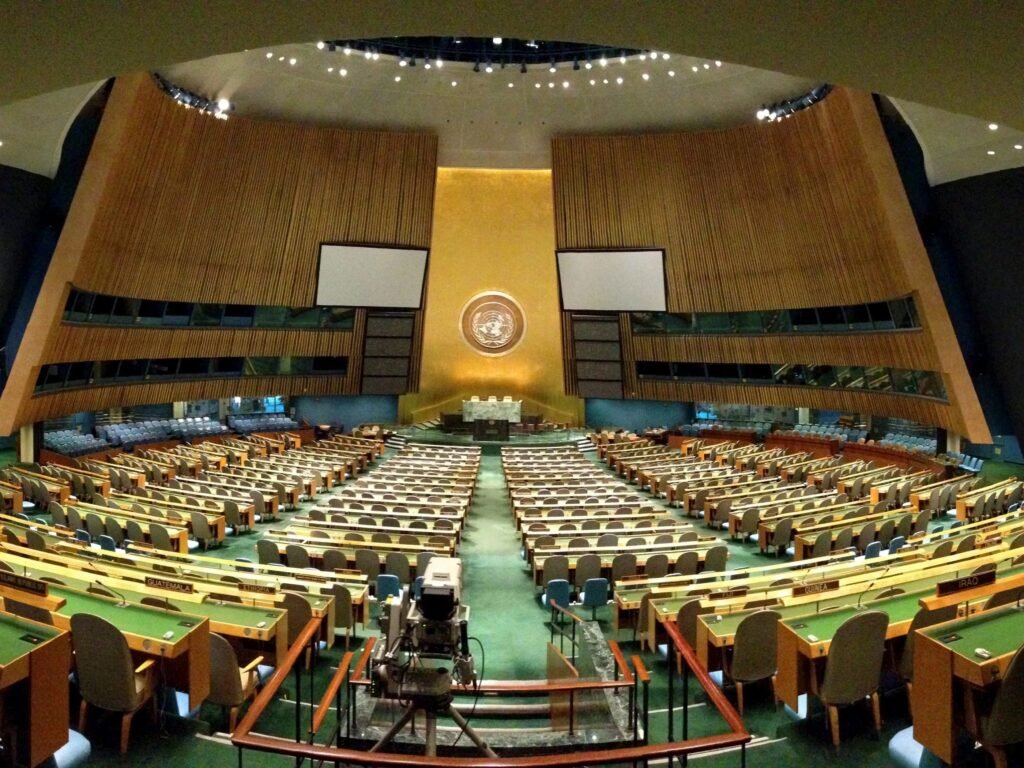
Pakistan has warned the United Nations that artificial intelligence systems used in warfare without effective human control are sharply increasing the risk of military miscalculation and rapid escalation between states. The warning was delivered on 25 October 2026 to the UN General Assembly’s First Committee, the body that deals with disarmament and international security.
Speaking during a debate on how the malicious use of information and communications technology threatens global peace and security, Pakistani delegate Husham Ahmed said AI-enabled targeting and decision-support tools are no longer a distant possibility. They are already being deployed at scale in active conflicts, he said, and their regulation cannot be treated as a problem for the future.
The Pakistan military AI warning UN delegates heard in New York centred on one principle: machines must never be left to make life-and-death decisions on their own. Where human judgement is removed from the chain, wars can start faster, escalate further, and break the rules designed to protect civilians.
What Pakistan told the First Committee
Ahmed, a counsellor at Pakistan’s Mission to the UN offices in Geneva, told the committee that AI systems operating without effective human judgement and control increase the risks of miscalculation and escalation, lower the threshold for the use of force, and erode compliance with international humanitarian law.
In plain terms, his argument was that when software helps choose targets or compresses the time commanders have to decide, mistakes become more likely and harder to reverse. A wrong identification or an automated recommendation accepted without question can turn a tense standoff into an exchange of fire before diplomats have time to intervene.
Pakistan’s message was not a rejection of technology itself. The delegate’s case was about control: AI may assist human decision-making, but it must not replace it, and responsibility for any strike must always rest clearly with a human being.
Why the warning matters now
The timing of the intervention matters because the tools under discussion are already in use. AI-enabled targeting systems, surveillance analytics, and decision-support software have featured in recent conflicts, and autonomous loitering munitions — weapons that can search for and strike targets on their own — have moved from testing ranges to battlefields.
That reality, Ahmed argued, is what makes the governance gap dangerous. The technology is spreading faster than the rules meant to govern it. Without agreed standards, states may deploy systems whose behaviour in a crisis nobody fully understands, and rivals may misread an automated action as a deliberate escalation.
The nuclear dimension
Pakistan’s warning carried a sharper edge for regions where conventional and nuclear weapons exist side by side. Ahmed said the dangers are acute in regions of close conventional-nuclear entanglement, where one nuclear-armed state has deployed autonomous loitering munitions and dual-capable missiles against another.
He did not name the state in question, but the point was unmistakable: when nuclear-armed rivals are involved, an AI-driven miscalculation can climb the escalation ladder far faster than diplomacy can keep up.
On that point, the delegate was absolute. “The decision to employ nuclear weapons must always remain in human hands,” he said. No algorithm, however advanced, should be allowed to cross that threshold.
What Pakistan wants: UN-led rules
Pakistan called for inclusive, UN-led governance frameworks for military AI, arguing that rules written by a small club of advanced states cannot carry the legitimacy the issue demands. “Military AI governance must be anchored in the UN,” Ahmed said, adding that initiatives outside the UN cannot replace its legitimacy, inclusivity, and universality.
The appeal also stressed that the risks must be addressed holistically rather than in separate silos: targeting software, autonomous weapons, cyber capabilities, and nuclear decision-making are increasingly connected.
Pakistan’s longer push on military AI rules
The 25 October intervention fits a longer Pakistani campaign at the UN. Pakistan has previously worked with the Netherlands and South Korea, among other countries, to support a First Committee resolution on military AI that would lead to a report by the UN Secretary-General based on member states’ views.
Pakistan has also pushed for a legally binding instrument on military AI, rather than voluntary guidelines alone, and has argued in the Conference on Disarmament for a dedicated agenda item on the security implications of military AI, including its effect on the nuclear sphere.
Separately, the UN Institute for Disarmament Research (UNIDIR) launched a forum on AI and international peace and security on 22 October, with Switzerland and Pakistan as partners. The forum is a sign that the institutional machinery around the issue is finally moving — even if binding rules remain some way off.
What happens next
For ordinary readers, the stakes are not abstract. The same kind of technologies that recommend videos and filter spam are now helping to select targets and compress battlefield decisions. Pakistan’s warning is, at its core, a simple one: the faster war becomes, the more important it is that a human being remains in charge of it.
Sources: UN General Assembly First Committee proceedings; official statements reported 25 October 2026.
Related Posts
 TechnologyOnePlus Ace 7 Pro: Launch Date, Built-In Cooling Fan, Specs and Expected Price in Pakistan
 TechnologyGTA 6 Launch Trailer: Release Date, Platforms and What the Final Trailer Shows
 TechnologyPakistan’s First AI Hospital Could Be on the Way as Riphah Partners With China’s Tairex
 TechnologyHonor 400 Price in Pakistan: Expected Price, 200MP Camera Specs
 TechnologyGoogle Pixel 9a Price in Pakistan: Specs, Camera and Review
 TechnologyGoogle Pixel 10 Pro Price in Pakistan: Non-PTA and PTA Prices
Most Popular
 How-ToPTA Tax Calculator 2026: Check Mobile Tax on Any Phone267 views
 SportsBallon d’Or 2026: London Ceremony, Nominees and All-Time Records Ahead of 70th Anniversary255 views
 TechnologyAround 20 Pakistani Tech Companies Showcase Innovation at TechCrunch Disrupt 2026 in San Francisco250 views
 TechnologyRedmi K100 Launching on 28 October: 10,000mAh Battery, 185Hz Display and Full Specs240 views
 Canada JobsTech Jobs in Canada: Roles, Salaries, and Skills Needed240 views
 TechnologyPaklaunch UNConference 26.2 New York: Pakistani Founders Meet 80 Global Investors at the Yale Club236 views