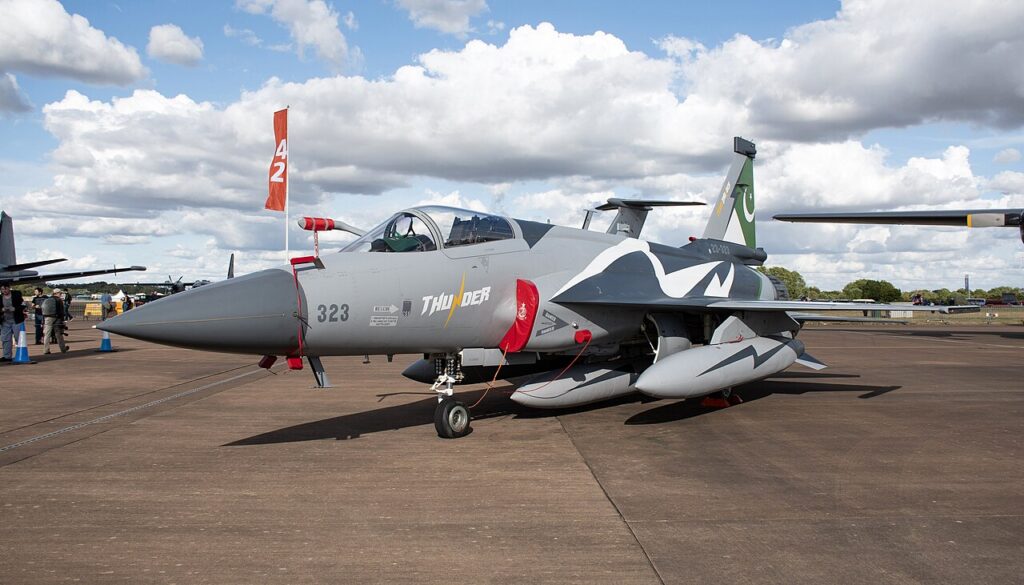
The Pakistan Air Force has shown its newly revealed Arrow-1 smart munition going into production, with fresh footage from inside the National Aerospace Science and Technology Park (NASTP) showing engineers and technicians assembling the new weapon. The PAF Arrow-1 smart munition was first unveiled earlier this month, and the new video — released by the air force’s public relations arm on Saturday — is the clearest sign yet that the system is moving from display to the production line. One detail in the footage has drawn particular attention: a unit carrying the serial number 26-021, which suggests that at least 21 Arrow-1 munitions have been acquired in 2026.
What the New Footage Shows
The footage was released by the PAF’s Directorate General of Public Relations (DGPR) in a promotional video posted on the social media platform X on 14 November 2026. The clips show the Arrow-1 production facility inside NASTP, with engineers and technicians working on the munitions as they are assembled. The video does not carry any narration explaining the weapon’s capabilities, and NASTP has not disclosed the Arrow-1’s specifications. What it does show is a production line in operation — the step that turns a newly revealed system into a fielded one. The serial number visible on one unit, 26-021, is the most concrete detail in the footage. Defence analysts read the marking as evidence that at least 21 Arrow-1 munitions have been acquired during 2026, with the 26 indicating the year and 021 the unit number. That reading is an interpretation of the marking rather than an official PAF statement, and the air force has not confirmed a total number.
PAF Arrow-1 Smart Munition and the JY-260 Connection
The Arrow-1 bears a close resemblance to the Chinese JY-260 target drone, according to defence analysis site Quwa, which first reported the production footage. The JY-260 is developed and sold by Beijing StarNeto Technology and is marketed as a stealth, high-subsonic target drone — a jet-powered aircraft built to simulate threats such as subsonic cruise missiles, high-speed drones and combat aircraft during air-defence training. StarNeto is a leading supplier of target drones to China’s People’s Liberation Army. Target drones are normally built to be shot at, not to shoot back. But both the JY-260 and its smaller stablemate, the JY-150, can carry payloads that would allow them to serve as decoys — aircraft that look like real fighters on enemy radar and draw fire away from manned jets. That dual-use possibility is what makes the Arrow-1 interesting to analysts: a system that looks like a training target may also be able to act as a decoy or a strike weapon. The PAF has not said which role the Arrow-1 will fill, and its exact identity is still debated among defence watchers — some describe it as a low-observable attack drone, while others see a decoy or cruise-missile role. Until the air force publishes specifications, those assessments remain informed guesswork rather than confirmed fact.
Part of a Bigger Drone Push
The Arrow-1 did not appear on its own. It was one of four new munitions the PAF showcased in a promotional video released on 8 November 2026. Alongside the Arrow-1, the video showed an improved version of the YIHA-III, or a variant of the Turkish Baykar Sivrisinek one-way attack drone, the Lightning-1 and Lightning-2 loitering munitions, and an unnamed jet-powered decoy or target drone believed to be the JY-150. Taken together, the four systems point to a shift in how the PAF plans to fight: a drone-led posture in which unmanned systems fly alongside manned fighters, a concept the air force is likely to call manned-unmanned teaming, or MUM-T. In that setup, decoy drones can mimic fighters on radar, loitering munitions can hunt targets on their own, and manned jets stay further from danger. November has been a busy month for the PAF’s new weapons. On 3 November, the air force test-fired the Fa’az, its first indigenously developed air-to-air missile, from a JF-17 fighter. The Arrow-1’s move into production less than a week after its public reveal suggests the new munitions are not display pieces but systems being prepared for service.
What Is Still Not Known About the Arrow-1
For all the footage, the PAF has disclosed almost nothing about what the Arrow-1 can actually do. No range, speed, guidance system, warhead or service-entry date has been published. There is no official confirmation of how many have been built, which aircraft will carry the weapon, or when it will enter squadron service. The serial number is the only hard number in the public record so far. That silence is normal for a new military system — air forces rarely publish full specifications — but it means the Arrow-1’s real capability will only become clear when the PAF says more, or when the weapon appears in exercises or at a defence exhibition. What is clear is the direction of travel: a production line is running at NASTP, the first batch appears to number at least 21, and the PAF’s drone programme is moving from announcements to hardware.
Related: Pakistan Test-Fires Fa’az: First Indigenously Developed Air-to-Air Missile
Sources: Quwa — PAF Arrow-1 Munition in Production at NASTP, Resembles China’s JY-260 (15 November 2026); Quwa — Pakistan Air Force Reveals Sivrisinek, Lightning, Arrow-1 (9 November 2026).
Related Posts
 TechnologyNCCIA Call Centre Raids: 154 Arrested as Illegal Loan-App Blackmail Rings Busted in Islamabad and Rawalpindi
 TechnologyTranssion Pakistan: Tecno and Infinix Maker Eyes Local Phone Parts Manufacturing
 TechnologyPUBG Mobile Flash Launches Worldwide: Full Game in Under 1GB for Budget Phones
 TechnologyPTA May Cut Voice SIM Limit to Three per CNIC — What It Means for Mobile Users
 TechnologyPakistani Startup WonderTree Beats 617 Rivals to Win GSMA AI Innovation Fund Grant
 TechnologyPINTECH Expo 2026 Lahore: 380 Student Projects, Rs 7.195 Million in Prizes as Punjab’s Biggest Innovation Showcase Closes Today
Most Popular
 How-ToPTA Tax Calculator 2026: Check Mobile Tax on Any Phone420 views
 Pakistan NewsPIA Boeing 787 Lease Deal: What It Means for the Airline394 views
 Canada JobsTech Jobs in Canada: Roles, Salaries, and Skills Needed391 views
 SportsUEFA Champions League 2026-27: Format, Teams and Schedule388 views
 TechnologyPM Shehbaz Sets November Deadline for Alibaba AI and Digitalisation Projects in Pakistan368 views
 ShowbizWomen’s Fashion in Pakistan 2026: Trends, Brands and Style Guide365 views