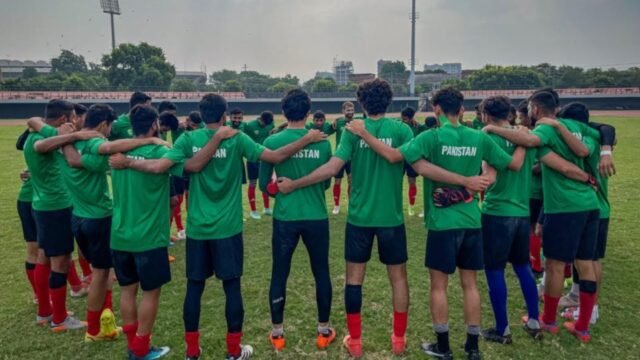
Sixteen Pakistani cricketers could miss the Abu Dhabi T10 after the Pakistan Cricket Board demanded 10,000 US dollars for every No-Objection Certificate the league needs to field them. The tournament begins on 7 November at Zayed Cricket Stadium in Abu Dhabi, and with the opening match only days away, the standoff remains unresolved.
The board communicated the fee demand to the Abu Dhabi T10 organisers at the start of this week, according to reports, long after the league had applied for the certificates. The player draft took place on 30 September, when five of the six franchises picked Pakistani players, and the organisers had applied for the NOCs well in advance. The late demand has left the league scrambling, with franchises now looking at replacement players even as mediation efforts continue behind the scenes.
For the players involved, the timing could hardly be worse. Many had planned their schedules around the tournament, and several are white-ball specialists for whom short-format leagues are a central part of the calendar. If the dispute is not settled before play begins, all sixteen will sit out the tenth edition of the tournament entirely.
The sixteen players caught in the middle
The draft spread Pakistani talent across five franchises. Salman Irshad was picked by the Arabian Aces, while the Emirates Eagles secured Akif Javed, Hasan Nawaz and Ali Raza. Naseem Shah, one of Pakistan’s most recognisable fast bowlers, was drafted by the Royal Desert Champions.
The UAE Bulls hold the largest Pakistani contingent, with six players: Shadab Khan, Mohammad Amir, Khawaja Nafay, Khushdil Shah, Azam Khan and Mohammad Wasim Junior. The United Tigers completed the list with Fakhar Zaman, Iftikhar Ahmed, Faheem Ashraf, Sufyan Moqeem and Abbas Afridi.
It is a strong group, mixing established internationals with rising names. Fakhar Zaman and Shadab Khan bring years of international experience, Naseem Shah is a fixture of Pakistan’s pace attack, and Hasan Nawaz and Sufyan Moqeem represent the newer generation pushing for regular selection. Losing all sixteen at once would strip the tournament of much of its Pakistani flavour, and Pakistani fans make up a large share of the T10 audience in the Gulf.
Owners offered to pay — and were refused
According to reports, some team owners considered paying the 10,000-dollar fee out of their own pockets, while others suggested deducting it from the players’ salaries. Both proposals were ultimately refused, leaving the situation unresolved heading into the tournament’s opening days.
The refusal matters because it shows the dispute is not only about money. If the franchises had simply absorbed the cost, the players could have taken the field. Instead, the standoff has become a question of principle on both sides, and the players are the ones paying for it.
The total bill, if the fee were paid for all sixteen players, would come to 160,000 dollars — a significant sum for a ten-day tournament, and one the franchises clearly did not budget for when they drafted their squads in September.
This is not the first NOC fee row
The PCB’s practice of charging fees for overseas league NOCs is not new. The policy first became a public issue around the launch of the ILT20, and it flared up again only last month. In October 2026, the board demanded 25,000 dollars per player from the Nepal Premier League. Most of the Pakistani cricketers picked for that competition returned home without featuring after the board withheld their certificates, although Jahandad Khan and Hussain Talat were among those who continued to play despite the board’s position.
The board’s reasoning, as reported, is partly about reciprocity. The PCB has noted that leagues in the UAE and Nepal do not make a comparable number of their players available for the Pakistan Super League, making the arrangement less attractive from Pakistan’s perspective. In other words, the board believes Pakistani players add value to foreign leagues, and it wants that value recognised in return.
How the PCB’s new contract system affects overseas leagues
The dispute also sits inside a wider change to how the PCB manages its players. Under the board’s overhauled central contract system, players are placed in tracks that decide how many overseas leagues they may play in each year.
Track A players, who are red-ball specialists, are not permitted to play in any overseas T20 or T10 league. Track AB players, who play across formats, are allowed one overseas league per year. Track BC players, the white-ball specialists, may play in up to two overseas leagues annually. Track C players, designated as T20 specialists, have had the cap on T20 appearances removed, and T10 tournaments fall within that framework.
The previous system was simpler: centrally contracted players could play in the PSL plus two additional foreign leagues. The new track-based system replaced it, giving the board finer control over workloads — but also creating more situations where a player’s participation depends on the board’s approval.
What happens next
With the tournament starting on 7 November and running until 20 November, the window for a resolution is now measured in hours rather than days. The franchises are exploring replacement players, which suggests they are preparing for the possibility that the Pakistanis do not arrive. Mediation efforts are continuing, but no breakthrough has been reported.
Pakistani viewers can watch the tournament on A Sports on television, with Tamasha and MYCO carrying the digital coverage. For now, though, the question hanging over the opening matches is whether any of the sixteen Pakistani names drafted in September will actually take the field — or whether a fee dispute will keep them at home.
If the PCB holds its line and the franchises refuse to pay, the biggest losers will be the players and the fans. The players lose a paycheque and a stage; the fans lose the chance to watch their stars in one of the shortest, sharpest formats in world cricket. And the episode will add another chapter to a debate that has followed Pakistan cricket for years: how much control should the board exercise over where its players earn their living?
Related Posts
 SportsIndia Beat Pakistan 3-2 in SAFF Championship 2026 Opener After Late Pakistan Fightback
 SportsHarry Kane Signs Record Bayern Munich Contract Until 2029 and Becomes Europe’s Highest-Paid Player
 SportsParis Masters 2026: Zverev and Djokovic Crash Out on a Day of Upsets as Alcaraz Survives
 SportsAfghanistan vs Zimbabwe 1st Test Live from Sharjah: Toss, Playing XIs, Schedule and Where to Watch
 SportsMohammad Rizwan Double Century: 200 Not Out Powers Peshawar in Quaid-e-Azam Trophy After Test Squad Axing
 SportsPakistan Beat Australia by One Wicket to Win Over-40s Cricket World Cup 2026
Most Popular
 How-ToPTA Tax Calculator 2026: Check Mobile Tax on Any Phone416 views
 Pakistan NewsPIA Boeing 787 Lease Deal: What It Means for the Airline388 views
 SportsUEFA Champions League 2026-27: Format, Teams and Schedule383 views
 Canada JobsTech Jobs in Canada: Roles, Salaries, and Skills Needed379 views
 TechnologyPM Shehbaz Sets November Deadline for Alibaba AI and Digitalisation Projects in Pakistan361 views
 ShowbizWomen’s Fashion in Pakistan 2026: Trends, Brands and Style Guide356 views