
ISLAMABAD — Federal Minister for Information Technology and Telecommunication Shaza Fatima Khawaja has said the responsible use of artificial intelligence in Pakistan’s judicial system is “the need of the hour,” unveiling a push to digitise court records and bring AI into the justice delivery system.
Addressing an international conference on AI and the Judiciary in Islamabad on Monday, the minister said authentic data, digitisation of court records, cybersecurity, data privacy and human oversight were essential to make justice faster, more transparent and more effective.
She pointed out that around 2.2 million cases were pending in the country during 2025, arguing that even small efficiency gains from technology could play a vital role in cutting the backlog.
AI in Pakistan’s Judiciary: What the Minister Announced at the Islamabad Conference
 File photo: Faisal Mosque, Islamabad. (Photo: Saaeed / CC BY-SA 4.0 via Wikimedia Commons)
The minister highlighted the Digital Nation Pakistan Act as the legal framework driving the country’s digital transformation, saying the legislation provides a comprehensive framework for transforming governance, the economy and society through technology.
Under the Act, the Pakistan Digital Authority has been set up to define digital-transformation standards. Working with the Ministry of Law and Justice, the Authority has published standards for machine-readable legislation — converting traditional PDF legal documents into machine-readable formats so courts and AI systems can work with authentic legal data and a proper linguistic corpus.
She stressed that legacy court records, pending cases and laws must all be digitised according to those standards, warning that AI cannot produce reliable results from unstructured data and paper-based records.
E-Office, Digital Case Management and Paperless Courts
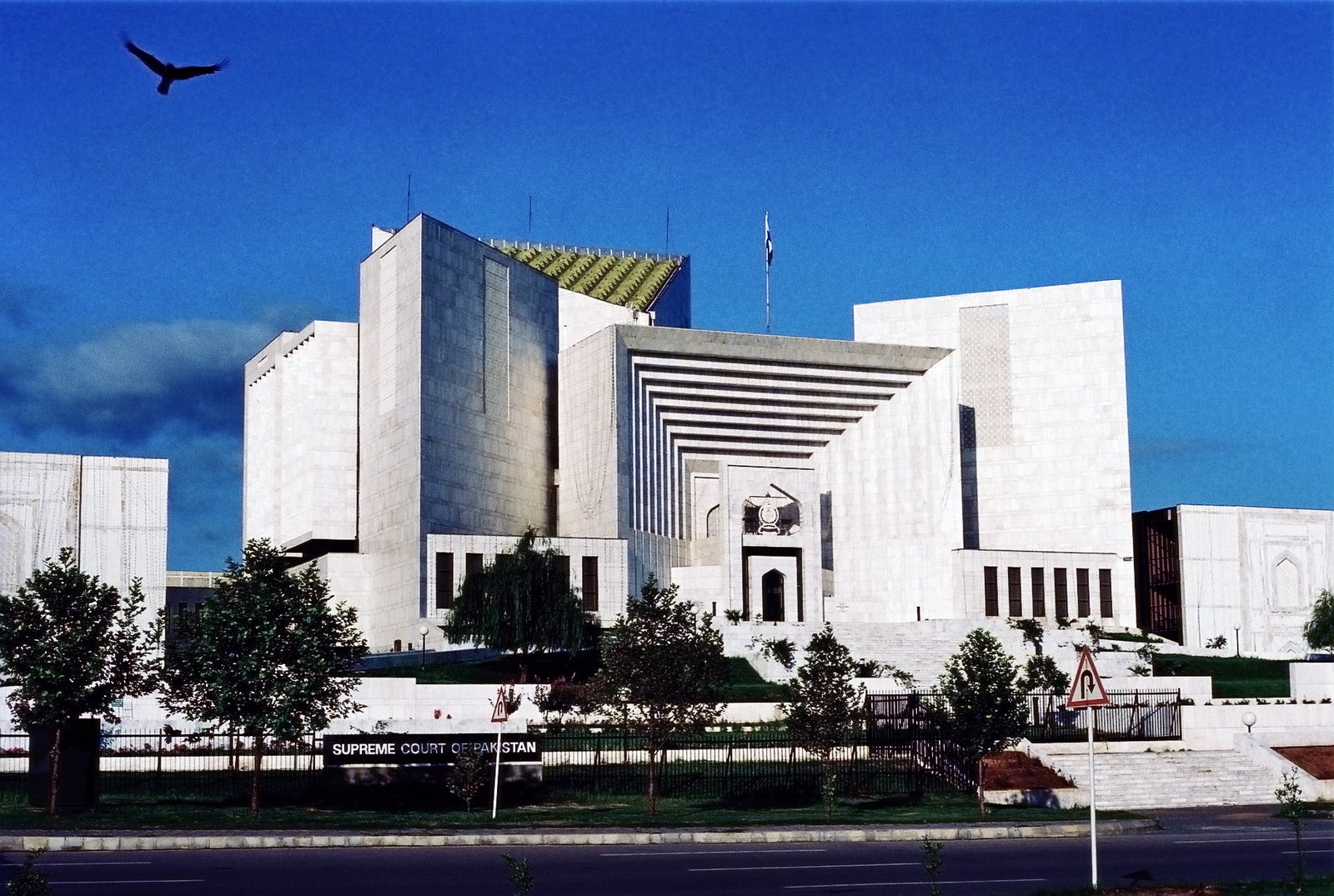 File photo: the Supreme Court of Pakistan, Islamabad. (Photo: Usman Ghani / CC BY-SA 3.0 via Wikimedia Commons)
Elaborating on the progress already made, Shaza Fatima Khawaja said the National Information Technology Board (NITB) has signed two memoranda of understanding with the Supreme Court of Pakistan. An E-Office system has been introduced at the apex court, and digital systems have been deployed to make the administrative affairs of the Supreme Court and the Law and Justice Commission of Pakistan paperless.
She said significant progress had been achieved in digitising the Case Management System, with a dashboard provided to the higher judiciary. The system is active, integrated and interoperable with provincial courts, she added.
The push builds on earlier steps: the National Judicial Policy Making Committee issued national guidelines for AI use in judicial institutions in April 2026, and the Supreme Court administration introduced the Smart Judicial Assistant, an AI-powered platform offering round-the-clock access to judicial information and services.
Safeguards: ‘Human in the Loop’ and Trust in AI
 File photo: a judge’s gavel. (Photo: Allen Allen, allenandallen.com / CC BY 2.0 via Wikimedia Commons)
While backing AI, the minister cautioned that trust is paramount. Because large language models can occasionally generate inaccurate or unverified outputs, keeping a “Human in the Loop” is strictly necessary within the judicial framework, she said.
Effective AI in the legal sector, she added, needs dedicated, secure databases of authenticated court judgments, statutes, case laws and court records, alongside robust cybersecurity, data privacy and accountability mechanisms.
She lauded the April 2026 national guidelines of the National Judicial Policy Committee as a landmark milestone and — quoting UNESCO data presented at the event — noted that only 9% of countries globally have issued guidelines for AI in judicial systems, underlining the need for clear national policies and codes of conduct. She urged participating nations to exchange best practices and develop their own national guidelines, calling for global cooperation.
She also noted that Pakistani startups, including Munshi and Lawbot Pakistan, are already building tech-driven and AI-based legal assistance for lawyers and citizens, and commended initiatives to mainstream alternative dispute resolution, arbitration and mediation alongside the traditional court system.
The judiciary push fits into Pakistan’s wider digital agenda, which includes new digital-asset regulation and a national AI policy. The minister said technology and AI could deliver legal assistance and access to justice “directly to citizens’ doorsteps,” saving time and resources while boosting judicial transparency. She thanked the Ministry of Law and Justice, the Federal Judicial Academy, the Farabi Center for AI and Cybersecurity, the Pakistan Digital Authority, NITB and the National Center for Artificial Intelligence for their work, and welcomed international delegates to Islamabad.
Related Posts
 TechnologyCall of Duty: Modern Warfare 4 Season 1 Arrives 6 November With New Hajin Warzone Map
 TechnologyJazzWorld Wins Best AI Automation Solution – Asia at Telecom Review Excellence Awards 2026
 TechnologyUfone Closes In on Jazz as Pakistan’s Mobile Subscribers Hit 211.47 Million
 TechnologyPakistan Tops the World in YouTube Viewing: PTA Counts 96 Million YouTube Users, 100 Million on TikTok
 TechnologyPakistan Records Over 1,000 Cyberattacks in 2026, National CERT Tells Parliament
 TechnologyEquiDash Wants to Be the ‘Uber of Investing’ — but the Maths Raises Airlift-Era Questions
Most Popular
 How-ToPTA Tax Calculator 2026: Check Mobile Tax on Any Phone400 views
 Pakistan NewsPIA Boeing 787 Lease Deal: What It Means for the Airline381 views
 SportsUEFA Champions League 2026-27: Format, Teams and Schedule375 views
 Canada JobsTech Jobs in Canada: Roles, Salaries, and Skills Needed356 views
 SportsBallon d’Or 2026: London Ceremony, Nominees and All-Time Records Ahead of 70th Anniversary337 views
 ShowbizWomen’s Fashion in Pakistan 2026: Trends, Brands and Style Guide333 views